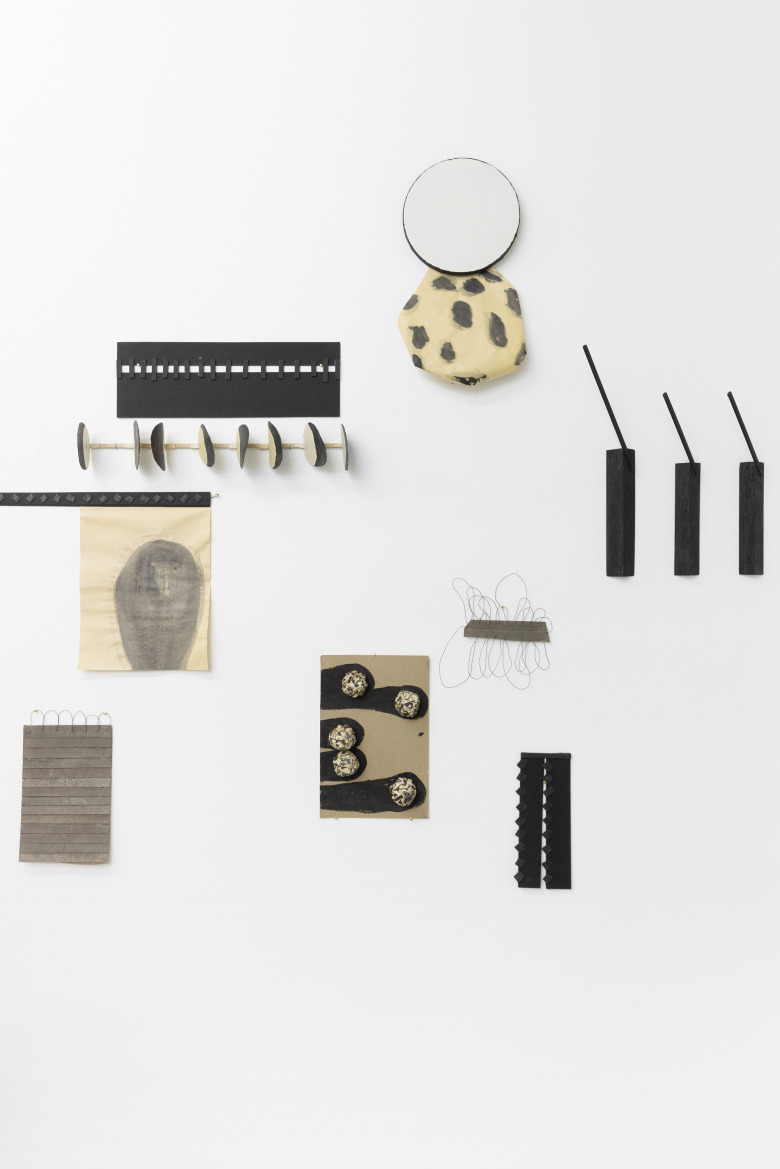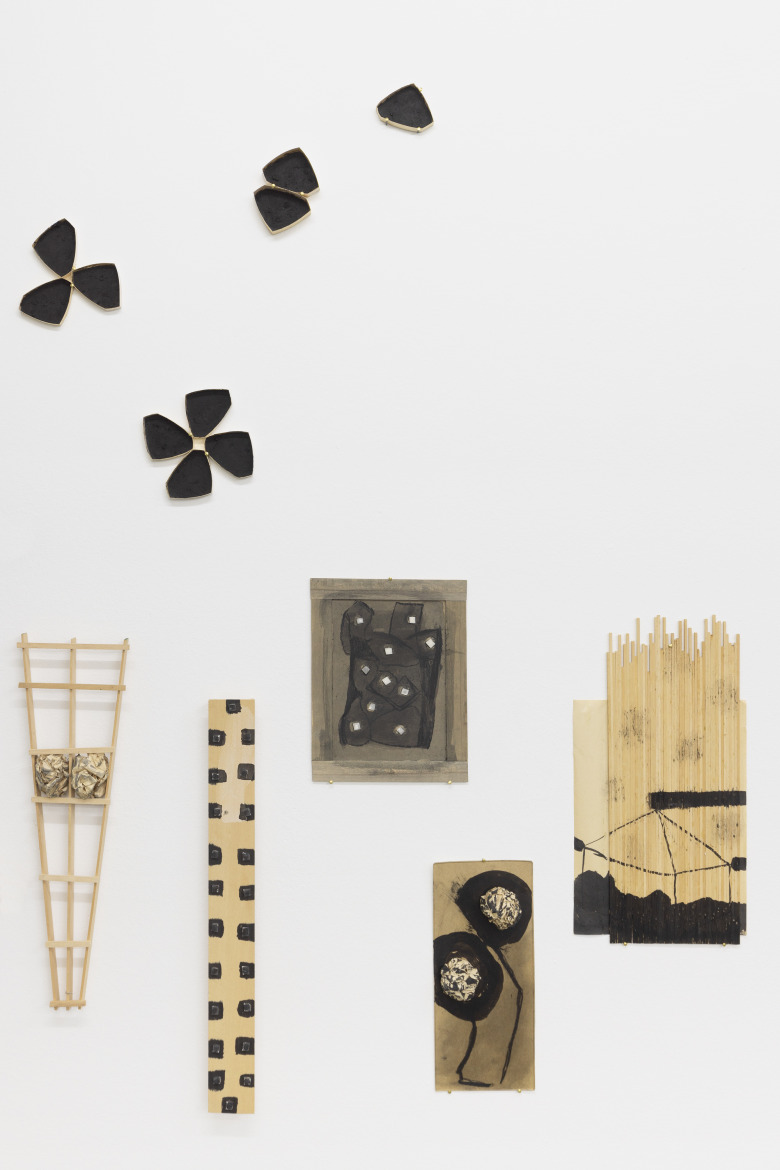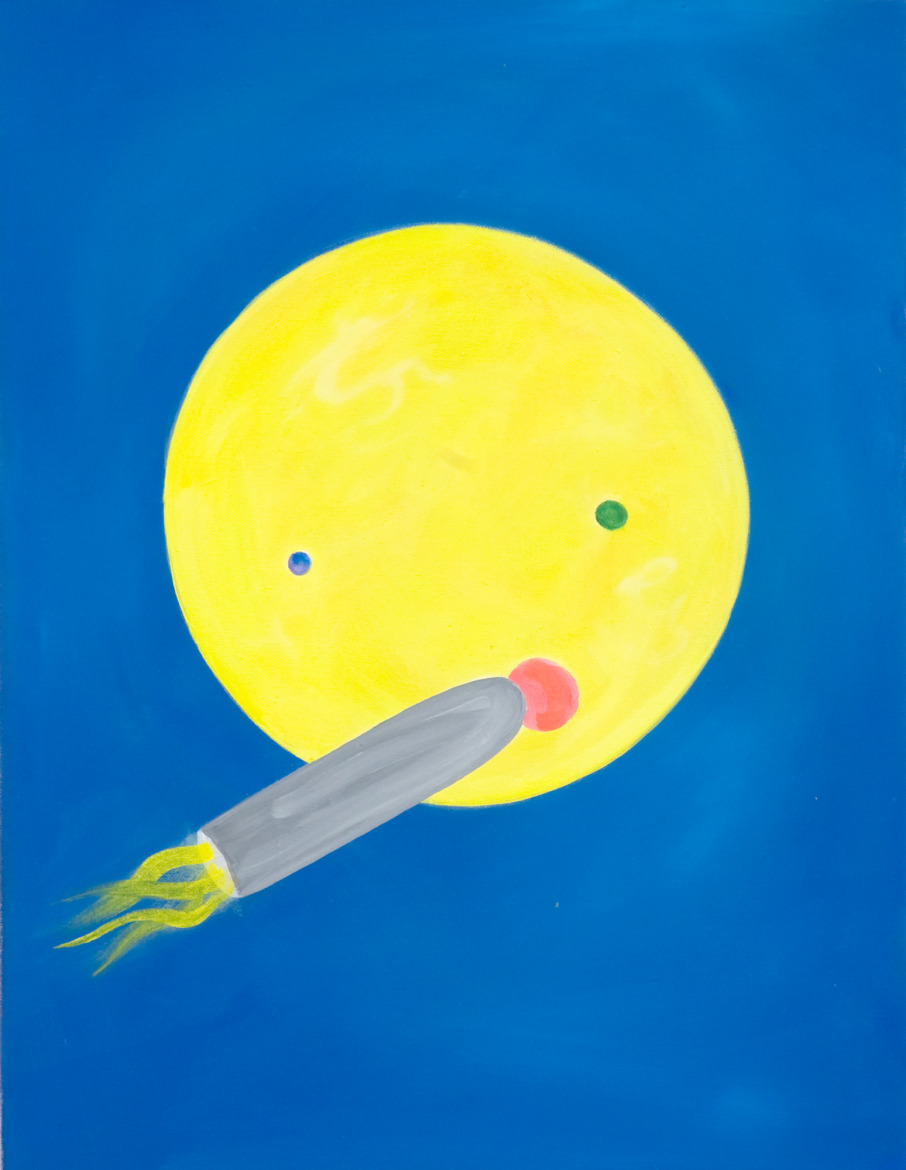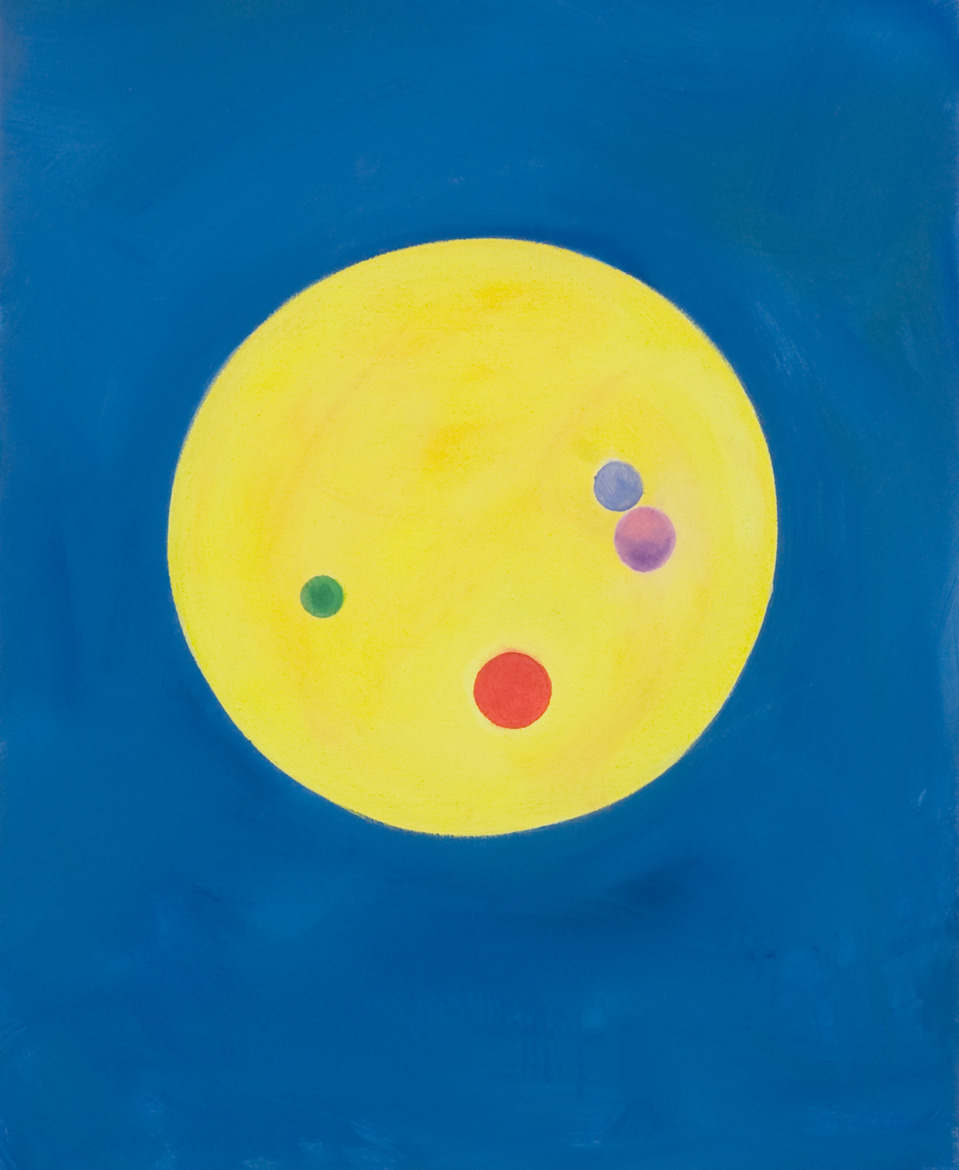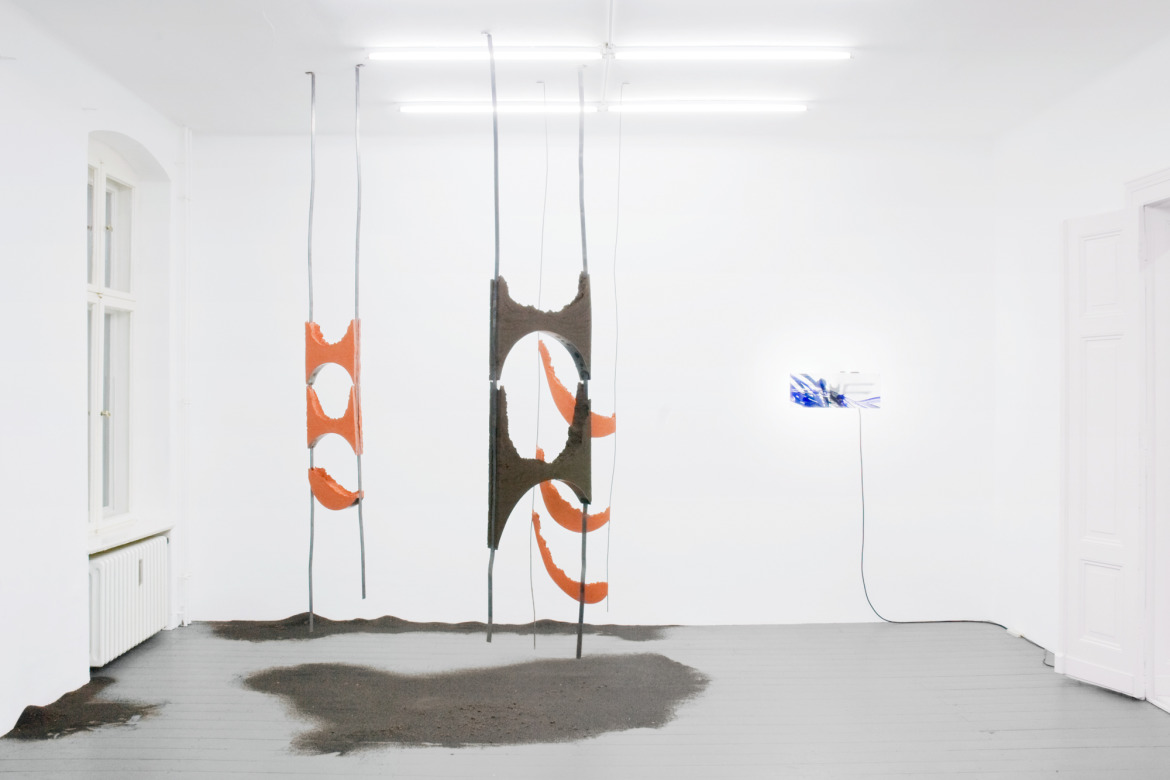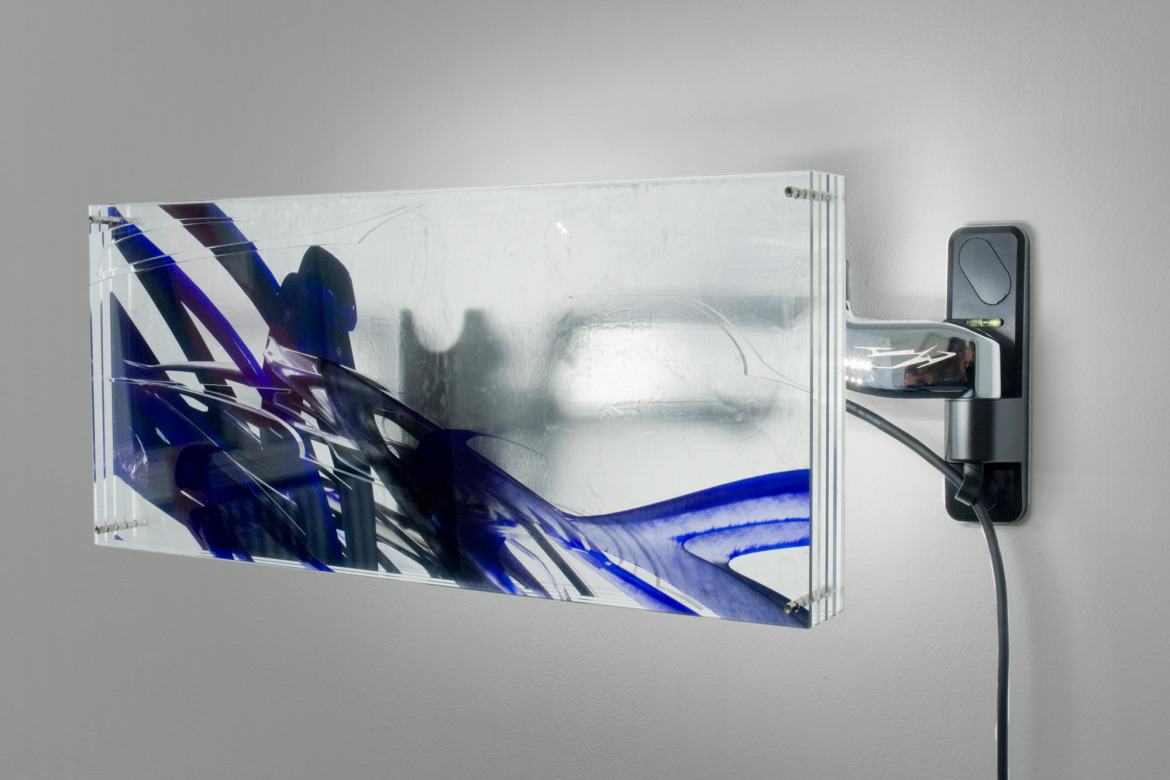
Matelot, Matelot

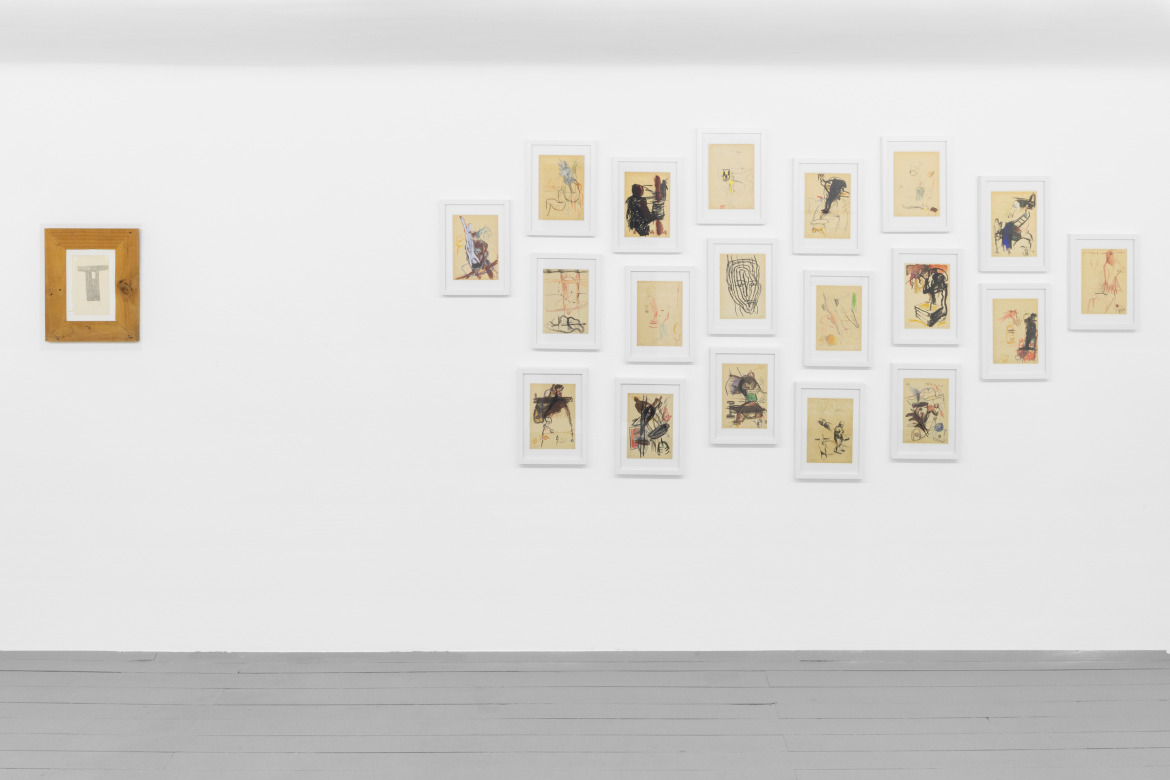
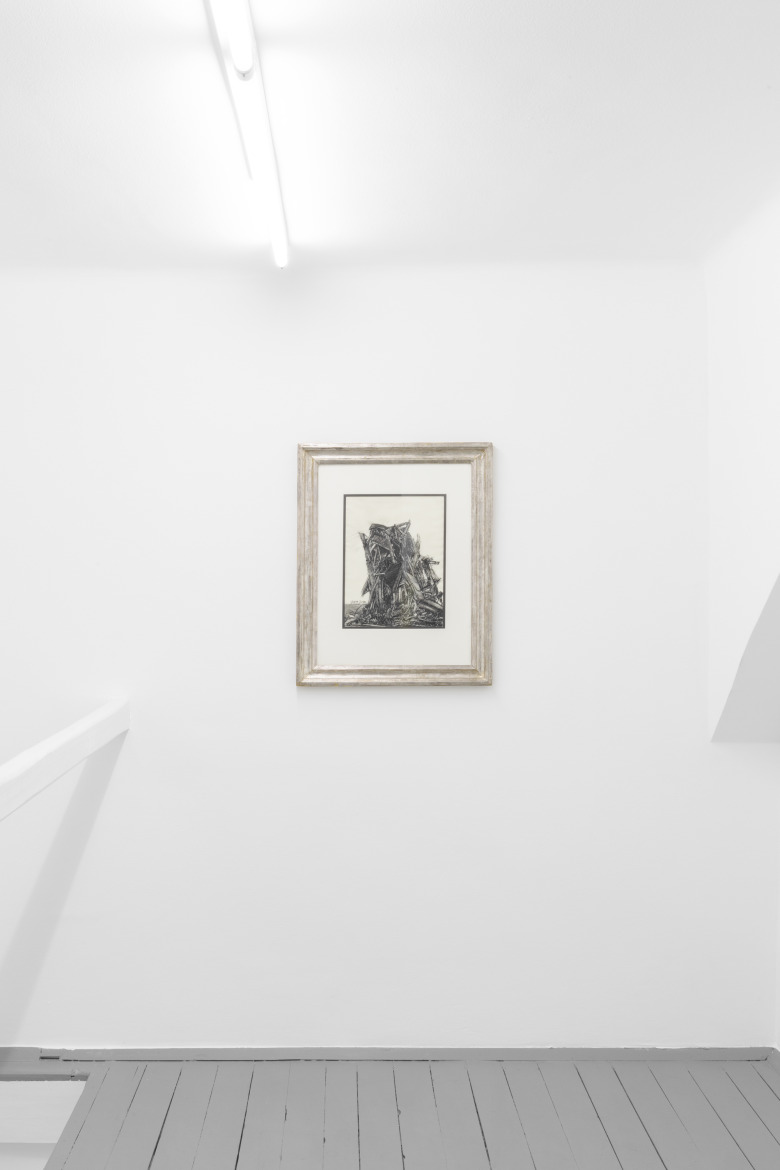
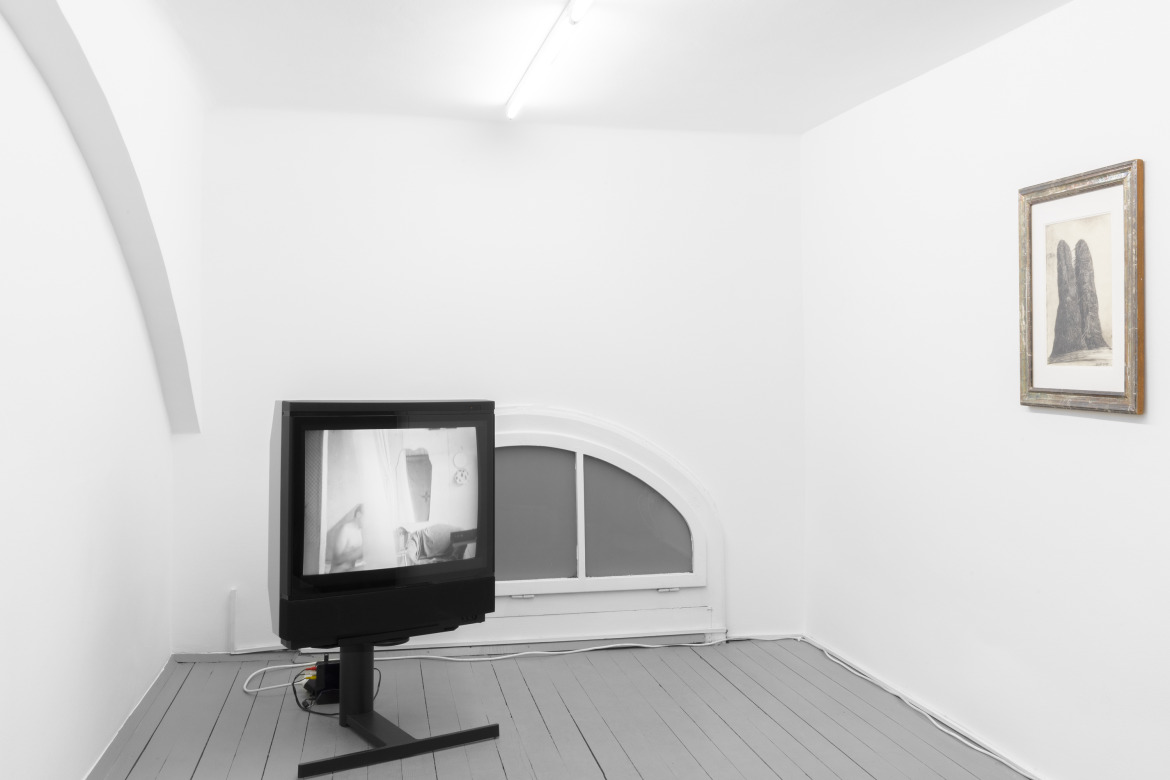
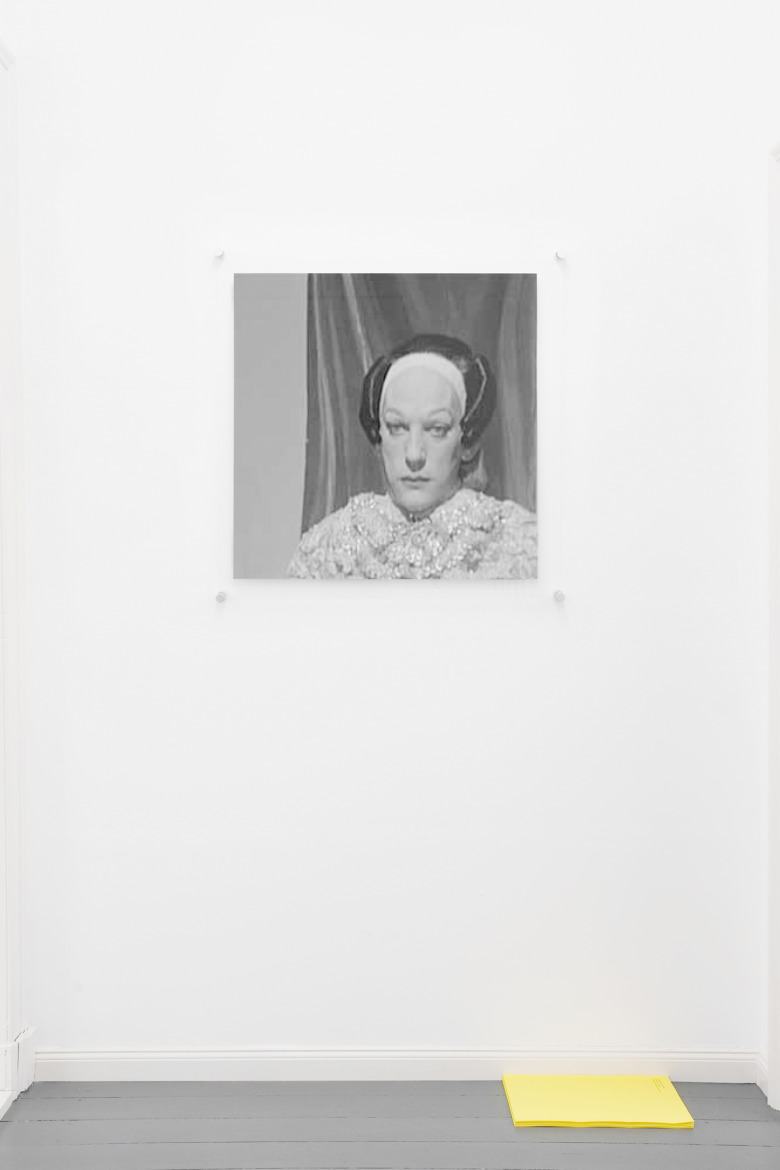
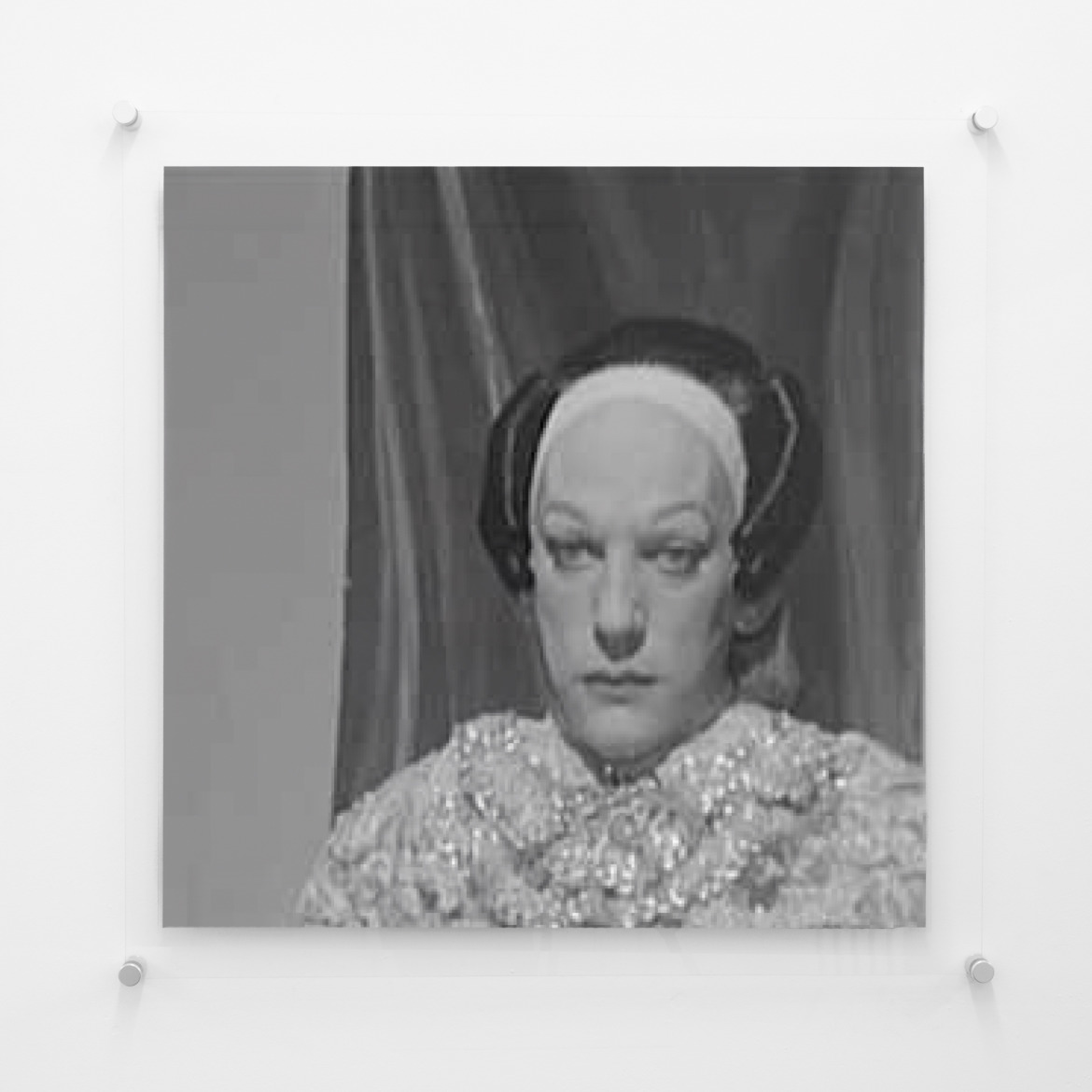
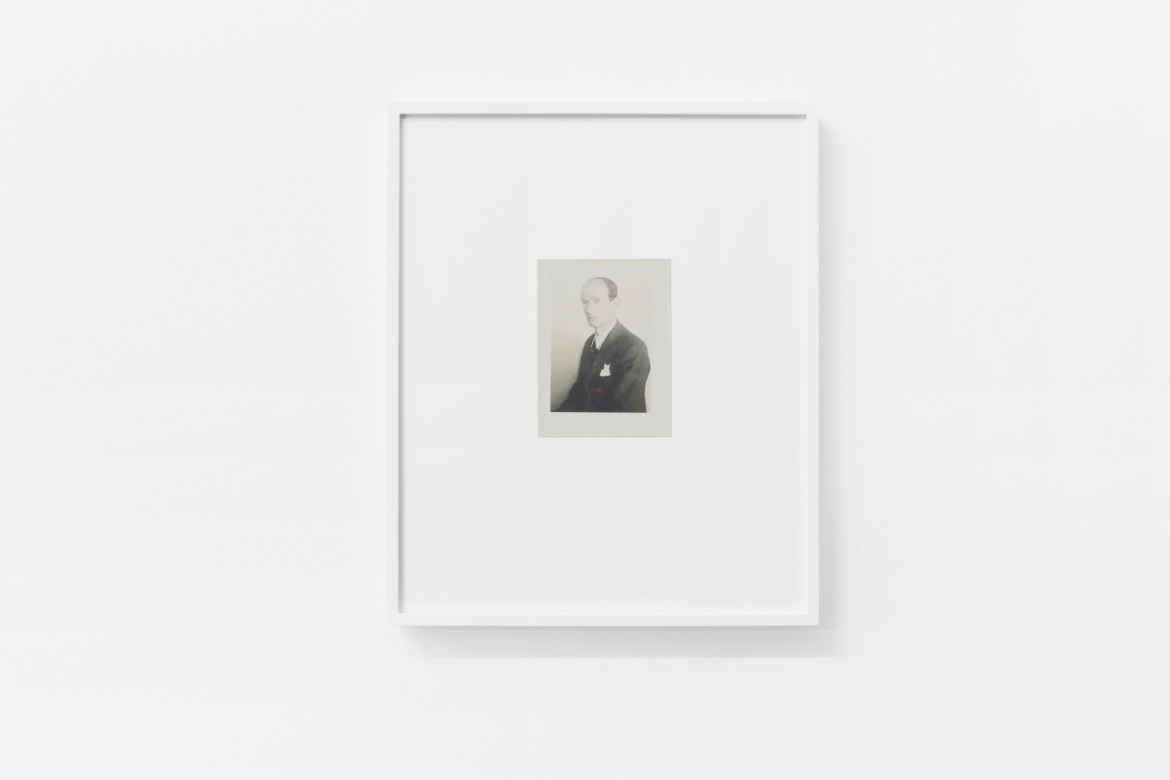
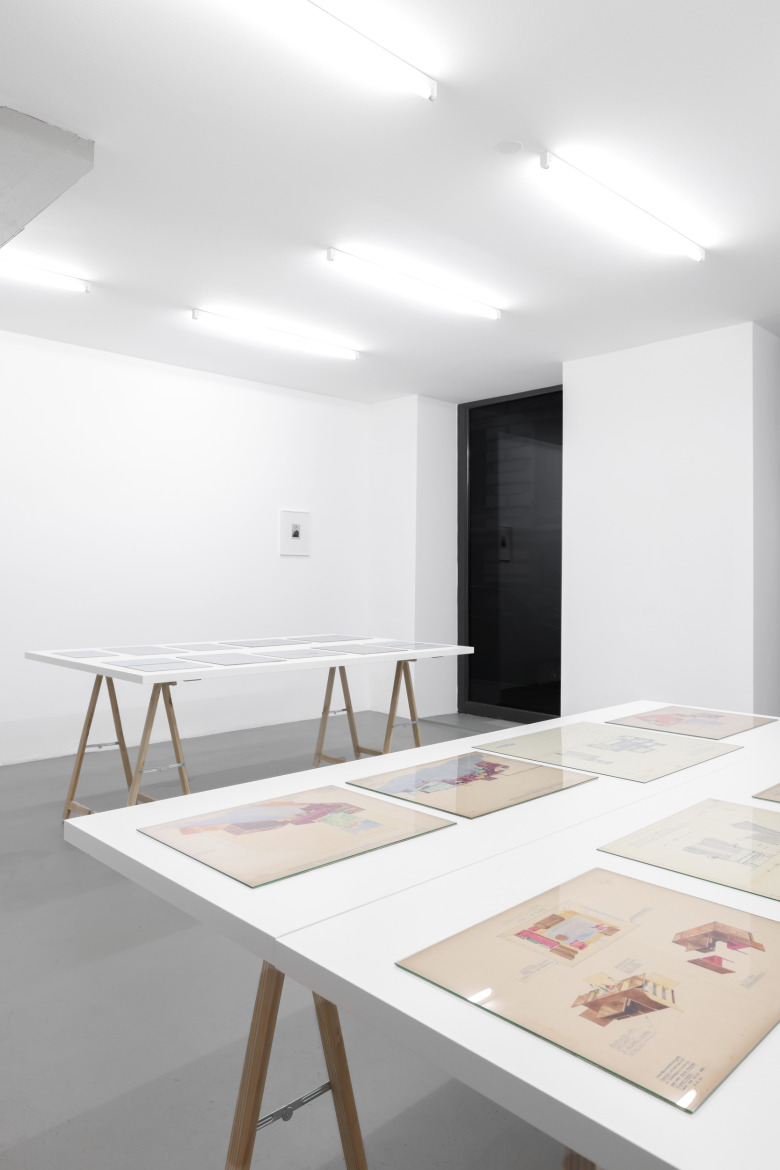
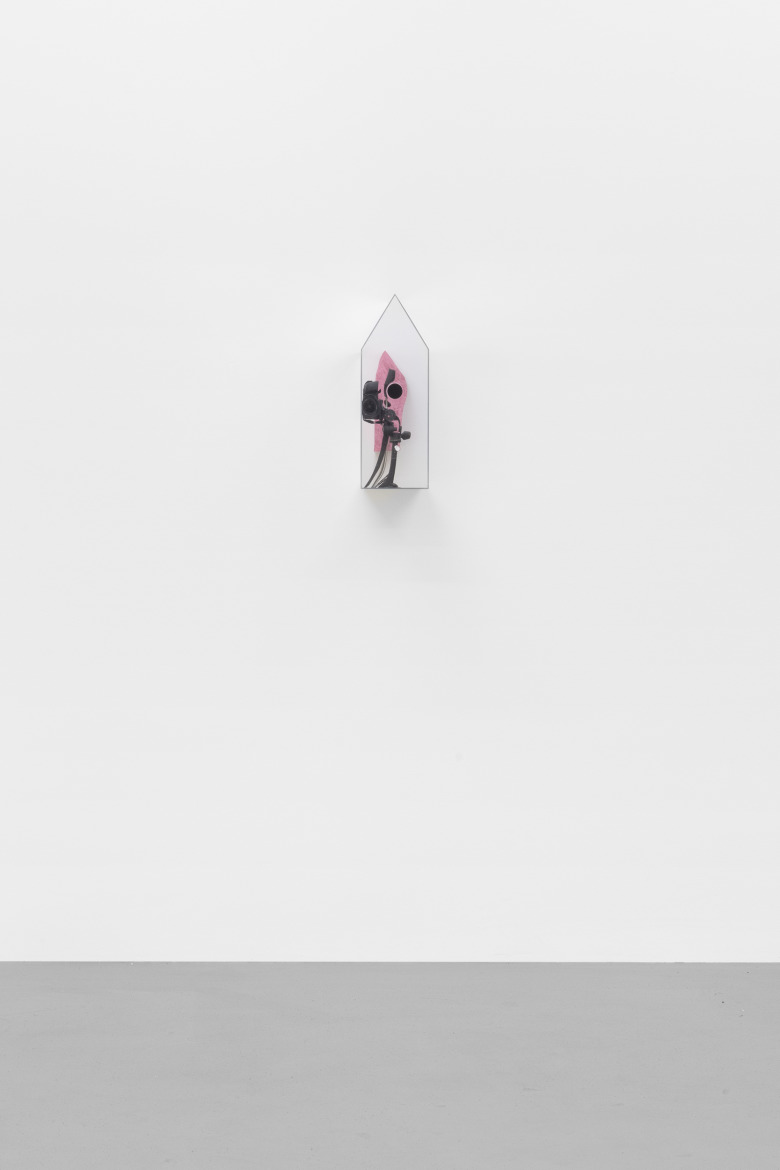
EXILE is looking forward to presenting a solo exhibition of a previously unseen body of work by artist David Medalla (1938-2020). The exhibition will be curated by Francesca Gavin and Adam Nankervis as part of this year’s edition of curated by – the gallery festival with international curators in Vienna.


Matelot, Matelot: the unseen work of David Medalla

‘Matelot’ was a song written and released by Noël Coward, ten days after the end of war in 1945. It is a bittersweet ode to a sailor, the vocalist mourning his departure and calling him over the sea. From a contemporary point of view, it is impossible not to feel the song is filled with queer longing for the male figure travelling “the wide world over/ Lips that he kissed Could not resist/ This loving, roving rover.”

David Medalla was born three years prior to the release of the song in the Philippines. Lauded as a boy genius, he was lecturing at university aged 12. He experimented with multimedia painting and even participatory land art as a teenager. He was inspired deeply by the openly gay Arthur Rimbaud, later noting “All of us are his children. His life became an allegory of freedom.” In 1954, Medalla was invited to a summer camp for gifted boys in upstate New York, quickly escaping to Greenwich Village and meeting everyone from James Dean to Jackson Pollock. Here he developed the painting practice that underpinned his work. Over the coming decades, Medalla moved across Europe, establishing himself as a unique artist that resisted the confinement of media. Medalla worked with painting, collage, action, sculpture, text, publishing and textiles. 

Medalla was deeply engaged with the conceptual and material possibilities of art. He notably exhibited as part of iconic curator Harald Szeemann’s exhibitions, ‘When Attitudes Become Form’ and documenta 5 – two shows that established much of the canon of conceptual late 20th century art. Medalla became best known for his engagement with kinetic art, such as his bubble machines such as ‘Cloud Canyons’. Here, foam was created to grow upwards in columns and spill out towards the viewer. The artist later noted the inspiration was his mother’s rice dessert as a child in the Philippines and his memories of watching a dying soldier foaming at the mouth during the Second World War. ‘Mud Machine’ (1964-67) fused science and sculpture, with automated sponges dipping into a pool of oil and mud and slowly smearing it on a glass plate. There was something cosmic and almost spiritual in the way he pushed beyond the limits of modernism. 

These pieces were created while he simultaneously co-founded Signals gallery and produced its affiliated magazine ‘Signals Newsbulletin’ in London, between 1964 and 1966. The gallery focused on avant garde artists of the era, many from Asia and Latin America including Lygia Clark, Gustav Metzger, Soto, Mira Schendel, Hélio Oiticica and Takis – whose work inspired the name of the space. Like Medalla, these were artists driven by unconventional materials, science, poetry, technology and new paradigms.

Ephemerality and chance were something built into Medalla’s work. At documenta 5, he exhibited the pioneering, participatory work ‘A Stitch in Time – inviting viewers to embroider and add whatever they wished with needle and thread.  In the 1970s he moved into political and counter-cultural performance work. He created actions with the psychedelic commune, the Exploding Gallery and later in the Artists’ Liberation Front and Artists’ for Democracy. Works around Tibetan and African liberation, resisted international dictatorships and in many ways was deeply embedded in the action-led artist activism that resounds today. 

Yet looking at Medalla’s practice in a wider sense, there was nothing didactic here. He was innately charming company, even later in life while living in Berlin, inspired by the poetry and possibility of creativity. He crossed paths and often became friends with people including Marcel Duchamp, William Burroughs, Jean Genet, Man Ray, Yve-Alain Bois, Raymond Duncan, Louis Aragon and many more. 

For many years the queerness in Medalla’s work was evident but unspoken. His lovers often became artistic collaborators. Overflowing phallic forms are a recurring motif. His bubbles were erect, overflowing and exploding. His ‘Body Motion Pendulum’ piece, for example, used an egg, rubber band and suction cup to create a kinetic, penis-like sculpture driven by the movement of the body. His personal sketchbooks were filled with figurative drawings and photographs of naked men. Desire was as clear a driver in his artistic impulse, as politics, participation and the poetic.

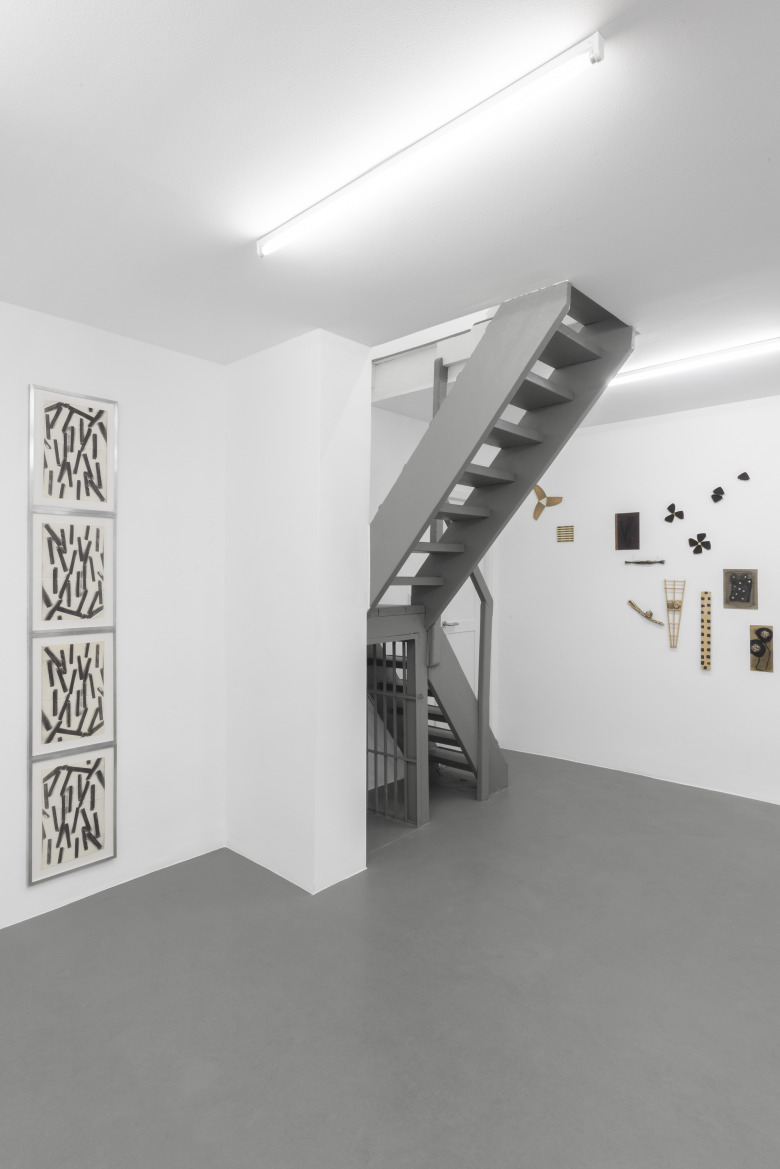
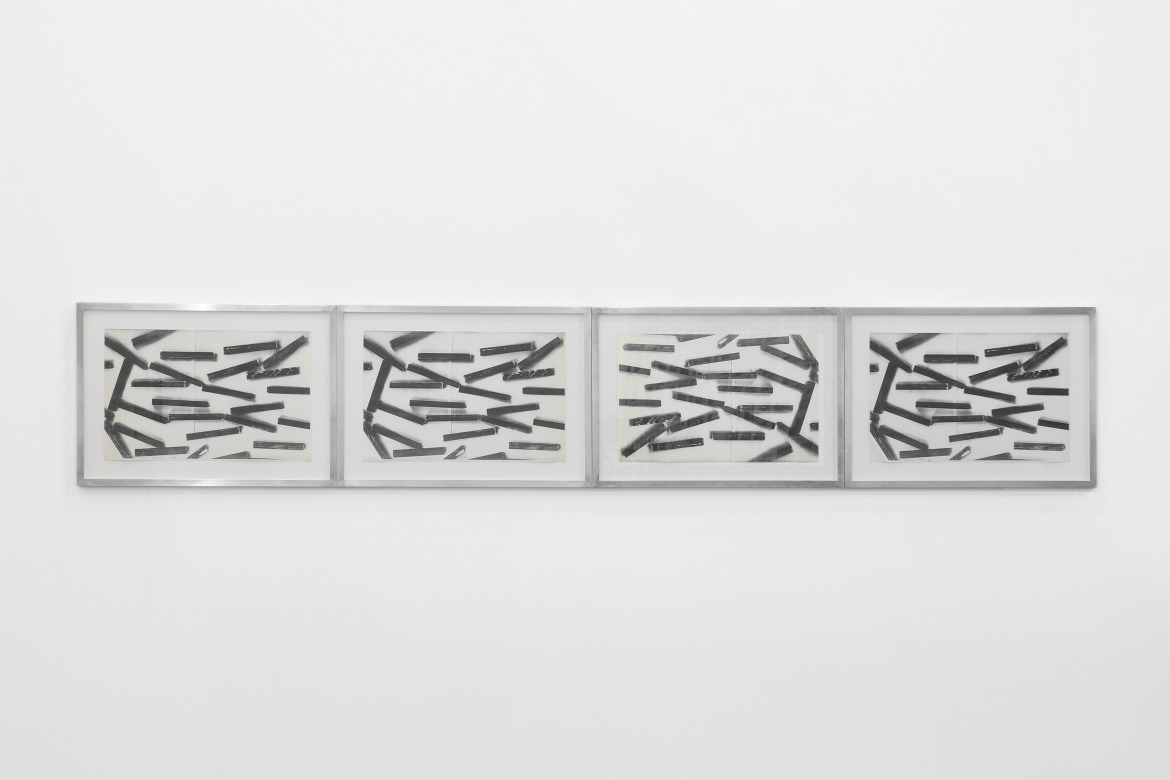
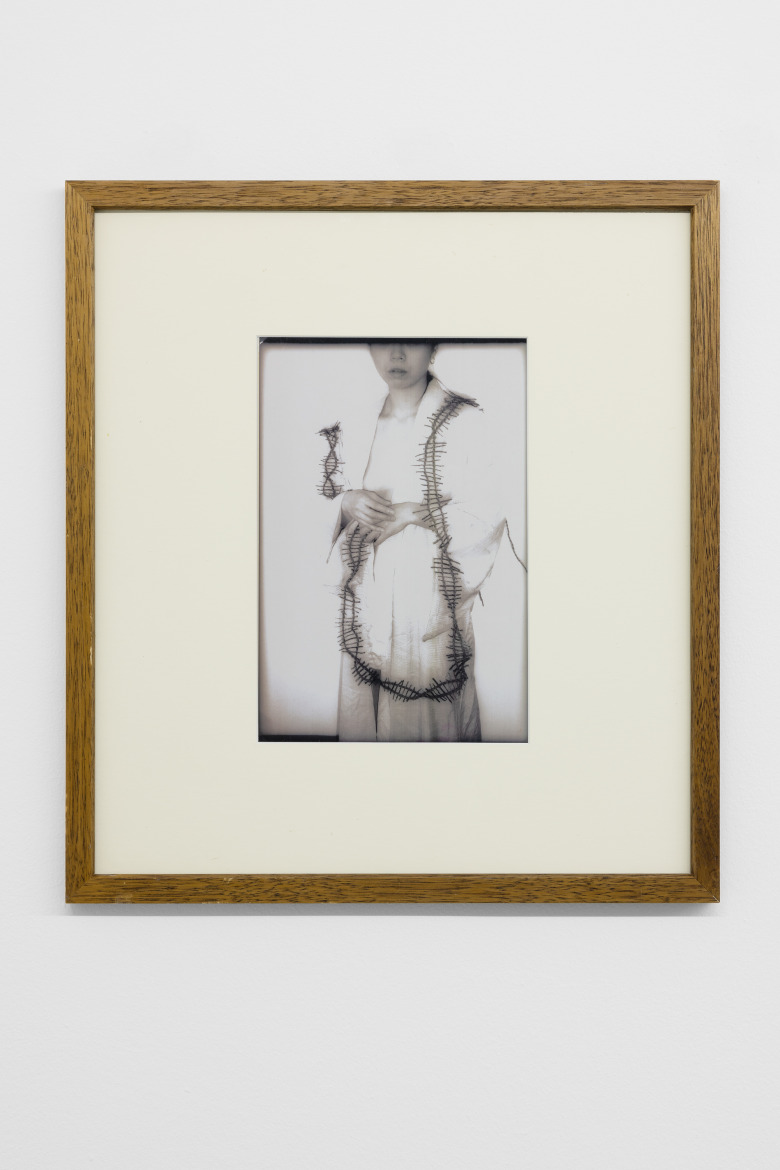
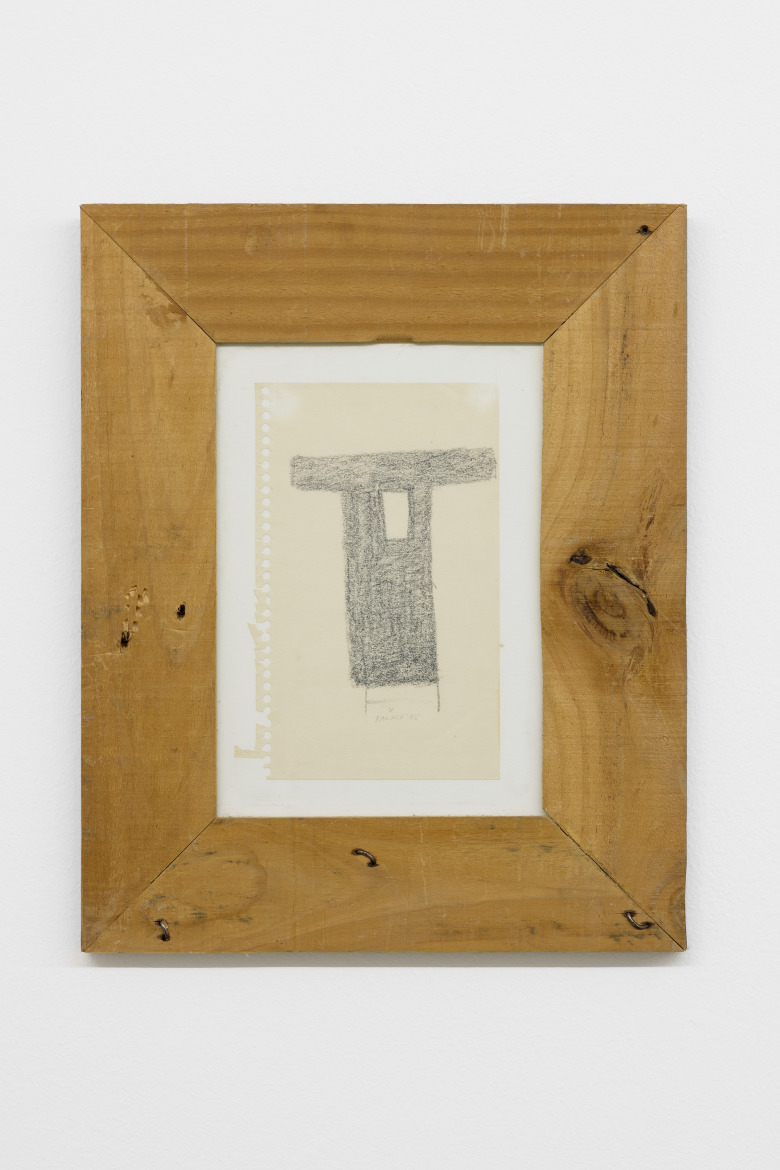
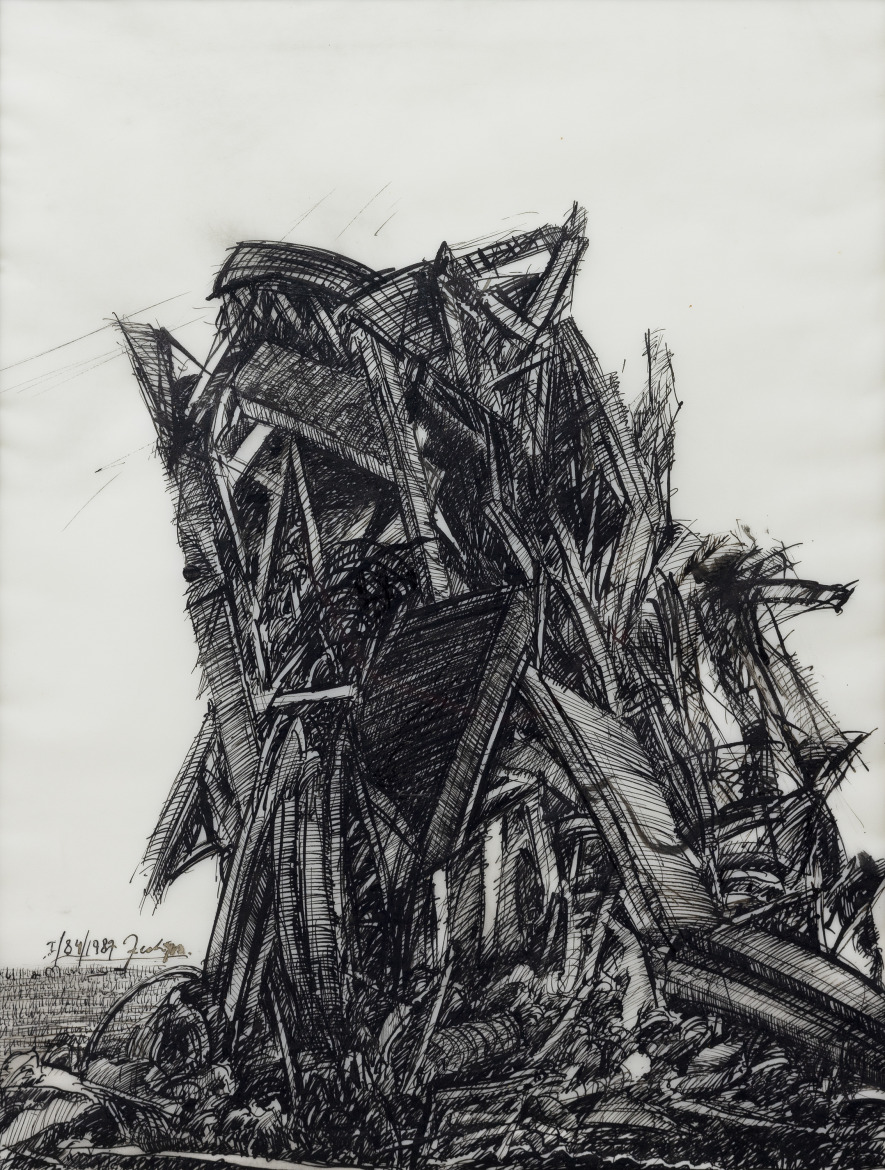
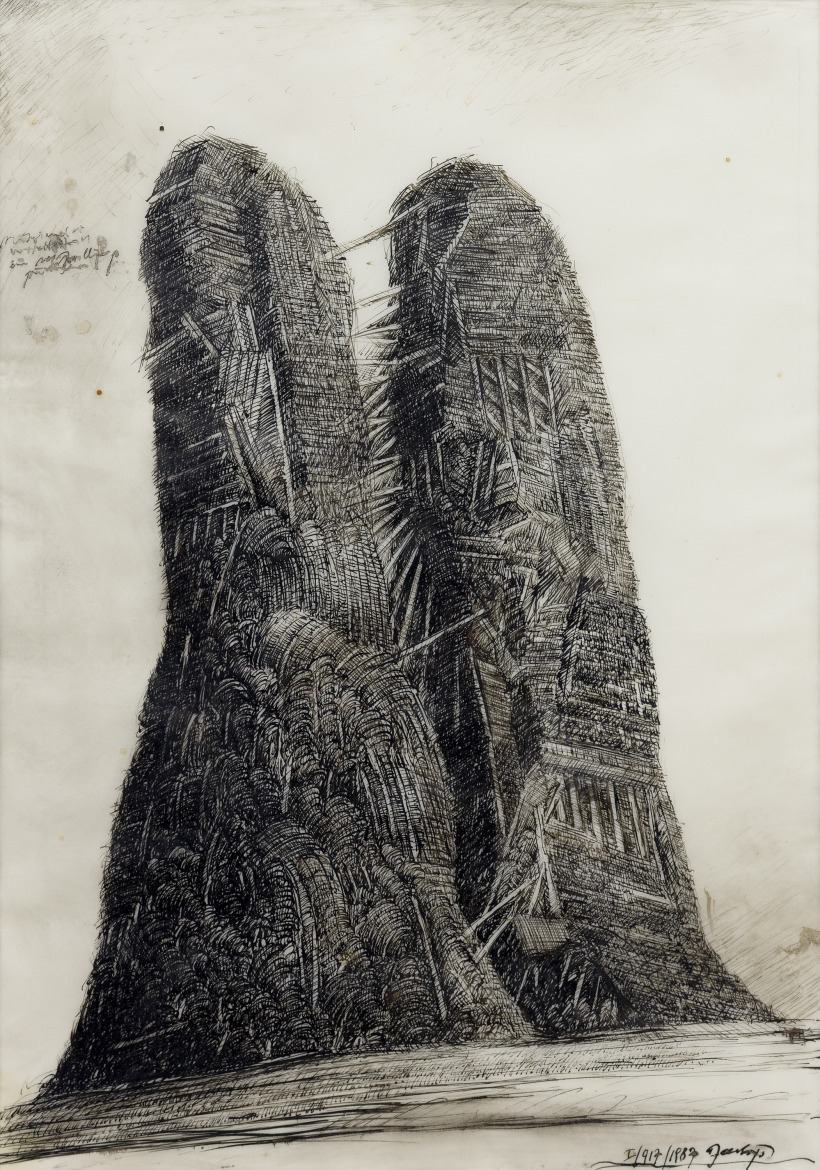
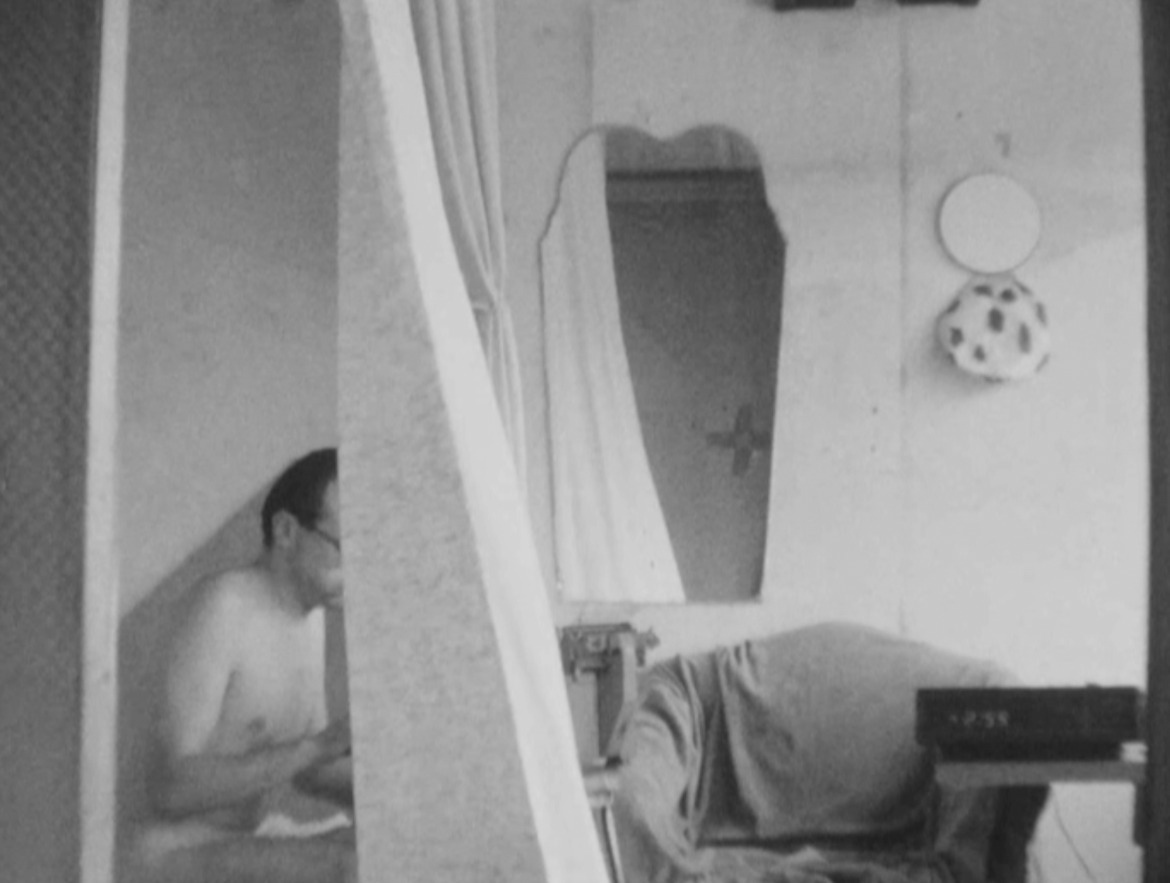
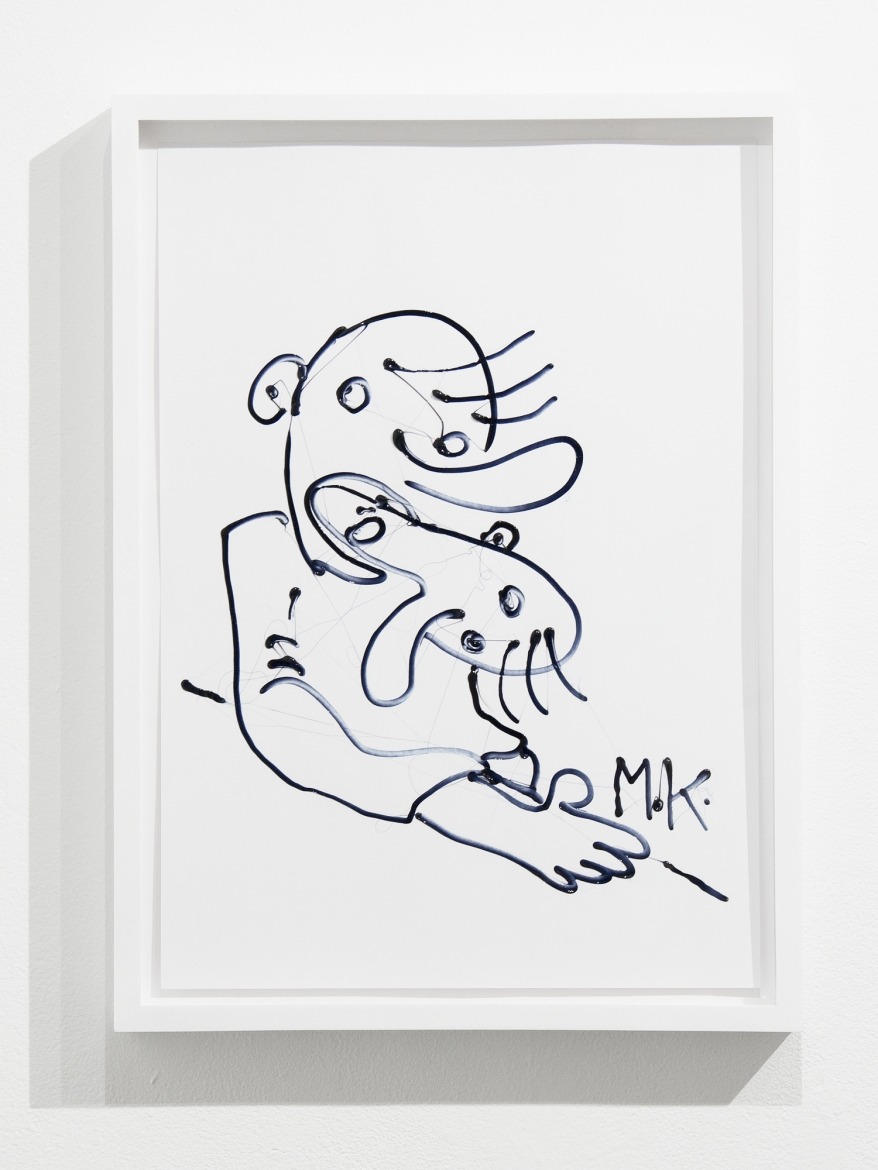
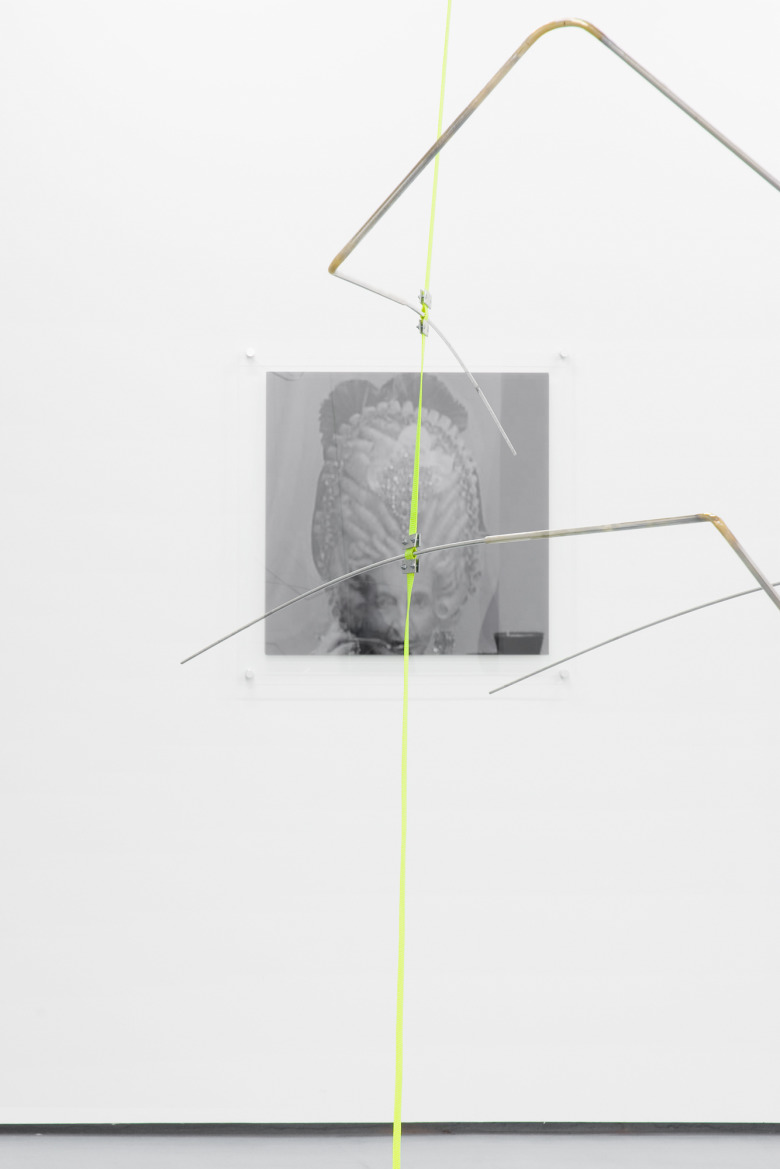
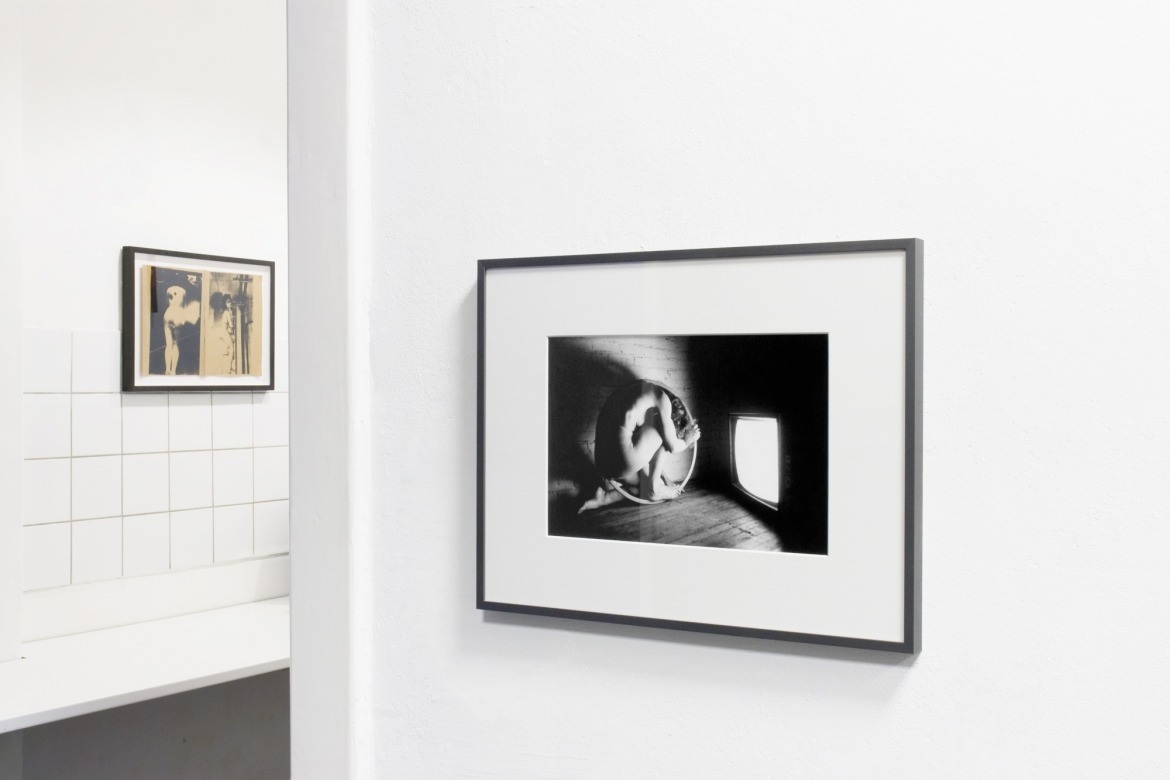
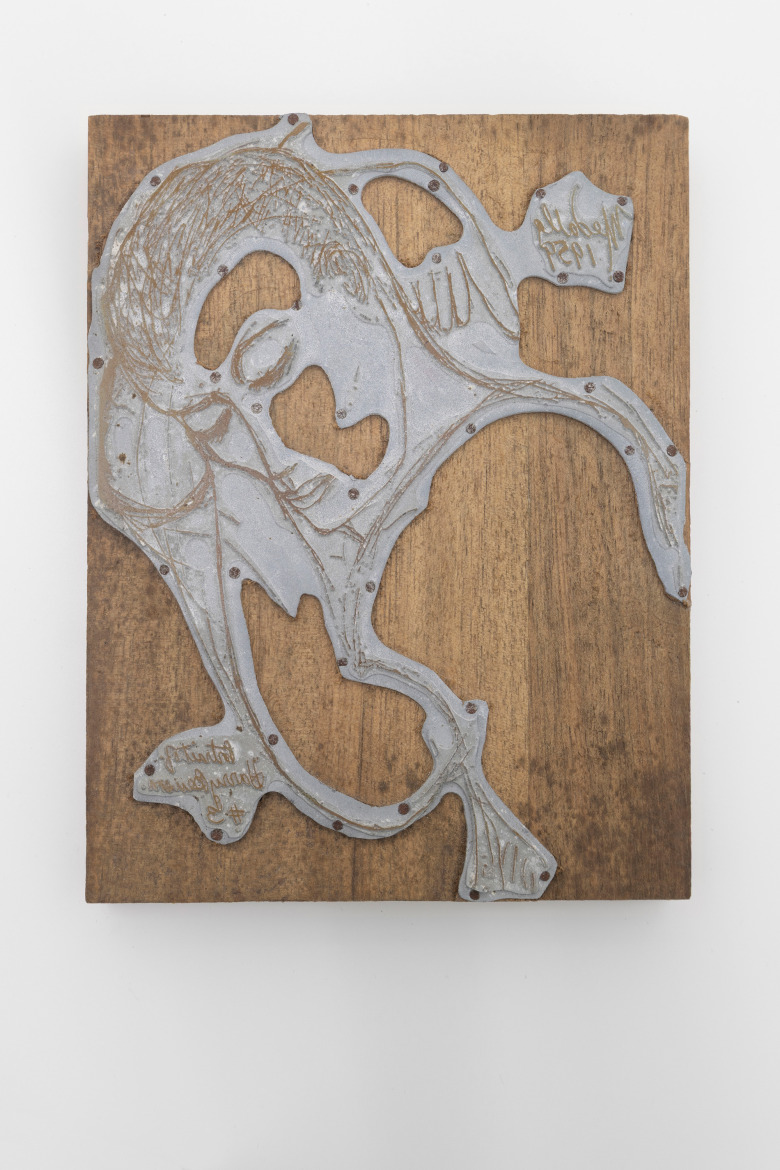
The print blocks, discovered recently by the late artist’s partner and collaborator Adam Nankervis, were never used. Created early in Medalla’s career, most likely in the late 1950s, they depict pensive male figures looking longingly at the viewer or poetically downward. Sometimes these young men hold branches like gentle masks or display their muscular bodies or alongside animals. The refusal of these printmaking objects to fulfil their purpose – to make prints – is a fitting metaphor for hidden sexuality. 

This is the only time these works will be seen in this largely unused form before belatedly being activated to produce print works. This exhibition aims to echo Medalla sense of transitory performance – a moment of time that cannot be repeated. The unread negatives of these images will soon to be transformed into something solid. 

These works represent an illusory, dream-like love for a male sexual ideal. Reversed compositionally, they are mirror images of an internal desire. Like Noël Coward’s song, they are erotic fantasies – dreamy, intimate and loving. 

Text by Francesca Gavin


Francesca Gavin is Editor-in-Chief of EPOCH Review and Director of Visual Arts at non-profit Murmur. She is the author of twelve books and has curated exhibitions at Somerset House, Palais de Tokyo and Fundação de Serralves, and co-curated Manifesta11. She hosts the long running radio show Rough Version on art and music on NTS Radio.

Adam Nankervis is an Australian artist and curator based in Berlin, known for social and experimental practice, museum MAN and another vacant space. A longtime collaborator and partner of David Medalla, he co-founded the Mondrian Fan Club and helped shape the London Biennale.
curatedby

David Medalla

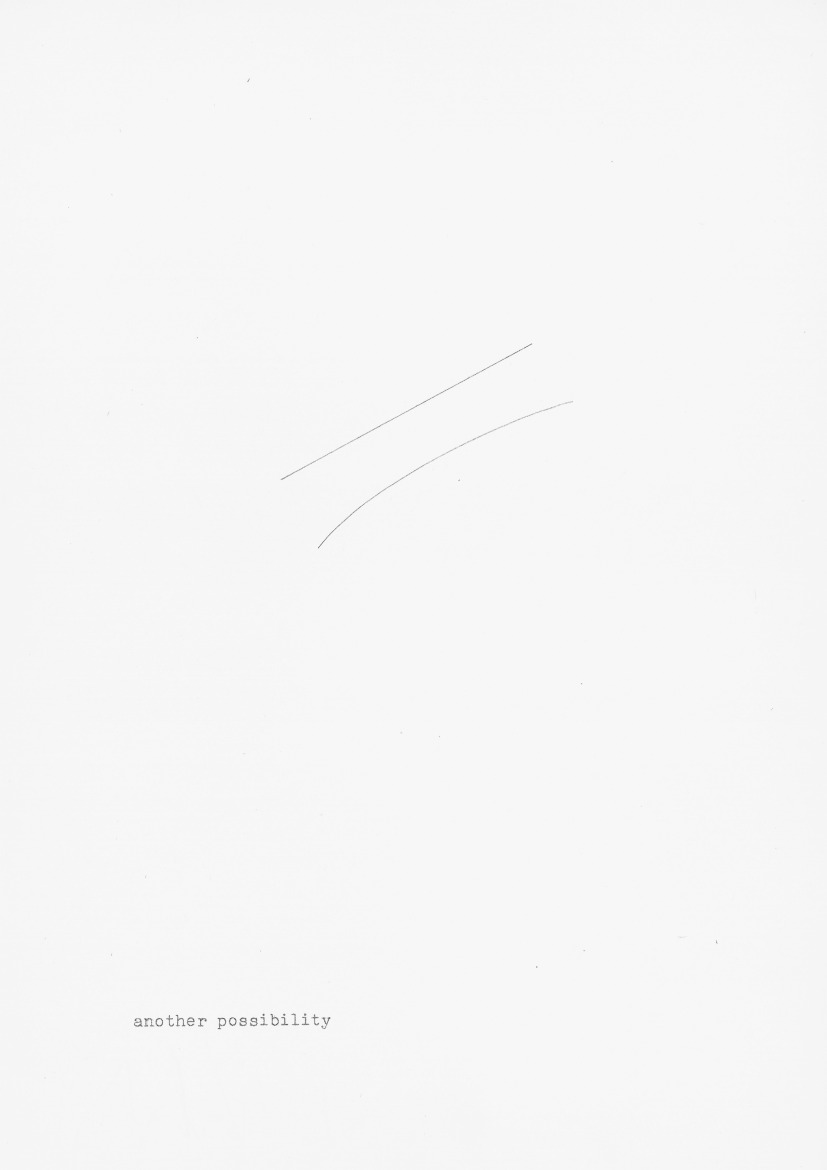
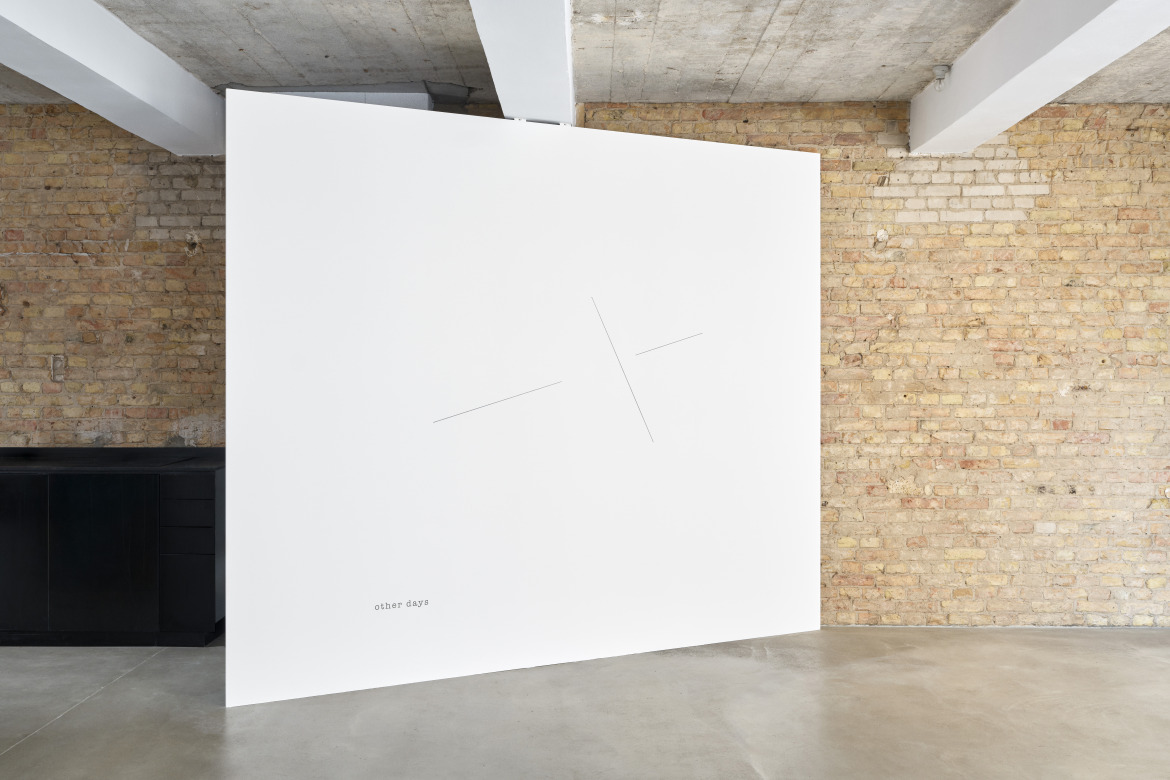
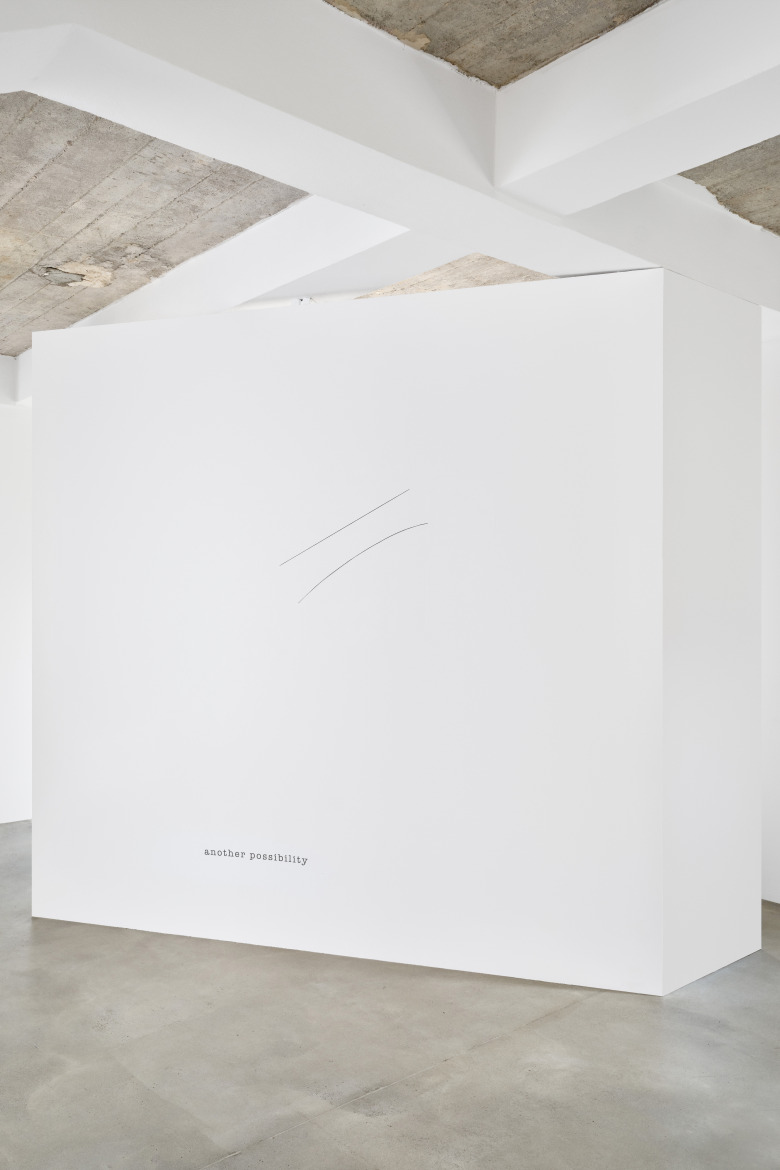
another possibility

“I (…) had an urge to exhibit these words in an exhibition. I imagined a single word as a sign on a wall as the only contents of the entire exhibition (the first project was the word “horizon”). But the cultural atmosphere of the time had changed quite drastically and an exhibition of that sort was unthinkable. In 1971 I nevertheless showed a single word in an exhibition of Czech concrete artists in Brno (…). It was the last opportunity to present such a work, all by itself, in an official exhibition space.” (Jiří Valoch interviewed by Hans-Ulrich Obrist, published in: The Czech Files, JRP Ringier, Zurich, 2015)
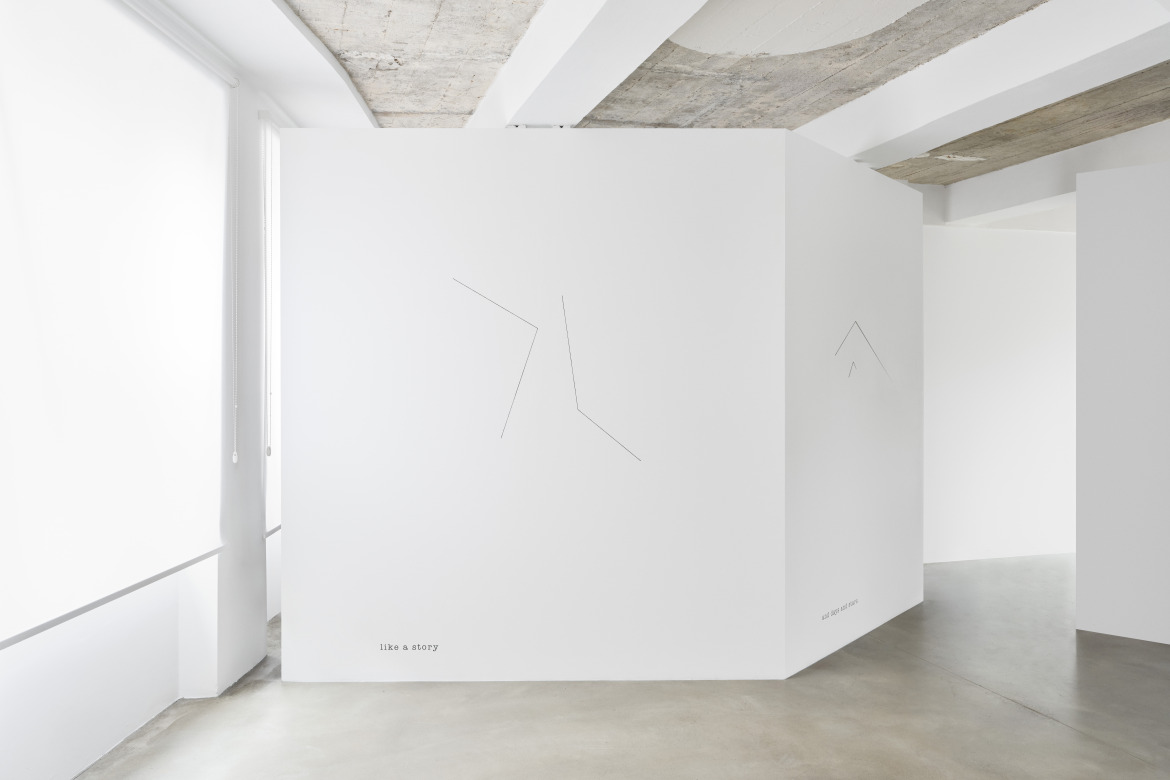
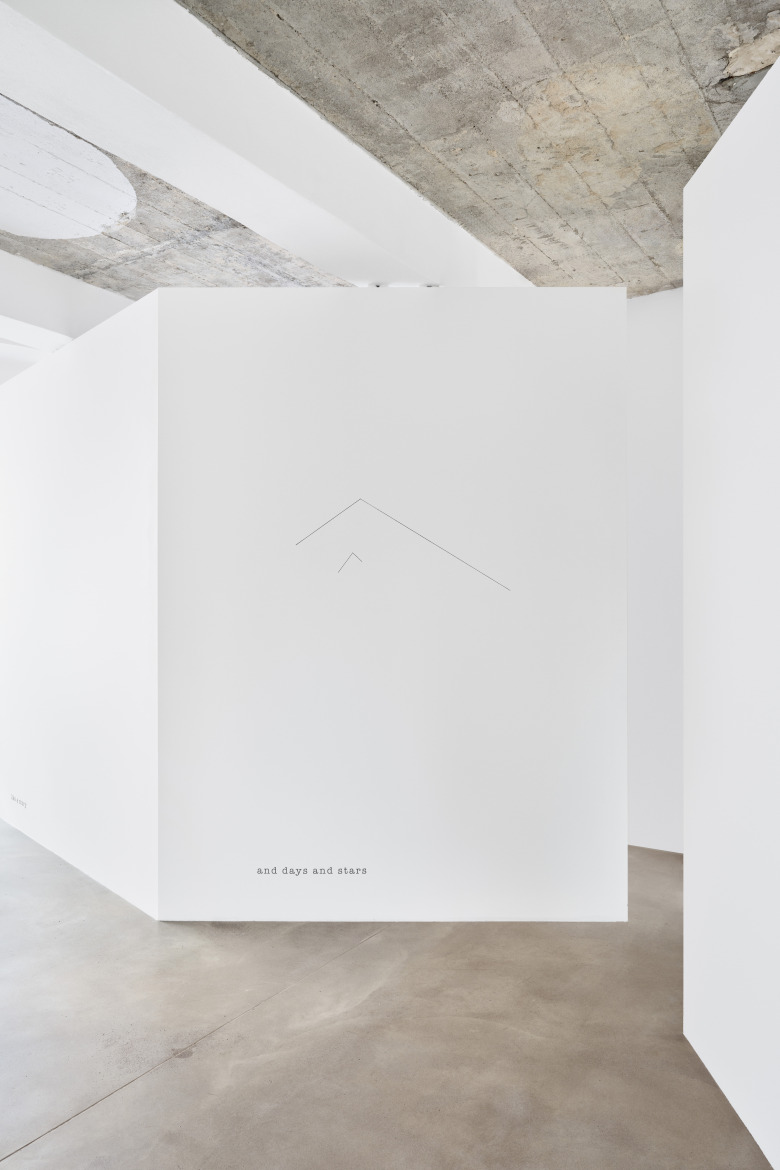
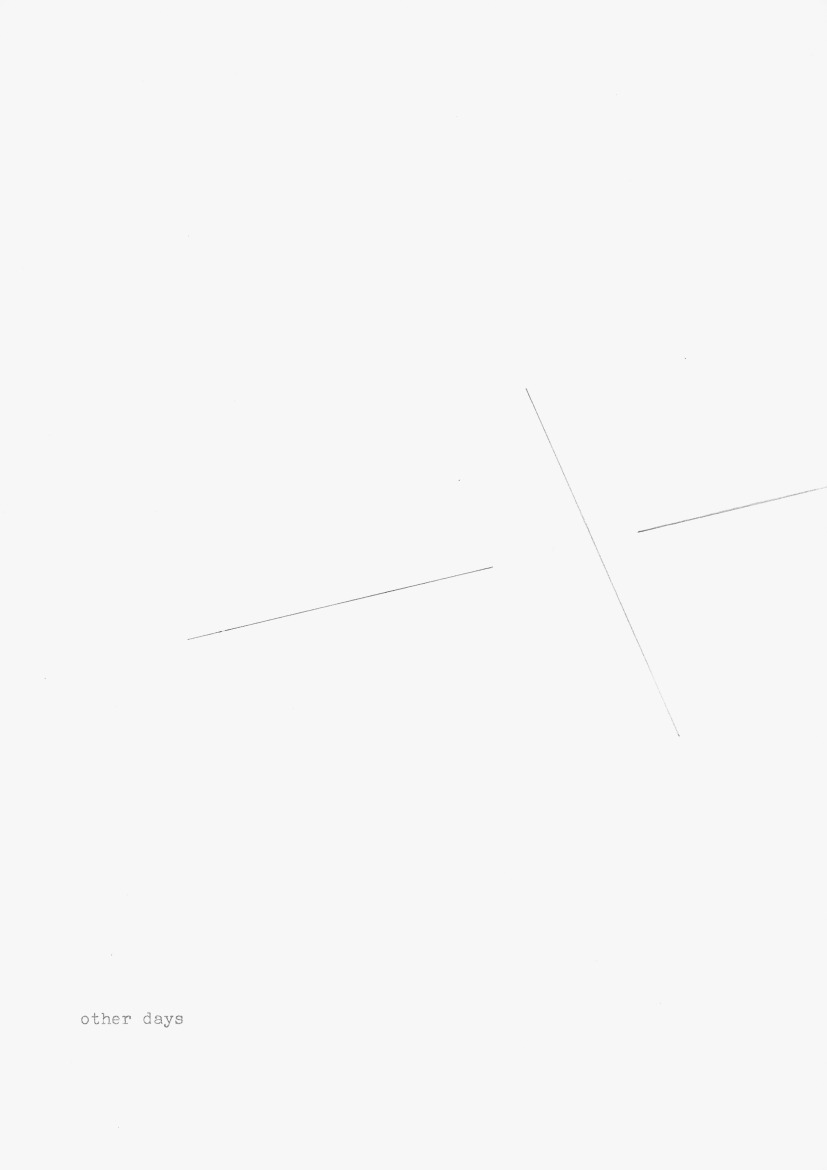
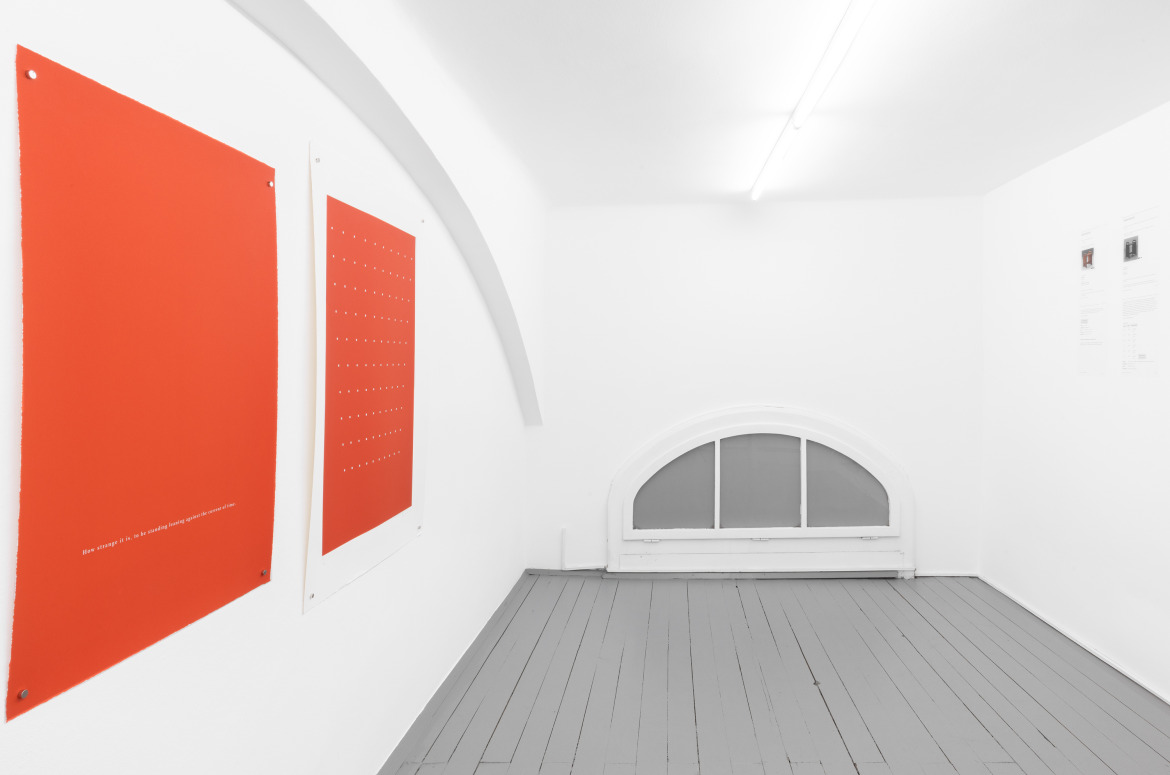
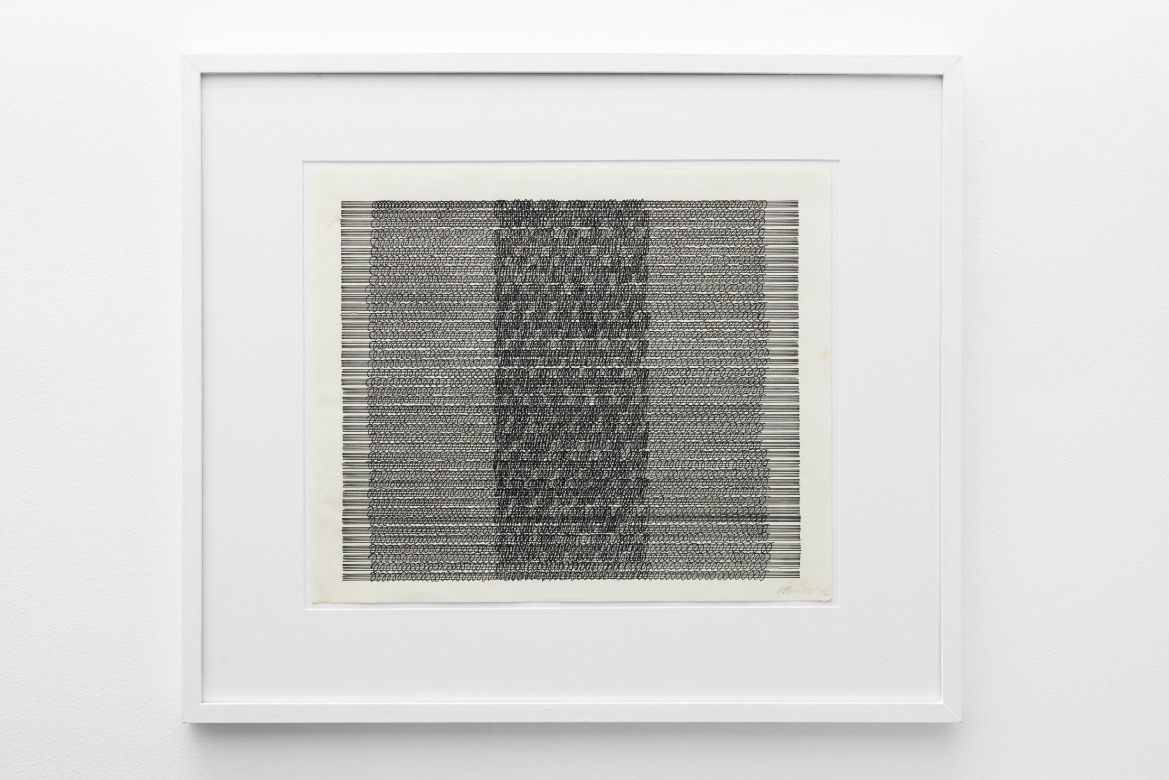
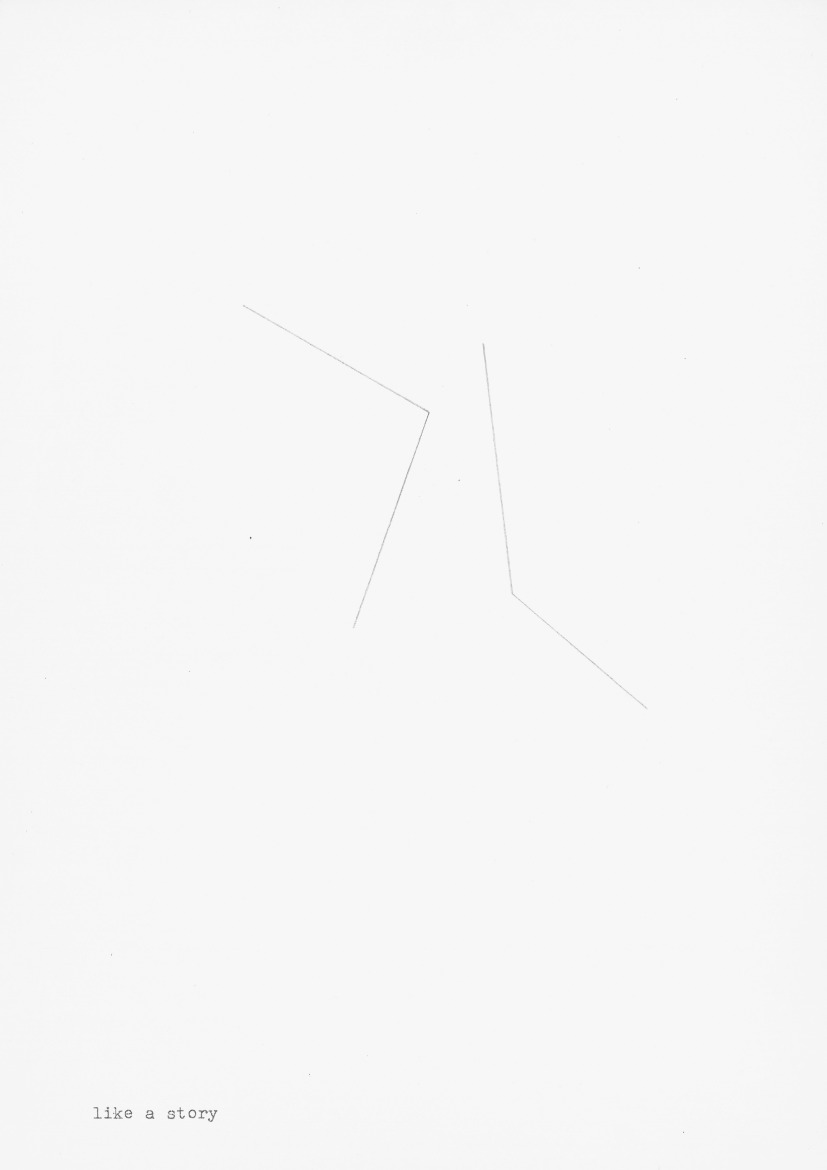
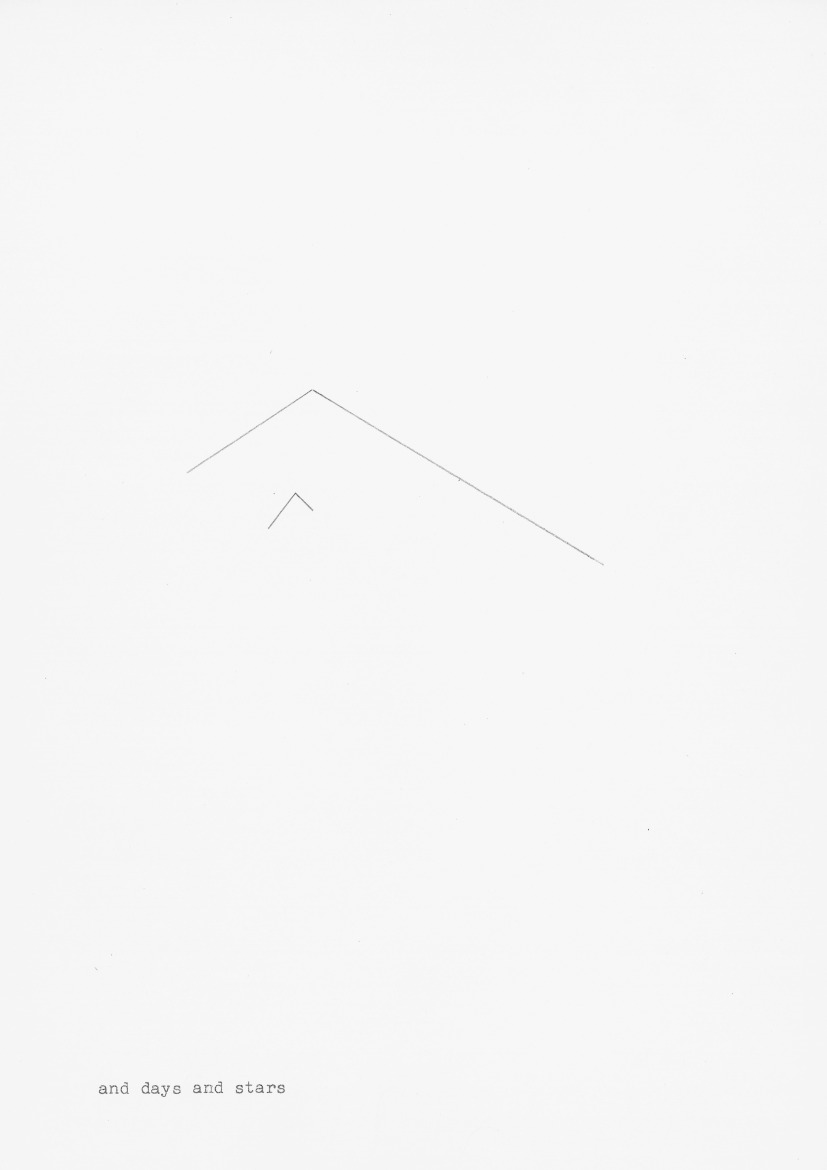
The exhibition another possibility presents four wall-based works by Czech artist Jiří Valoch (born 1946, lives and works in Brno). By the late 1970s, Valoch was barred from publicly exhibiting his work in Czechoslovakia but continued to create concepts for wall-based works in private, using typewriter and pencil on standard A4 sized paper. Together with the artist, four of these concepts were selected and will be shown for the first time as wall-based work and as originally intended by Valoch.

Valoch has extensively exhibited as part of national and  international solo-, and group exhibitions, such as at Palais de Tokyo, Paris, mumok, Vienna, ZKM, Karlsruhe, National Gallery, Prague, FJK3, Vienna and Museion, Bolzano.  In 2023, Valoch was awarded Le Prix d’Honneur Bernard Heidsieck-Centre Pompidou for his contribution to the use of text in intermedia art practice outside contexts of traditional literature. Works by Jiří Valoch are included in institutional collections such as Tate Modern, London, Archiv der Avantgarden/Dresden State Art Collection, MACBA Barcelona, ZKM Karlsruhe, Kontakt Collection, Vienna, National Gallery Prague, Museum of Contemporary Art Krakow, Moravian Gallery Brno.
The exhibition follows up on last year’s exhibition of Valoch at →EXILE Erfurt and is again organised in collaboration with Jana Písaříková and Ondřej Chrobák, Moravian Gallery, Brno and Anna Ebner-Quadri, and the editions, Vienna.


Versatzstücke

Versatzstücke are parts of stage decorations that can be moved around as desired. In a figurative sense, they refer to reused or rearranged components of a work – be it a thought, a quotation, or an element of a theory – that are used in a new context. In Austrian German, the term is used also for physical objects that function as a pledge, or a security deposit. Versatzstücke is the title of an exhibition at EXILE marking the end of the 1st quarter of the 21st century with works by Kathe Burkhart, Elke Denda, Sigmund Jaray, Tess Jaray, Jobst Meyer, Kazuko Miyamoto, Astrid Proll, W.G. Sebald, and Jiří Valoch.

In 1895, a train arrived at a station; in 2001, planes flew into buildings. While it is most likely a popular myth, the audience reacted with awe and terror when they watched the iconic 50-second film by the Lumière brothers. In 2001, a global audience watched a live stream of buildings collapsing under the sheer force of melting steel. In-between lies the 20th century. Appearing as an accumulation of objects in flux, Versatzstücke criss-crosses some of the past century’s trajectories that continue to define or haunt today’s societies. The works in the exhibition, ranging from 1899 to 2002, are assembled fragments in response to artistic and political events of the 20th century and often relate to issues of violence, terror or collective as well as individual trauma. At the end of the first quarter of the 21st century, these objects, in their physical presence, refer to the seemingly unstoppable excessive acceleration of the current digital and immaterial age, itself defined by power-consuming data centres that manage our digital identities and are in the hands of a few privately owned companies that have unparalleled financial and political power. 

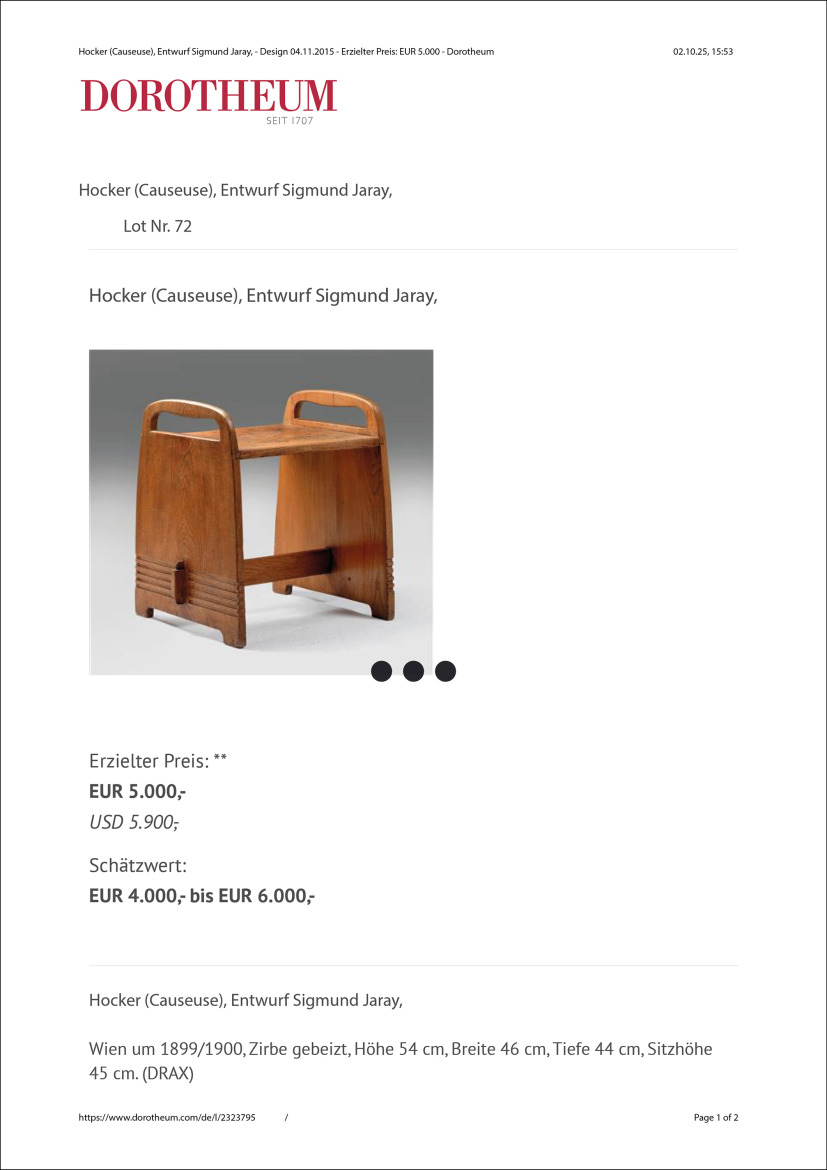
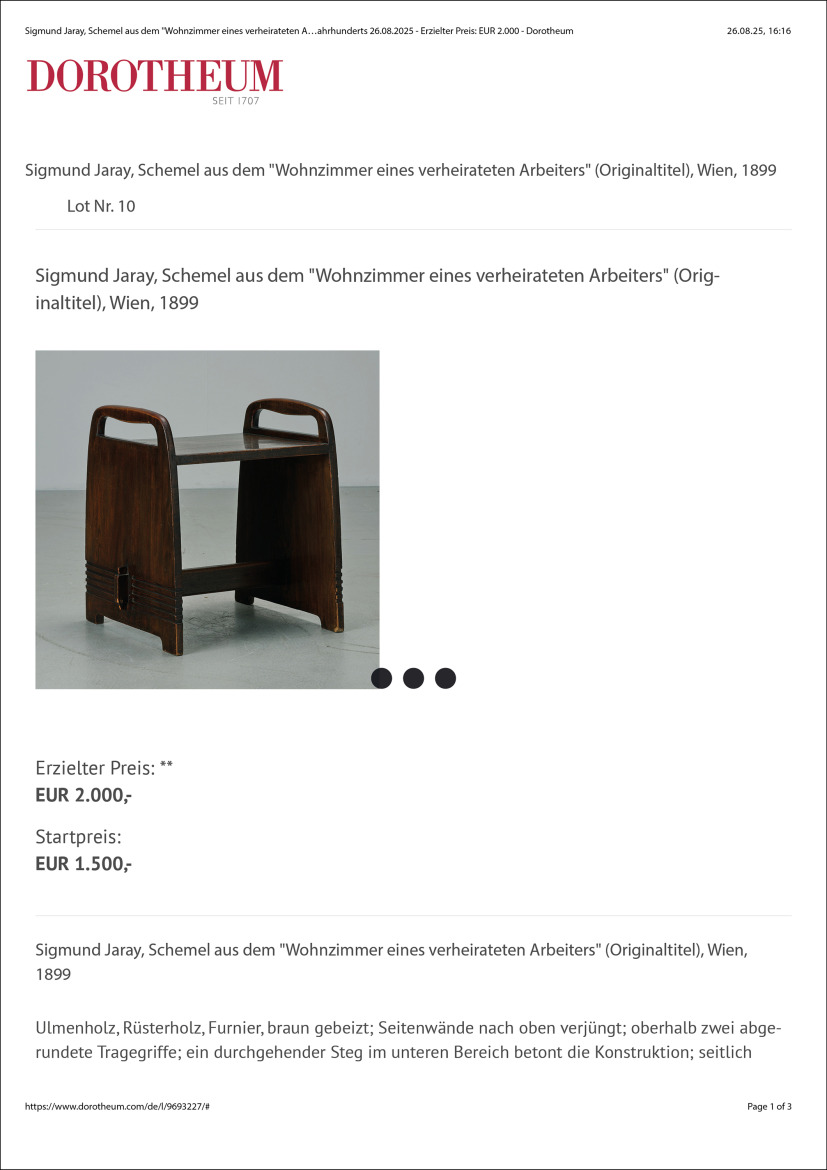
In 1899, Sigmund Jaray, an ancestor of Tess Jaray, who was born in Vienna in 1937, won second prize for Wohnzimmer eines verheirateten Arbeiters, which is now in the MAK Museum’s collection. The Jaray family moved to Vienna to work on the construction of the Ringstrasse, as well as the 1873 Weltausstellung held in the Prater. Jaray’s award-winning room is an exception to the familiy company’s more conservative approach, with its subtle Art Nouveau lines and sense of lightness, yet it is based on the idea of improving the living conditions of the working class. Fast forward to 2015 and 2025: a stool from the aforementioned room was auctioned at the Dorotheum auction house in Vienna. A transitionary venue for a diverse range of goods, Dorotheum played a major role in the resale of looted Jewish goods under the Nazi regime; however, all relevant documents proving these allegations were lost at the end of the Second World War. The stool’s physical absence from the exhibition, and it’s representation through a simple PDF printout, highlights the transient nature of commodified goods and is a metaphor for the absence of the Jaray family from contemporary Austrian society. 

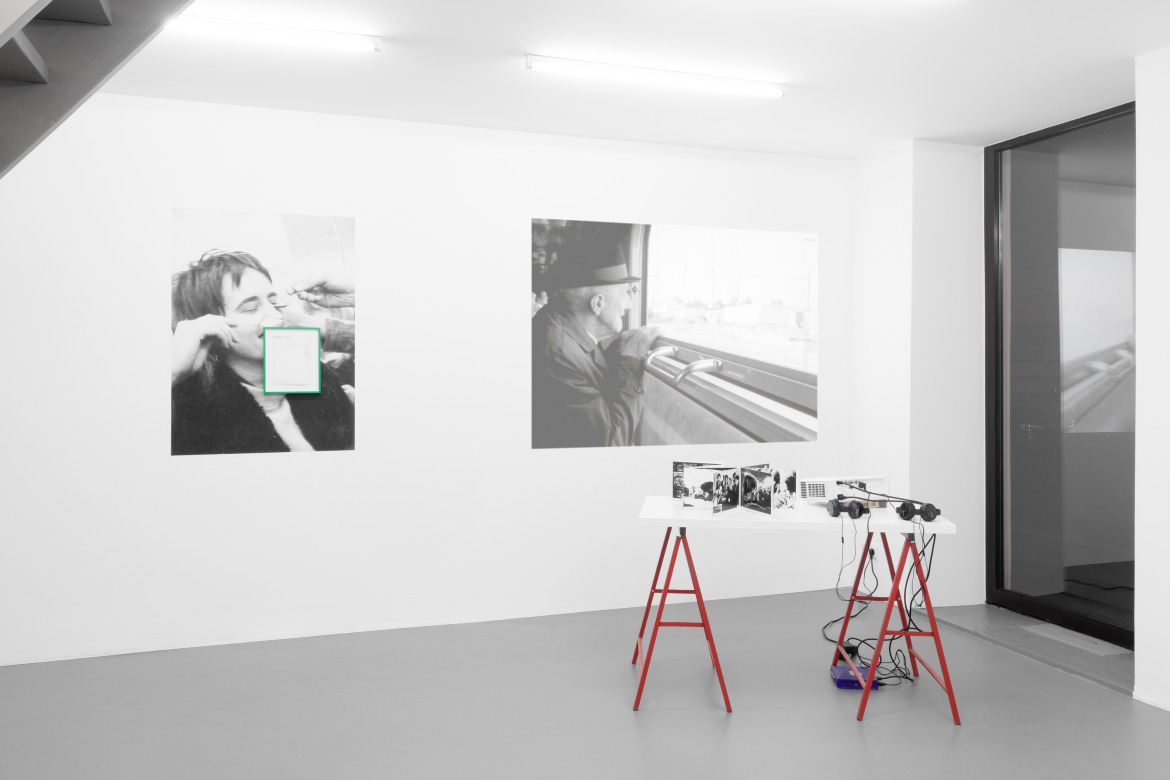
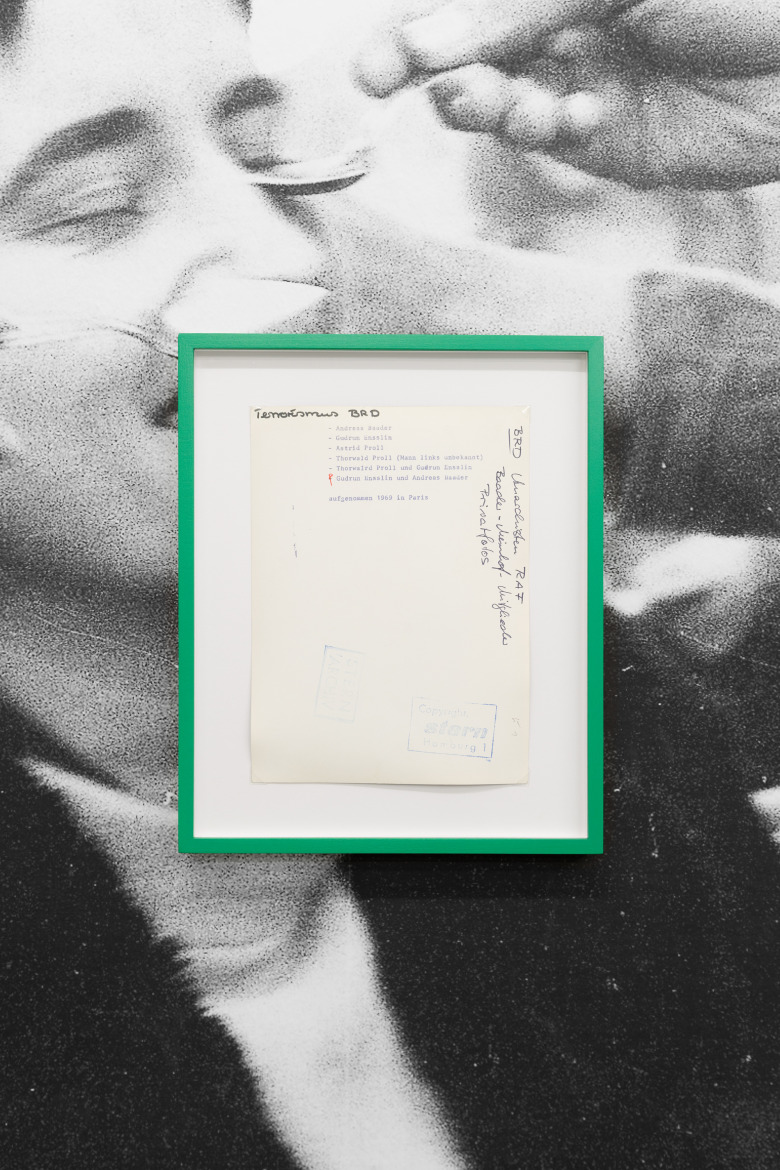
In 1967, Benno Ohnesorg was killed by German police during a student protest in Berlin. Inspired by the student movement of the time, Gudrun Ensslin and Andreas Baader concluded that more radical forms of protest were needed against the perceived post-fascist German state. Consequently, in 1968, they set fire to a shopping centre in Frankfurt, were caught by German police shortly thereafter, put on trial, and sentenced to three years in jail. During the appeal, they escaped to Paris with a group of supporters. Astrid Proll, a 22-year-old photography student at the time, joined the group on their escape to Paris, taking her Minox half-frame camera with her. Once in Paris, the group went to the famous Café de Flore, a popular hangout for intellectuals and artists, where Proll put the camera on the table. In an act of collective ownership, the camera was passed around and the group took the now famous photographs of each other. While the photos initially appear reminiscent of youth culture or fashion snaps, they would become the last private, pre-institutionalised images of the group members who, at this time, were forming the RAF (Red Army Faction), which created political upheaval in Germany in the 1970s and 1980s. Eventually the roll of film was sold off to Der Stern magazine that licensed these photographs, disregarding the photographers’ copyright. The exhibition shows an enlarged segment of a photo of Astrid Proll with the back side of a framed original photo from Der Stern magazine archive on top. The photograph itself is hidden, yet the labels and text on verso classify the depicted as ‘terrorists’ and ‘anarchists’. 
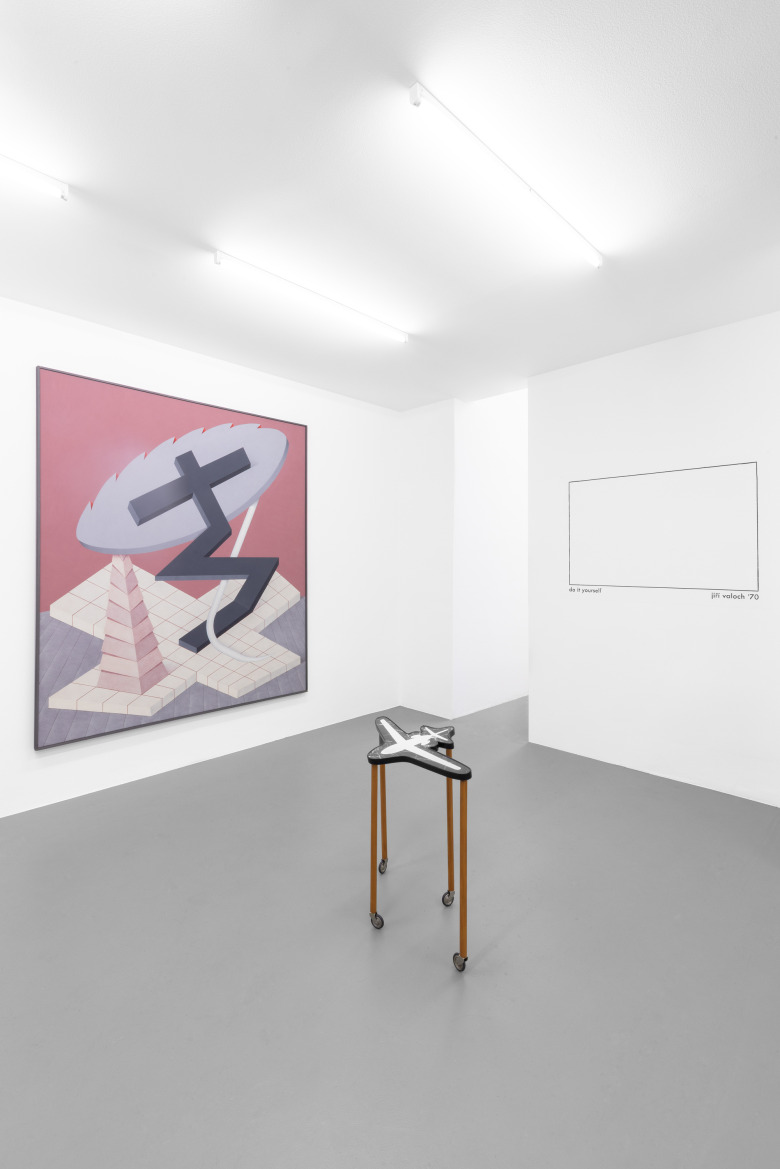
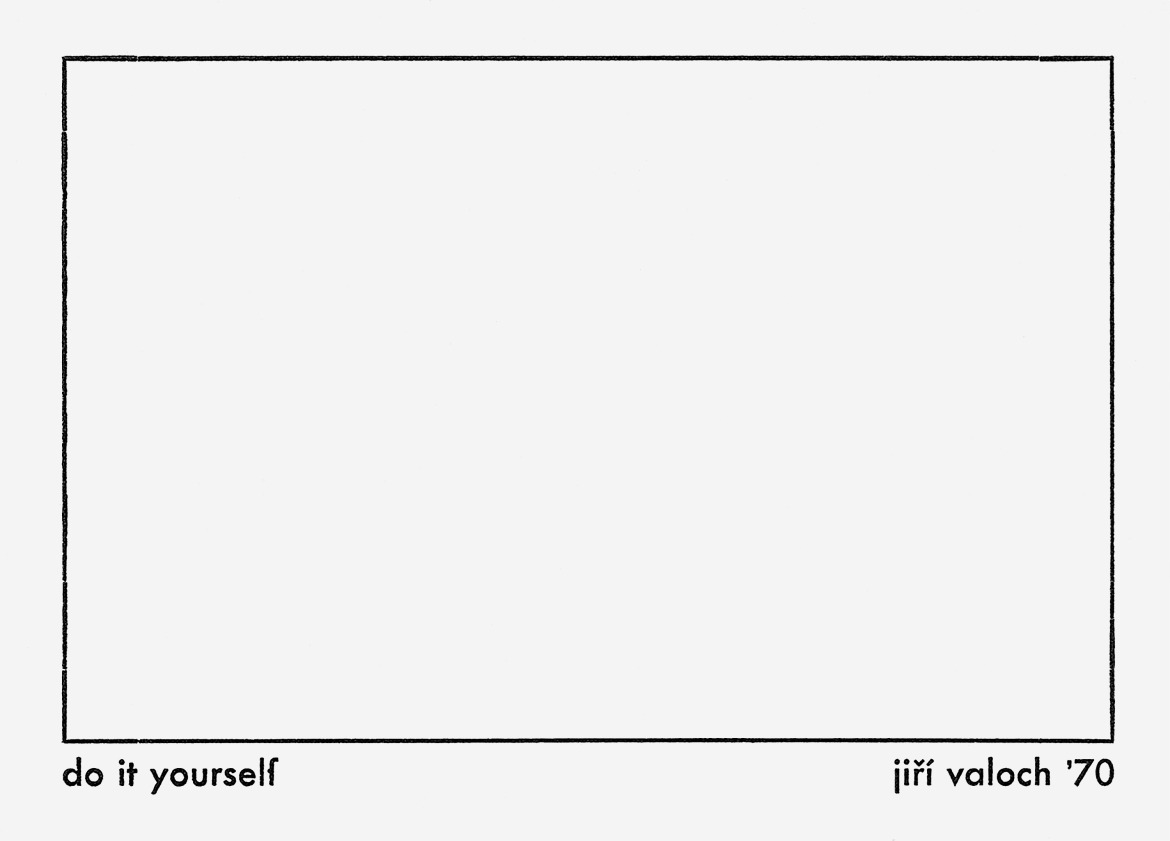
In 1970, the Czech conceptual artist Jiří Valoch sent a postcard entitled Do it yourself by mail across borders and countries. This simple gesture undermined existing censorship in Czechoslovakia and encouraged recipients to create their own artwork. On one hand political protest, the postcard enabled it’s recipient to develop their own creative ideas while Valoch himself was already barred from exhibiting in his home country. Do It Yourself is a frame within a frame, a blind mirror of personal self-reflection in the face of systemic silencing.

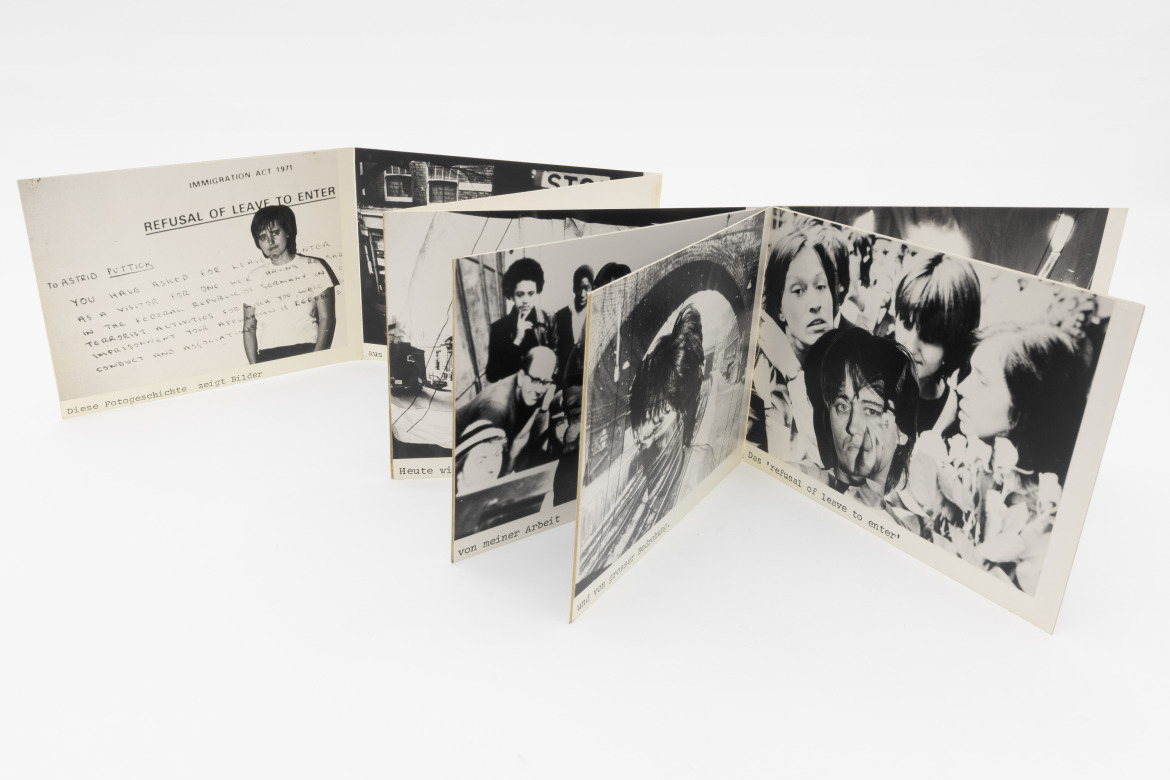
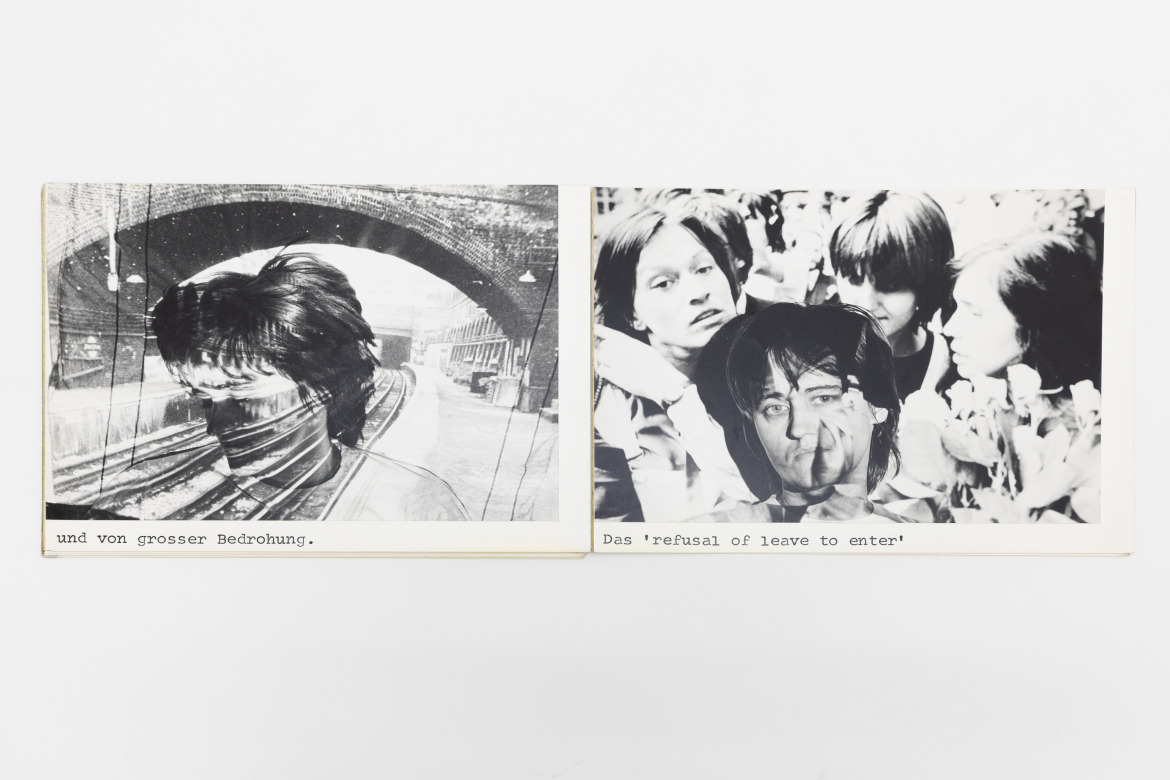
In 1981, Proll was extradited to Germany after previously being imprisoned and held in solitary confinement in Germany, escaping to London and living illegally under the alias Anna Puttick. Following her extradition, Proll did not need to finish her jail sentence for her participation in the RAF due to the severity of the previous solitary confinement. She returned to work with photography and submitted the exhibited leporello entitled Refusal of Leave to Enter as part of her application to film school. This never before shown work reads like a photo story, consisting of 11 self-portraits with images relating to her time in London, projected onto her body. 

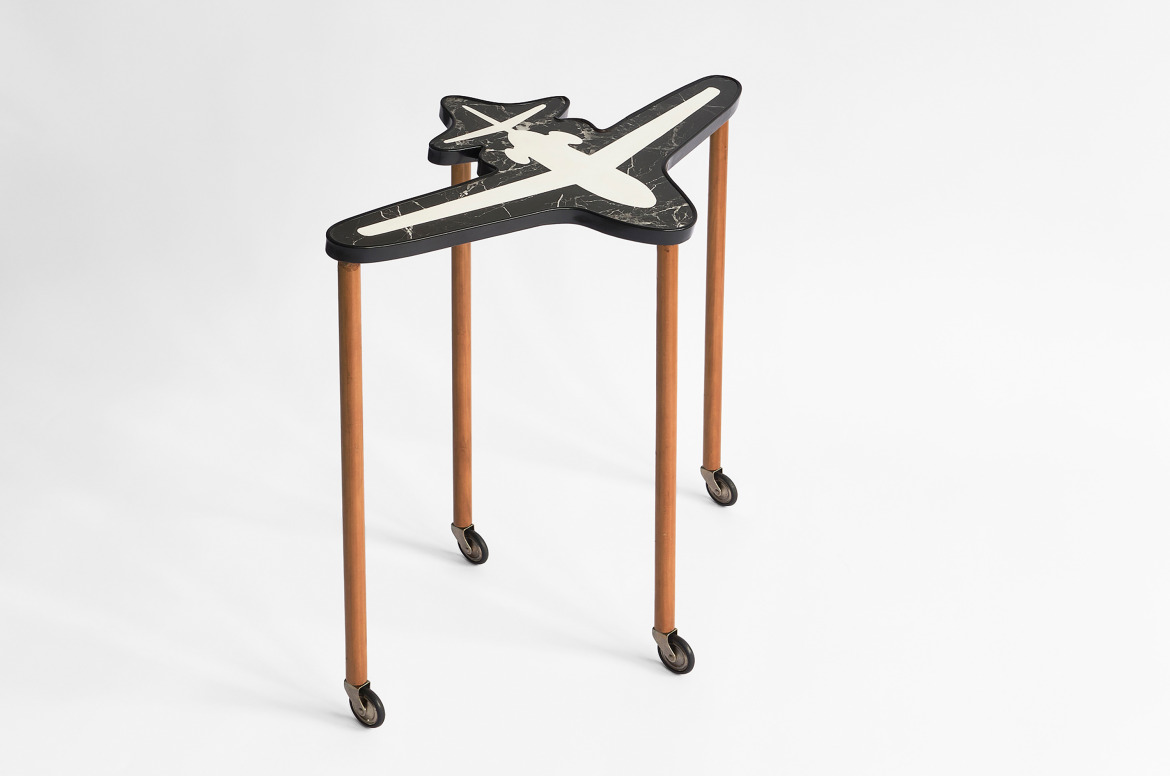
In 1982, Elke Denda created Flugzeugtisch, which she produced during her studies at the Kunstakademie Düsseldorf. This table-like yet dysfunctional movable object with a Formica top and a downward-sliding aeroplane breaks the boundaries between artwork and design object, and appears to be deeply influenced by Postmodernism. Denda started to develop a successful career in the arts but later withdrew from the art world to open a catering service and restaurant.

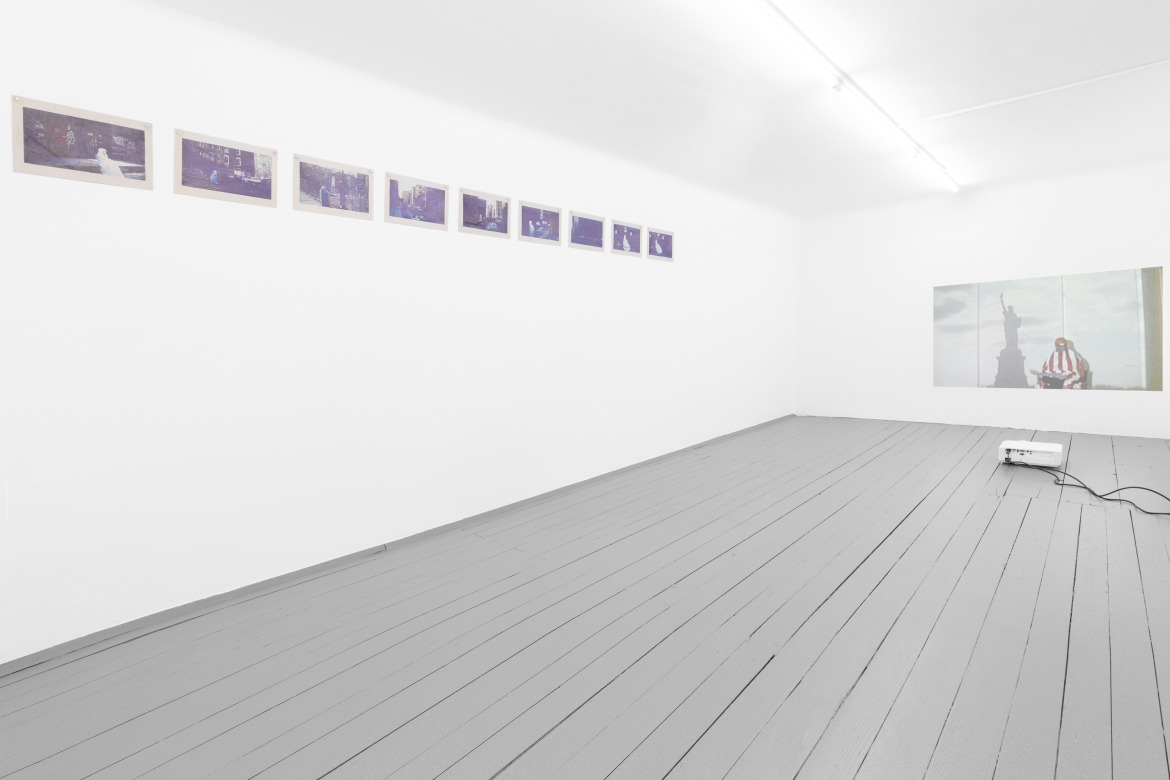
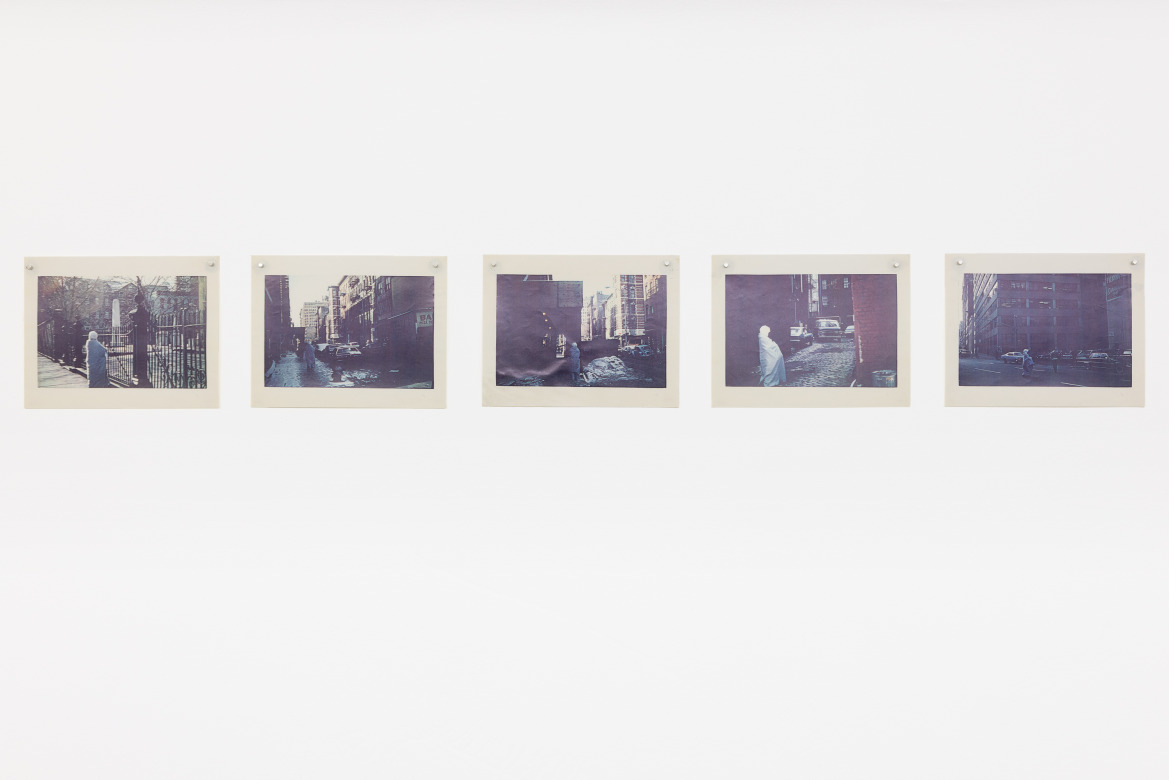
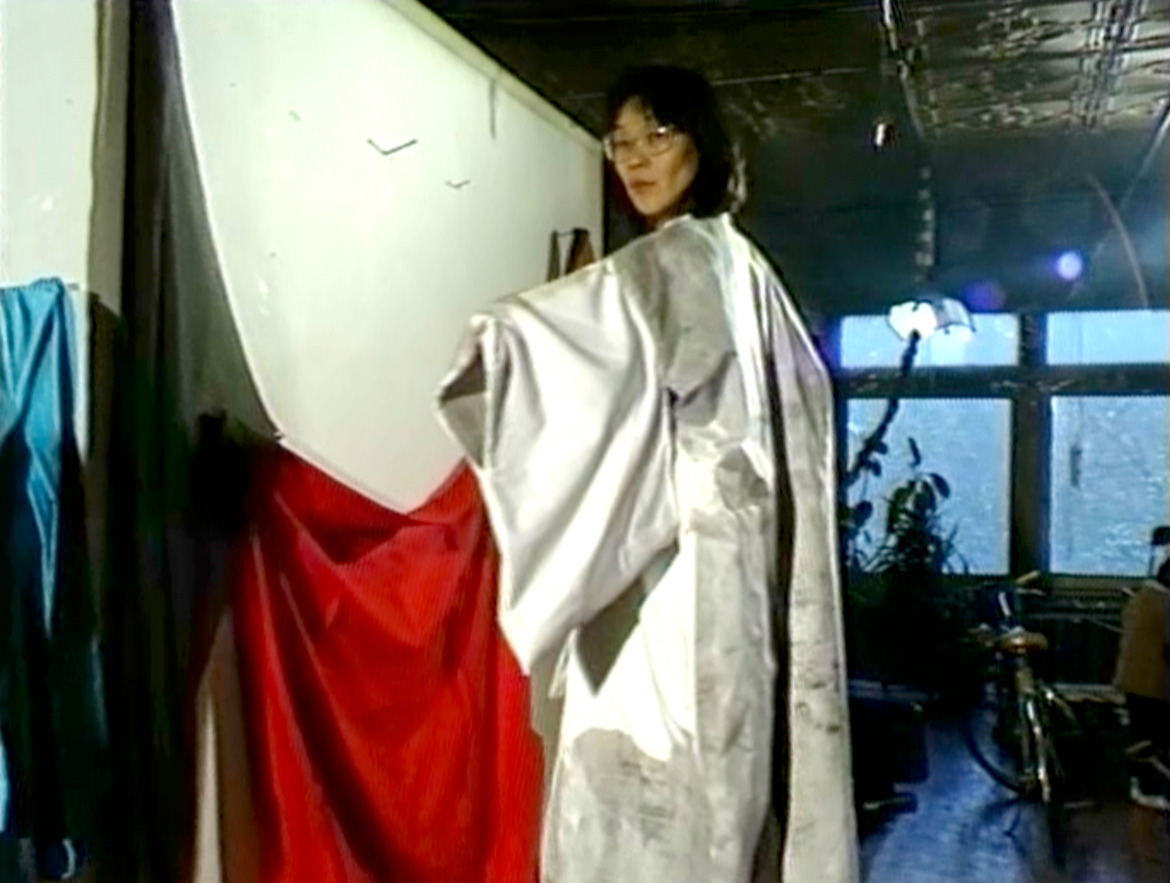
In 1983, Kazuko Miyamoto, since 1974 a member of the women’s art collective A.I.R., walked around Lower Manhattan from A.I.R. gallery to the alternative performance art space Franklin Furnace, dressed in a blue blanket. Her head was covered with what appeared to be a white plastic bag. Entitled Waiting for the Carnival, the fragmented remaining set of photocopies documenting this performative walk is on display. Although Miyamoto’s walk had a clear beginning and end, it also represents the many marginalised individuals walking seemingly lost through the streets of Manhattan. Miyamoto’s performance was in stark contrast to the glitzy, Wall Street-fuelled art world of 1980s New York. She pays tribute to an alternative vision of art that is less capital-driven, where collaboration, collectivity and community take precedence over hyper-individuality and capitalist obscenity. At the same time, she raises awareness of issues such as poverty, homelessness and displacement.

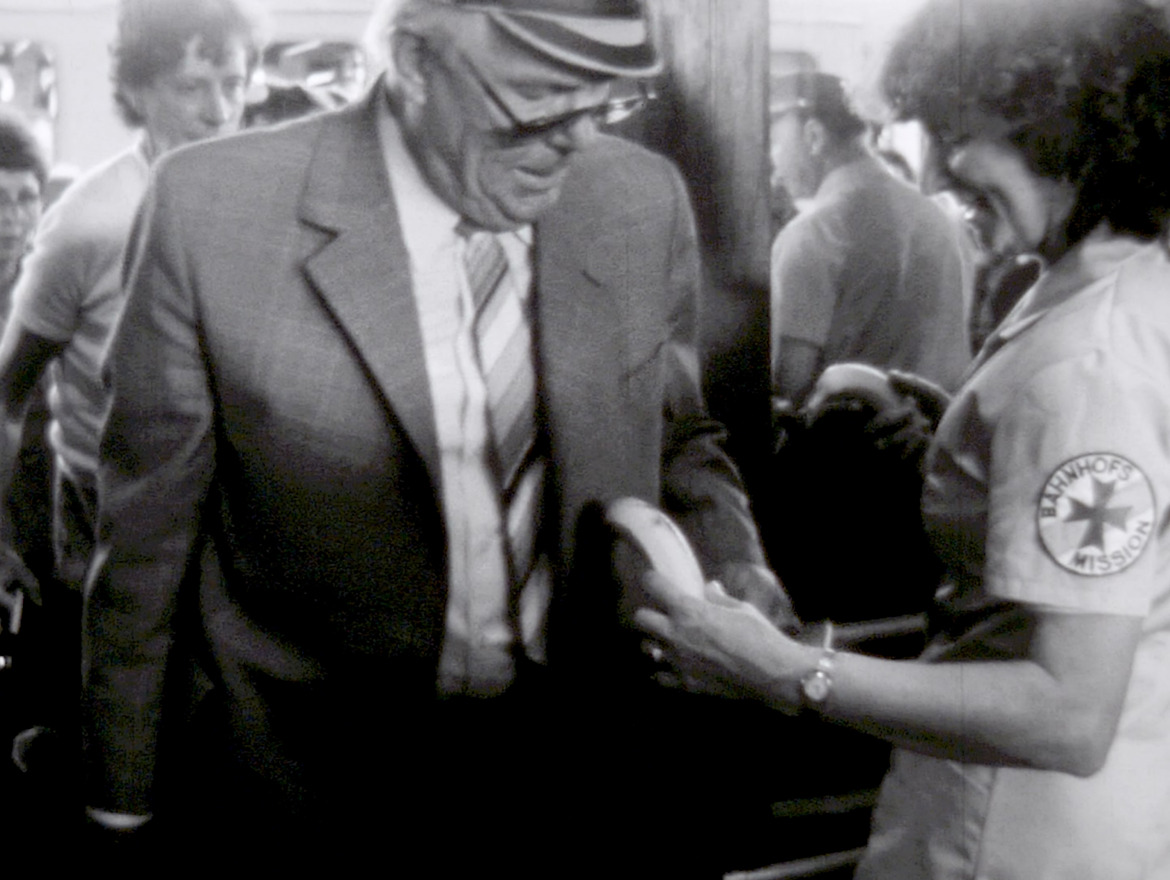
In 1988, Proll produced her graduation film, Der Zug aus Leipzig, in collaboration with Claudia Richards. In the film, the artists travel to the German-German border station at Büchen, where Proll interviewed East German pensioners who were allowed to cross the ideological divide from socialism to capitalism and back. As the train arrives at the station, the East-German travellers undergo border procedures, receive charitable food donations before continuing their journey to Hamburg.  The film reflects on Proll’s own biography as an individual caught in-between political systems and nation states. 

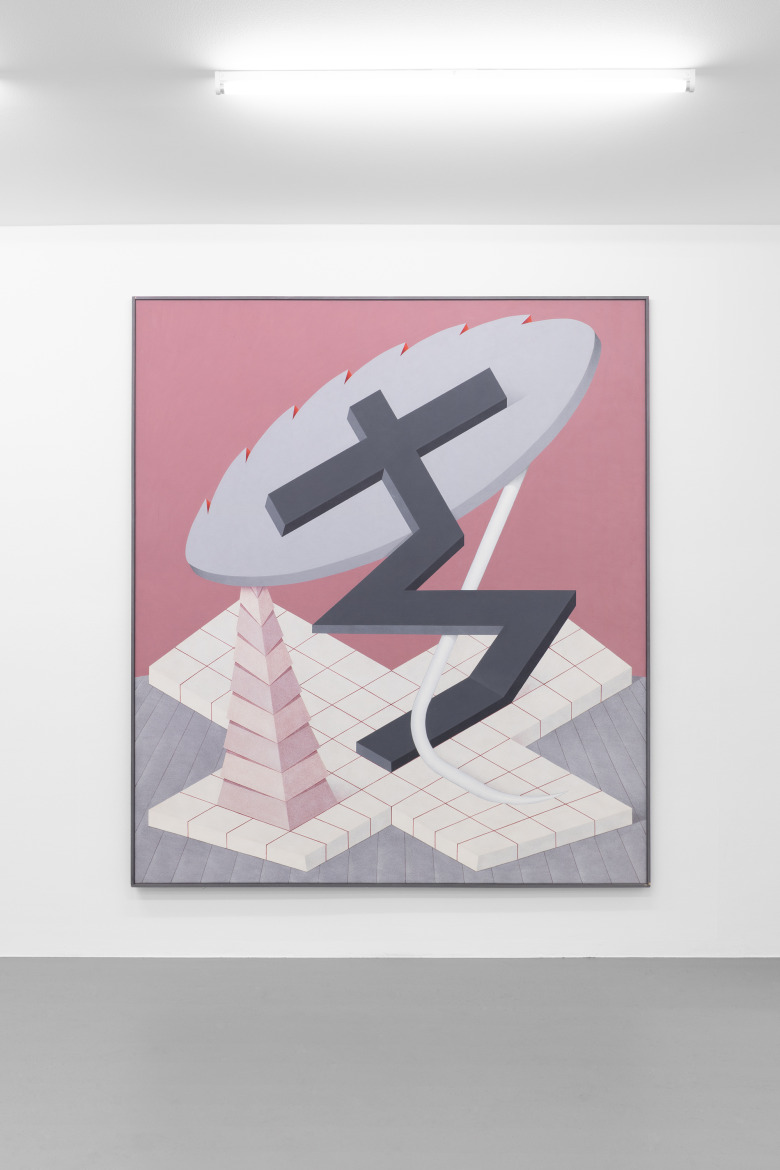
In 1989, the German painter Jobst Meyer created the exhibited work Konstruktion mit Kreuzscheibe und Haken. The date and arrangement of the objects make this work remarkable. A black, zigzag, cross-like shape, reminiscent of Rietveld’s 1932 chair, as well as Alchimia’s 1975 adaptation, sits atop a white-and-red, Superstudio-esque, checkered cross arranged with a pyramid-like form, a hook, and a circular saw blade. In the context of the year it was created, the painting could be interpreted as a visionary allegory of the looming consequences of the annexation of socialist East Germany by capitalist West Germany. The form, painted in a greyish black with the symbol of the cross, holds two identifiers of the ruling CDU party under German Chancellor Helmut Kohl, hooking the East with its commodified lure of freedom while using a saw blade to cut through the advances of West Germany’s socialist counterpart.

In 2001, Tess Jaray collaborated with German author W. G. Sebald on a series of silkscreen prints. The resulting book and set of prints were the first public exposure of Sebald’s poetry. Himself an emigrant from Germany to the UK, Sebald’s writings often refer to absence, alienation and exile, with the author frequently using trains and train stations as metaphors. Due to their close friendship, Sebald was very familiar with the Jaray family history, and the exhibited quote reads as a poetic yet precise reflection on contemporary society. 

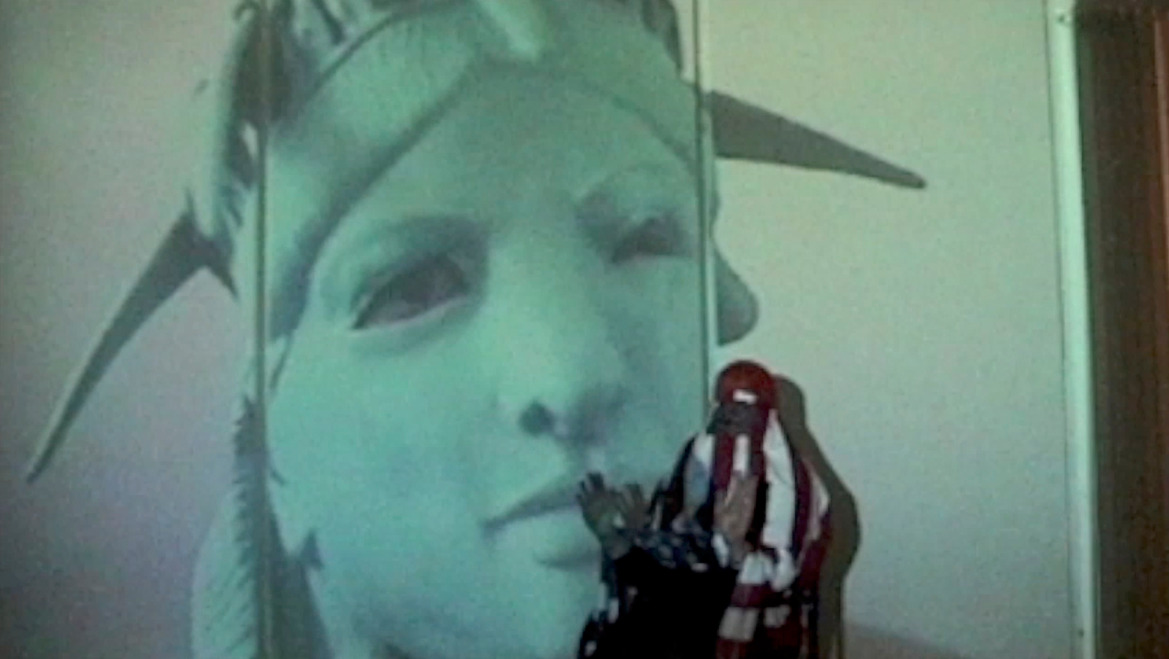
In 2002, Kathe Burkart performed American Woman in front of a small audience. Dressed in a burqa made from an American flag, the artist sat on a chair and gestured to music while video footage of and around 9/11 was projected onto her. This radical performance, at a time when the War on Terror had just begun, is likely one of the first critical responses to US politics in response to 9/11. Here, it also marks the end of the exhibition and symbolised the end of the 20th century.

Beginning with a train arriving at a station, we are now faced with airplanes bringing down seemingly invincible steel towers of Western dominance and capitalism. From here, the world is catapulted into a new dawn: a hyper-accelerated, multi-crisis era that leaves us all too often in states of disbelief, shock and awe. Yet the works on display also present forms of individual or collective response, of subversion to perceived norms, either within an artistic context or far beyond it.

Curated by Christian Siekmeier

Projekt für eine Ausstellung (1969-71)

EXILE Erfurt is happy to present a solo exhibition by Czech artist Jiří Valoch (born 1946, lives in Brno, Czech Republic).

In 1971, the German publishing house Dumont published the book Aktuelle Kunst in Osteuropa. Although it did not receive much recognition at the time, it has since become legendary. The book was initiated by the artist, gallery owner and publisher Klaus Groh. Deeply connected to the global mail-art movement of the time, Groh made the first attempt through this publication to introduce progressive forms of Eastern European conceptualism to a Western audience. One of those who helped him compile the book was twenty-five-year-old Jiří Valoch, who was already eight years into his artistic career.

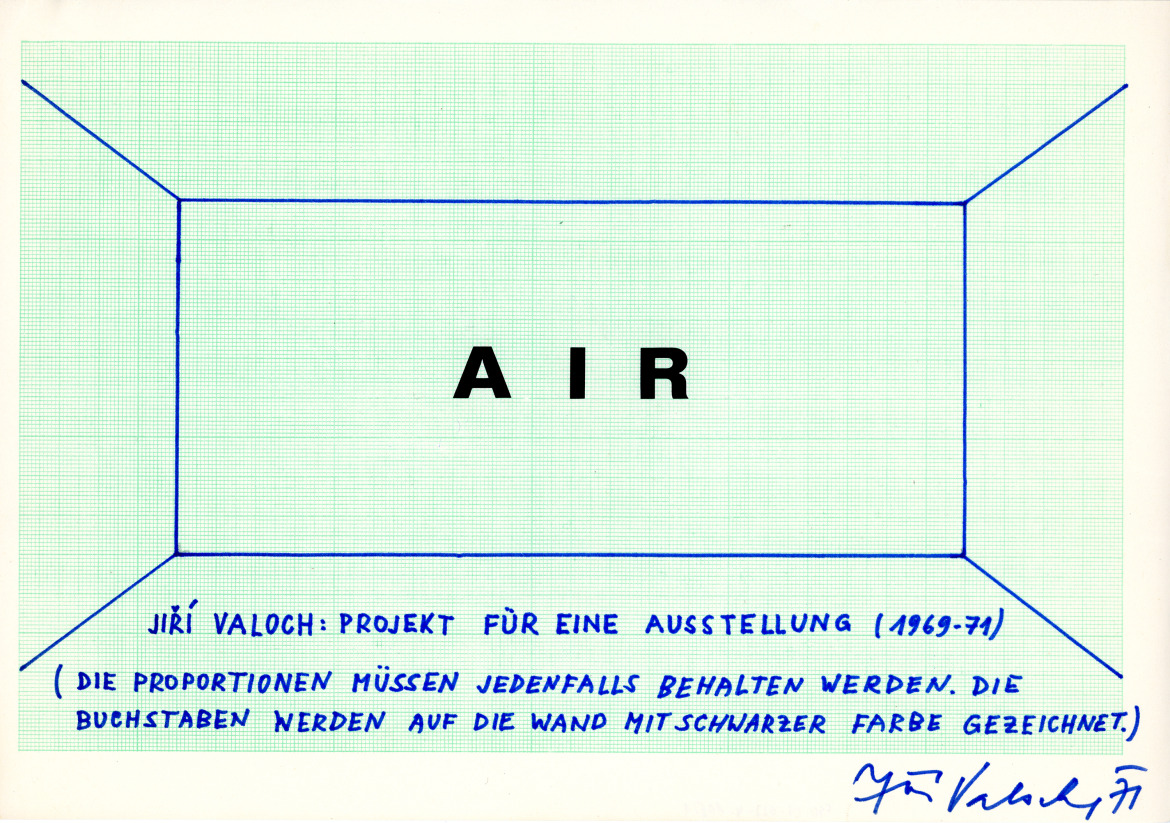
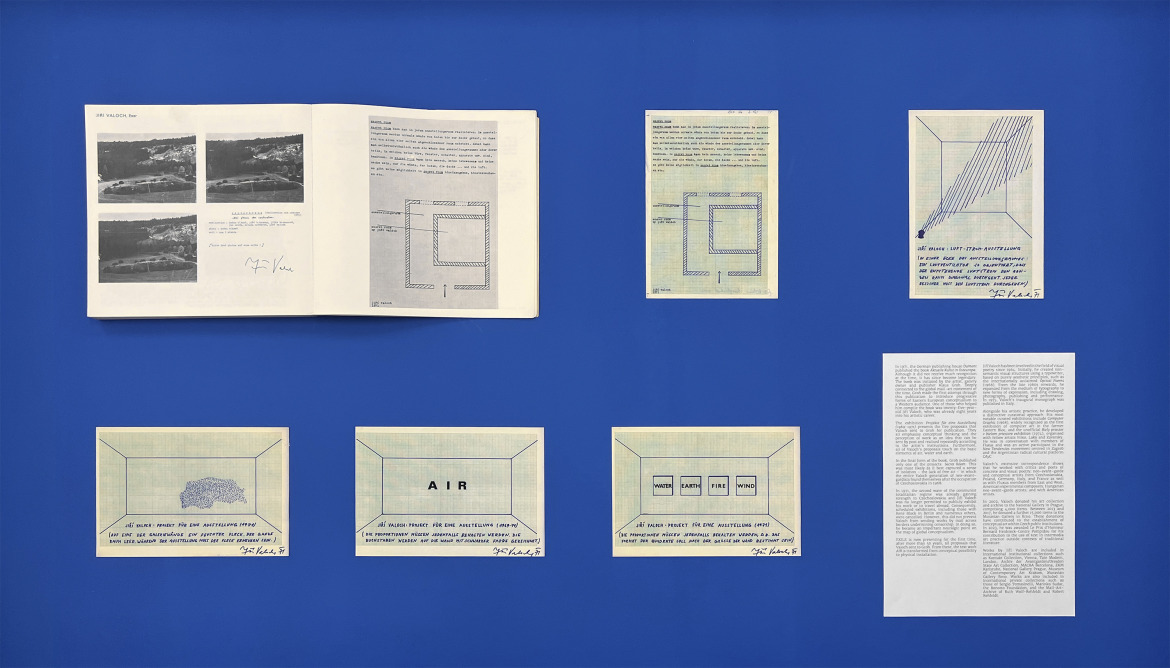
The exhibition Projekt für eine Ausstellung (1969-1971) presents the five proposals that Valoch sent to Groh for publication. They all emphasise conceptual thinking and the perception of work as an idea that can be sent by post and realised repeatedly according to the artist’s instructions. Furthermore, all of Valoch’s proposals touch on the basic elements of air, water and earth.

In the final form of the book, Groh published only one of the projects: Secret Room. This was most likely as it best captured a sense of isolation – the lack of free air – in which the entire Valoch generation of neo-avant-gardists found themselves after the occupation of Czechoslovakia in 1968.

In 1971, the second wave of the communist totalitarian regime was already gaining strength in Czechoslovakia and Jiří Valoch was no longer permitted to publicly exhibit his work or to travel abroad. Consequently, scheduled exhibitions, including those with René Block in Berlin and numerous others, were cancelled. However, this did not prevent Valoch from sending works by mail across borders undermining censorship. In doing so, he became an important neuralgic point on the map of global conceptualism.

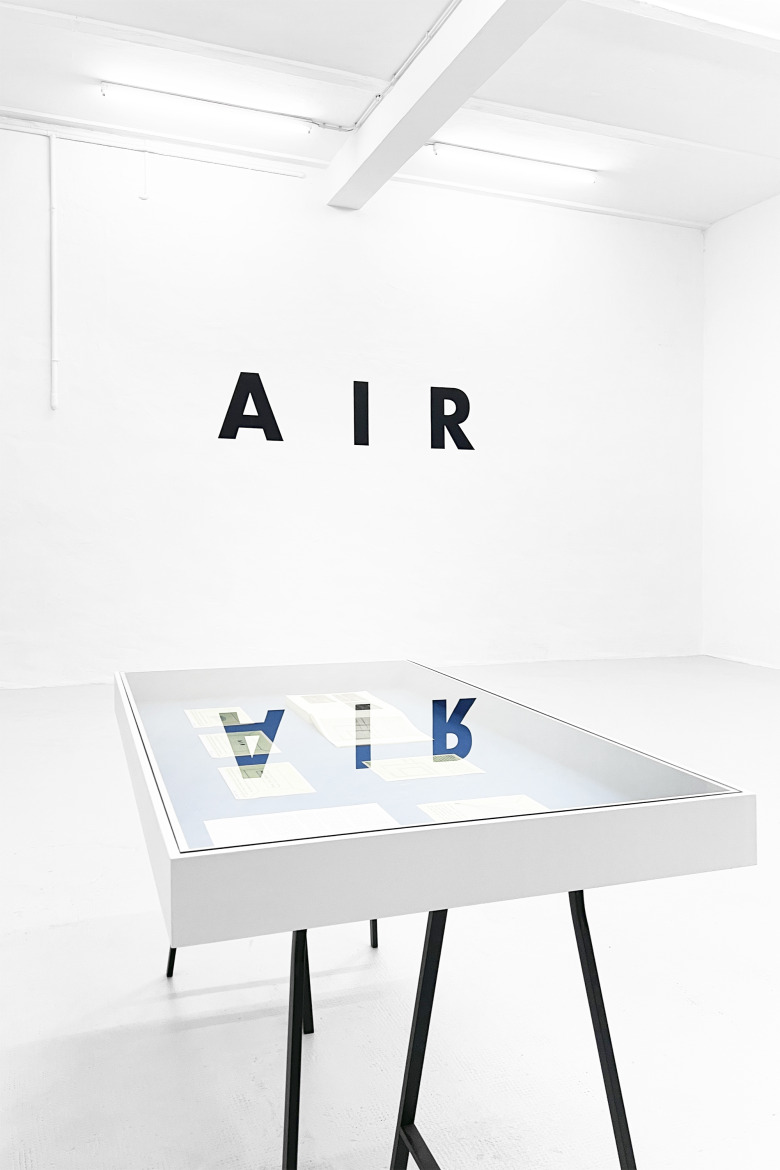
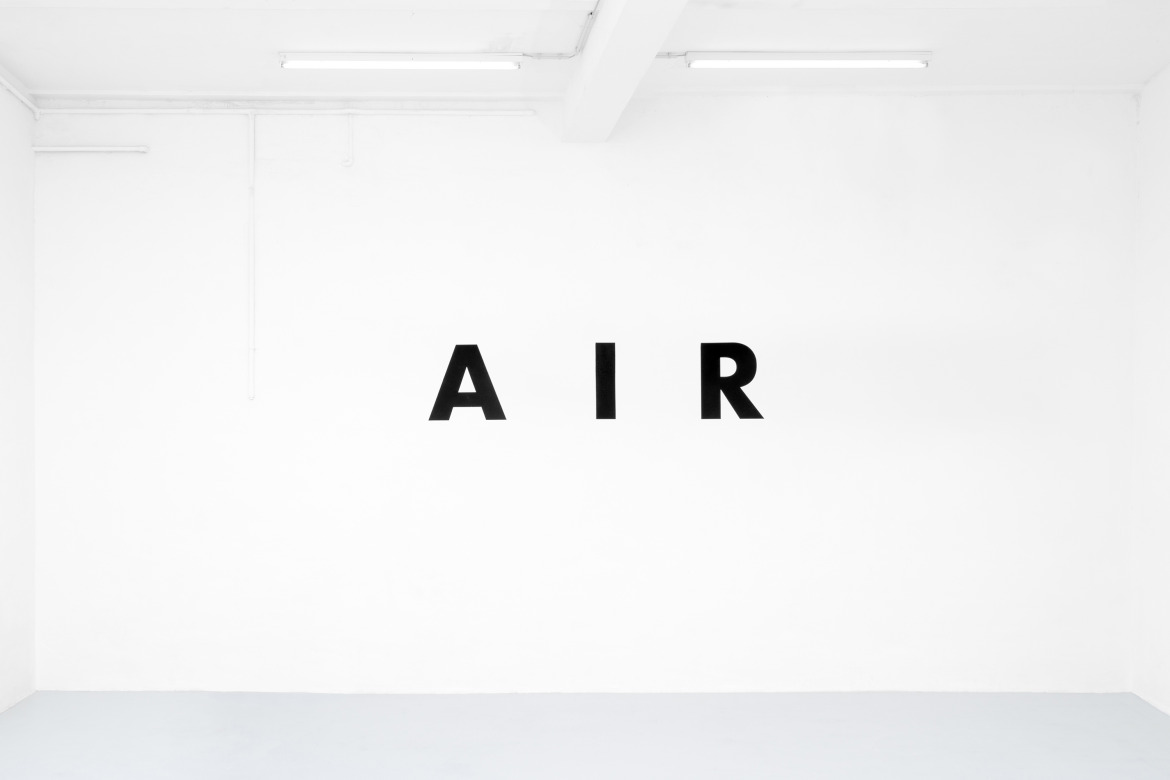
EXILE is now presenting for the first time, after more than 50 years, all proposals that Valoch sent to Groh. From these, the text work AIR is transformed from conceptual possibility to physical installation.

Jiří Valoch has been involved in the field of visual poetry since 1964. Initially, he created non-semantic visual structures using a typewriter, based on purely aesthetic principles, such as the internationally acclaimed Optical Poems (1966). From the late 1960s onwards, he expanded from the medium of typography to new forms of expression, including drawing, photography, publishing and performance. In 1975, Valoch’s inaugural monograph was published in Italy.

Alongside his artistic practice, he developed a distinctive curatorial approach. His most notable curated exhibitions include Computer Graphic (1968), widely recognised as the first exhibition of computer art in the former Eastern Bloc, and the unofficial Biely priestor v bielom priestore exhibition (1974), organised with fellow artists Filko, Laky and Zavarsky. He was in conversation with members of Fluxus and was an active participant in the New Tendencies movement centred in Zagreb and the Argentinian radical cultural platform CAyC.

Valoch’s extensive correspondence shows that he worked with critics and poets of concrete and visual poetry; neo-avant-garde and conceptual artists from Czechoslovakia (theoretician Jindřich Chalupecký, artists Jan Steklik, Jiří H. Kocman, Alex Mlynarčik, Stano Filko, Rudolf Sikora, Július Koller, Karel Adamus, Milan Grygar, Petr Štembera, Milan Knižák, Jan Wojnar, Zdeněk Barborka, Ivan M. Jirous, Jiří Kolar, Ladislav Novák, and Jaroslav Malina), Poland (Andrzej Lachowicz, Natalia LL, and Henryk Stażewski), Germany (Bernard Heidsieck, Ferdinand Kriwet, along with theoretician Max Bense), Italy (Adriano Spatola and Ugo Carrega), and France (Pierre Garnier and Henri Chopin); with Fluxus members from East and West; American experimental composers (Steve Reich); Hungarian neo-avant-garde artists (Tamàs Szentjóby/St. Auby, Endre Tót, and Imre Bak); and with American artists (Christo, Allan Kaprow, and Seth Siegelaub).

In 2002, Valoch donated his art collection and archive to the National Gallery in Prague, comprising 4,000 items. Between 2013 and 2017, he donated a further 15,000 items to the Moravian Gallery in Brno. These donations have contributed to the establishment of conceptual art within Czech public institutions. In 2023, he was awarded Le Prix d’Honneur Bernard Heidsieck-Centre Pompidou for his contribution to the use of text in intermedia art practice outside contexts of traditional literature.

Works by Jiří Valoch are included in international institutional collections such as Kontakt Collection, Vienna, Tate Modern, London, Archiv der Avantgarden/Dresden State Art Collection, MACBA Barcelona, ZKM Karlsruhe, National Gallery Prague, Museum of Contemporary Art Krakow, Moravian Gallery Brno. Works are also included in international private collections such as those of Sergio Tomasinelli, Marinko Sudac, the Bonotto Foundation, and the Mail-Art-Archive of Ruth Wolf-Rehfeldt and Robert Rehfeldt.

The exhibition is organised in collaboration with Jana Písaříková and Ondřej Chrobák, Moravian Gallery, Brno and Anna Ebner-Quadri, and the editions, Vienna. We cordially like to thank the Archiv der Forschungsstelle Osteuropa an der Universität Bremen, Osteuropasammlung Klaus Groh for supporting the exhibition.

Wohin am Wochenende, Monopol Magazine, September, 25, 2025 (PDF, 1.6 MB)

String Constructions, 117 Hester Street, 1972-73

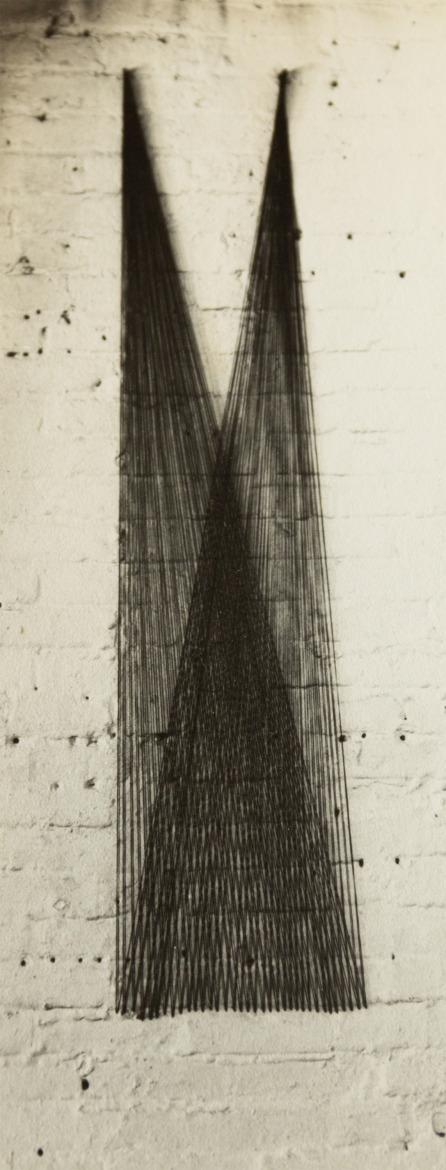
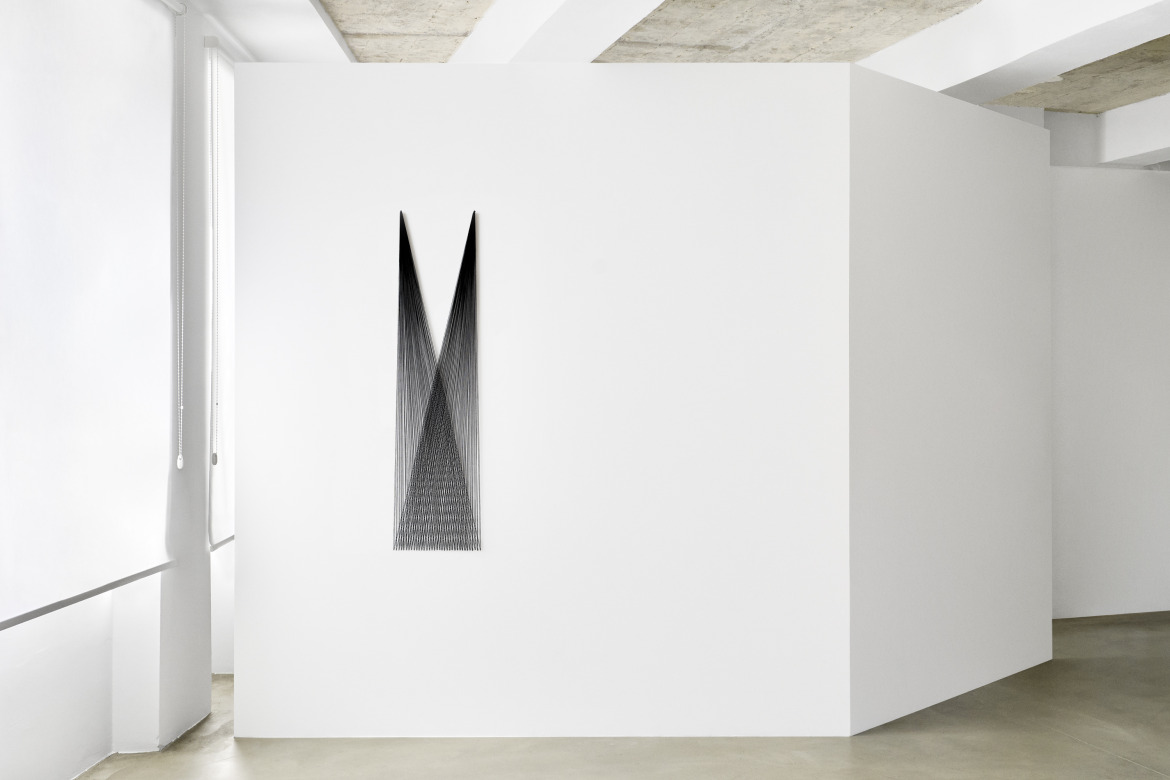
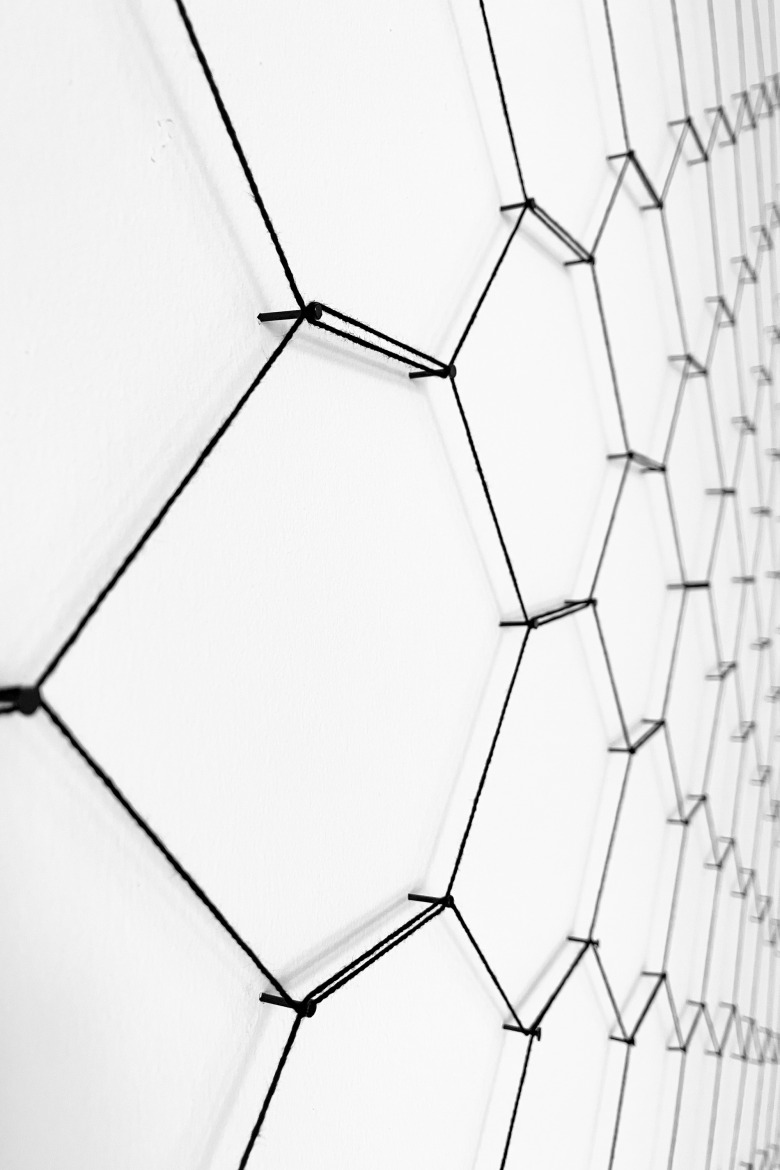
EXILE is pleased to present a research exhibition of Kazuko Miyamoto’s early string constructions in Berlin. These early works are transitional in many ways, and their relationship to Minimalism, as experienced through her predominantly male peers, contrasts with her later presentations as a member of the women’s art collective, A.I.R.. The three String Constructions on display were last installed in 1972–73 in Miyamoto’s studio building at 117 Hester Street in New York and present a pivotal transition from the pictorial plane to early wall-based spatial constructions.

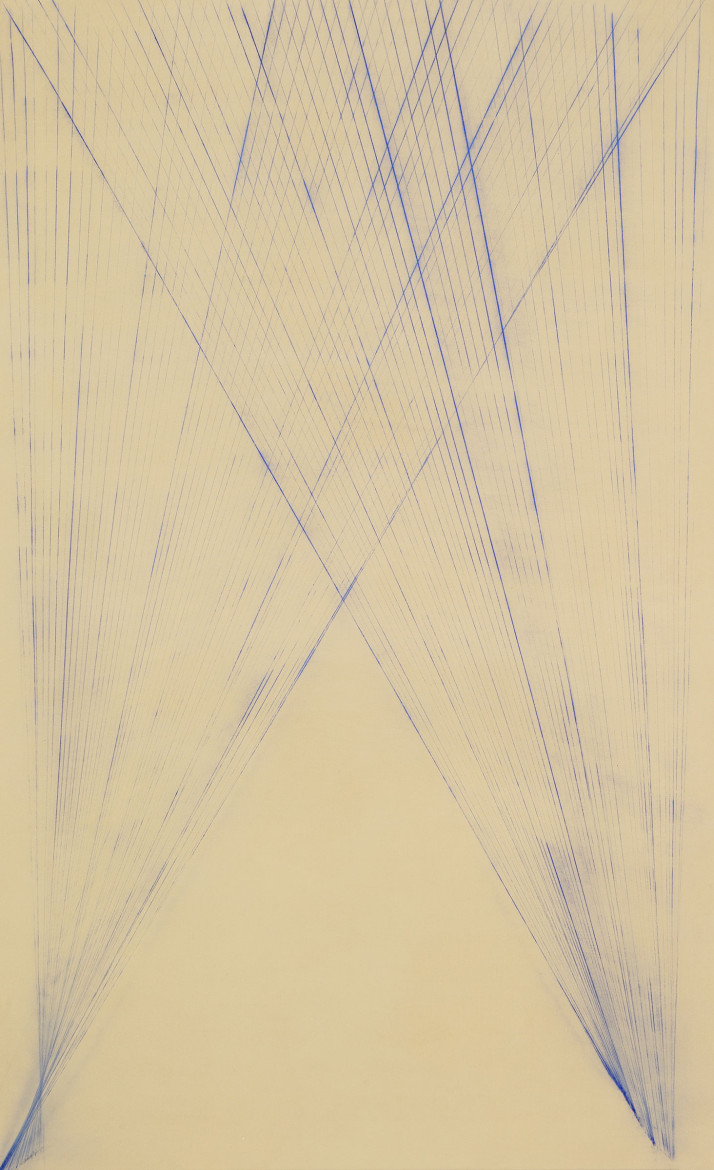
Following a brief period of painting (1969–1972), Miyamoto began to create ephemeral, wall-based works using only industrial nails and readily available cotton string. One of Miyamoto’s final paintings, Chalkline Drawing (blue) (1972), is a large-scale, vertical, subtle, yellow monochrome canvas upon which the artist applied the type of blue chalk line frequently used by bricklayers or construction workers to create geometric, straight lines on walls. Although the string itself is not (yet) present, its imprints create two overlapping fan-like triangular shapes that open from the bottom edges of the painting towards its top centre, breaking up the otherwise monochrome surface. This painting marks the end of Miyamoto’s early painting phase, which began in 1969 with the triptych Progression of Rectangles. For Miyamoto, Chalkline Drawing (blue) also marks a departure from producing physical artwork. Subsequently, her works took on an ephemeral quality, only documented in photographs taken in her studio at 117 Hester Street in New York — the same building where artists such as Sol LeWitt, amongst many others, had their studios.

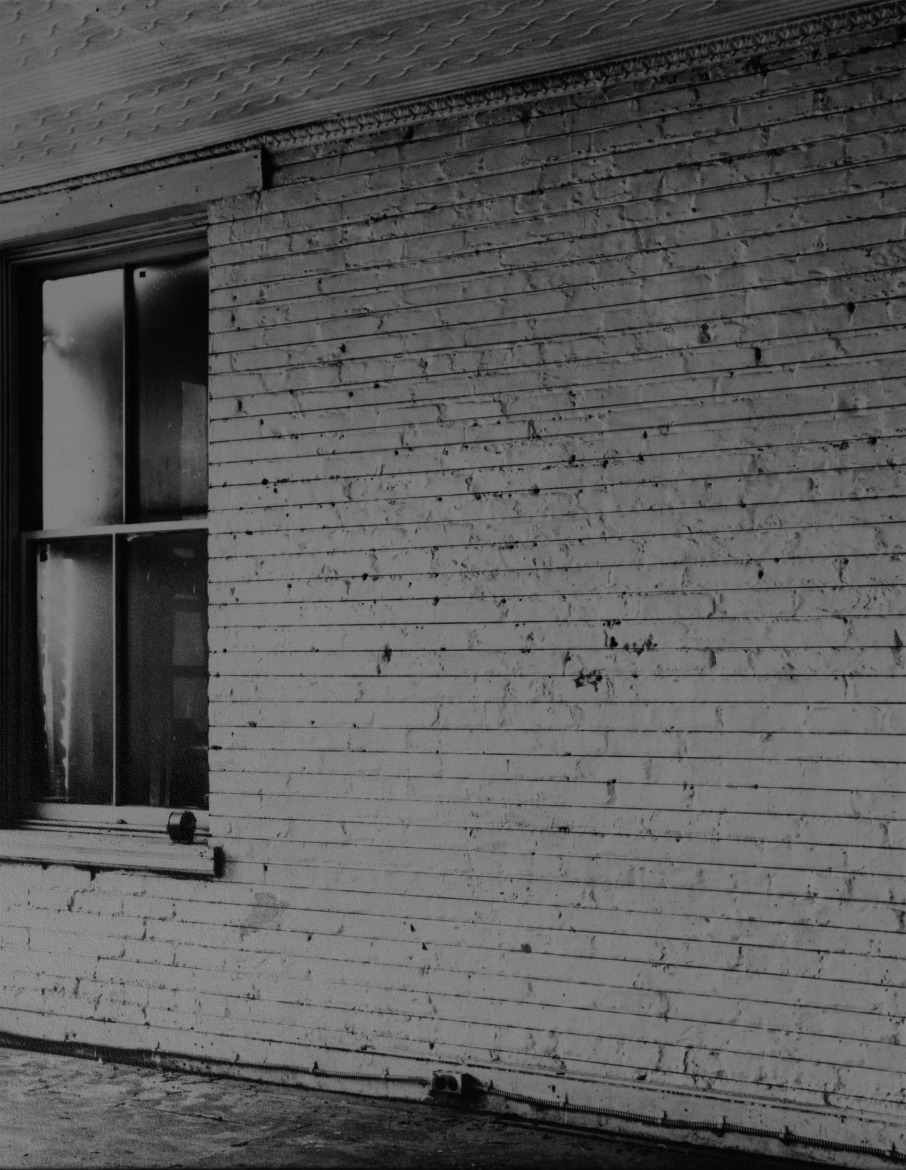
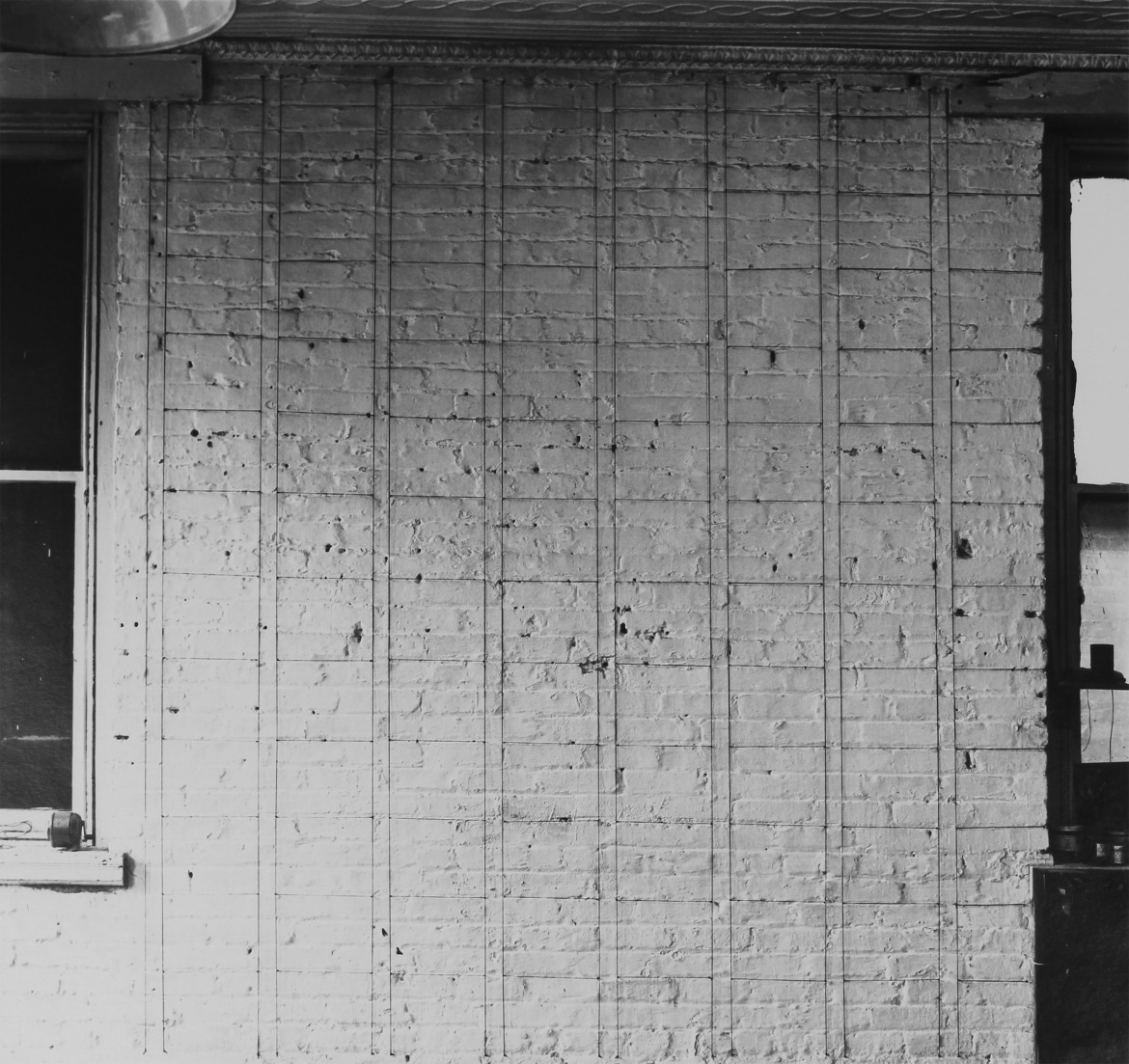
String along mortar line (1972) is often considered to be Miyamoto’s initial string construction. Here, Miyamoto places a nail at each end of the horizontal mortar lines on a wall of her studio and connects the two nails with black string. This essentially creates an architectural measuring tool that is reminiscent of the chalk line used previously. However, in this case, the string itself appears as the final result, without the performative notion of applying colour. The string itself creates a measuring unit along the full length of the studio’s brick wall. Therefore, String along mortar line (1972) has no inherent form and is dependent on the dimensions and materiality of a chosen brick wall.

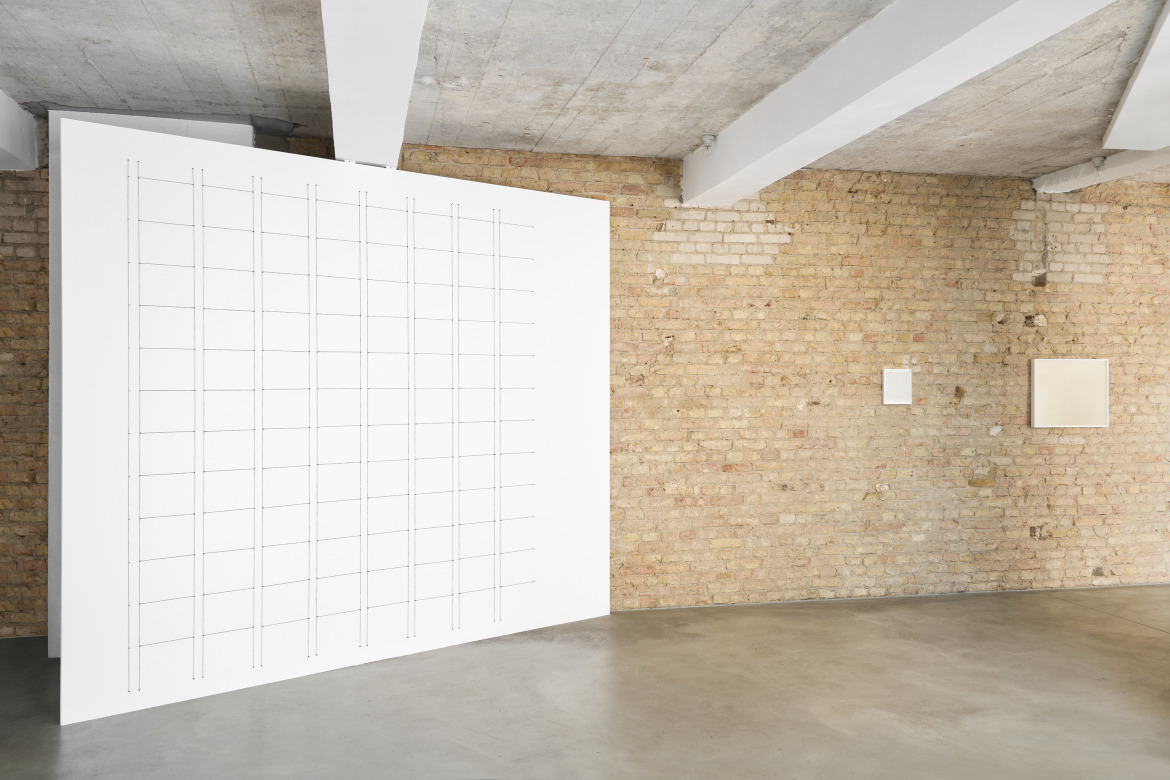
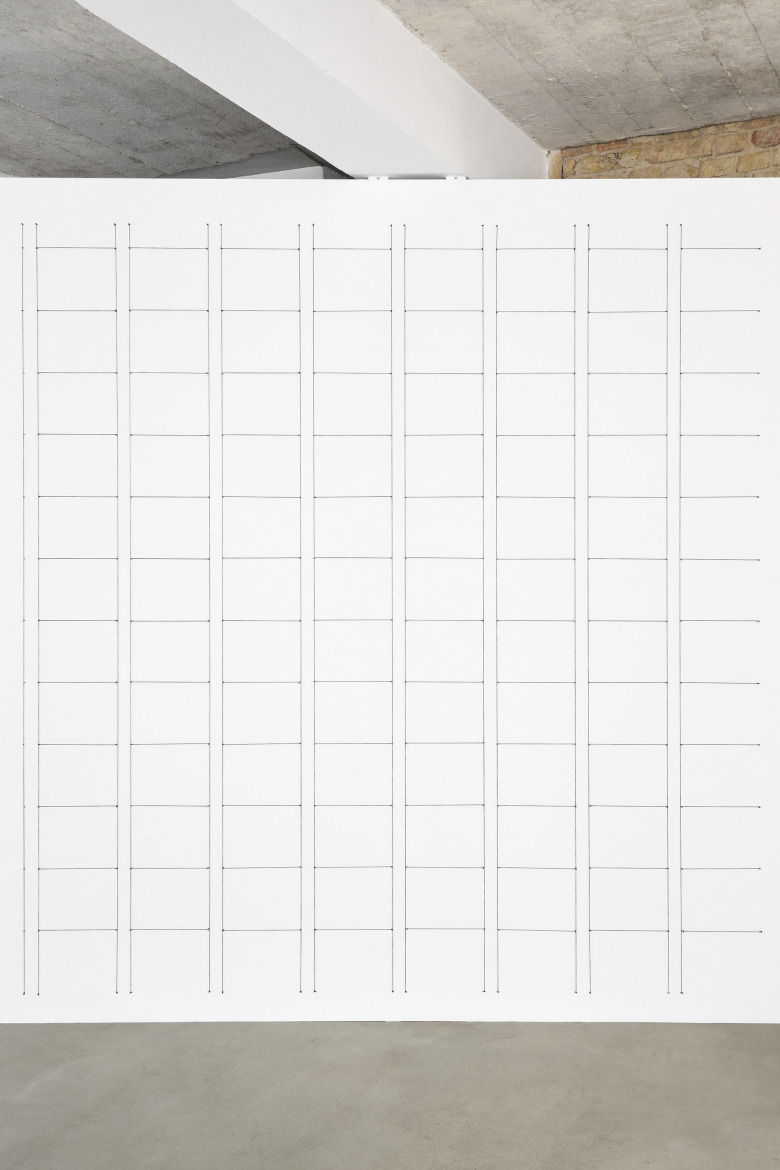
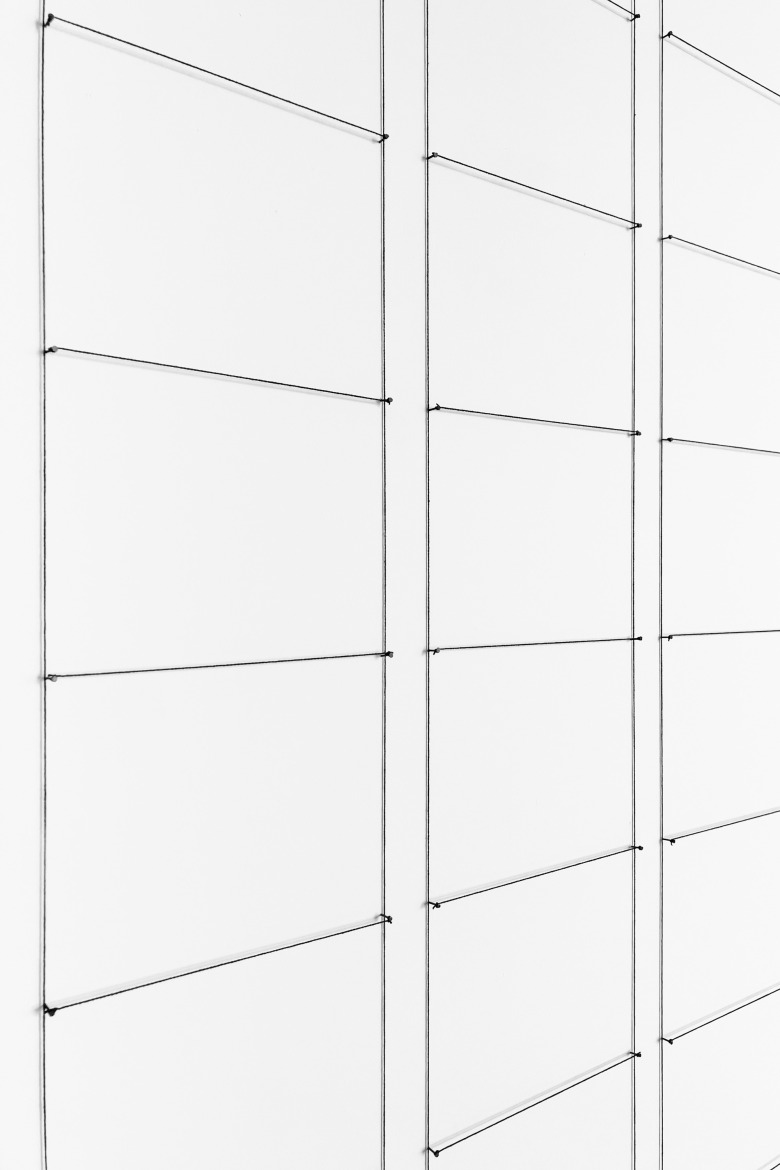
Consequently, the three string constructions on display stem from the work String along mortar Line (1972) and showcase three geometric motifs that were potentially explored consecutively. Untitled (1972) rotates the horizontal lines of String along mortar Line (1972) by 90 degrees, connecting the top and bottom mortar lines of the studio wall with vertical strings with their distance to each other referring to the horizontal dimension of the bricks. A grid of nails connected with shorter horizontal strings sits in-between these vertical lines, adding a second layer and spatial dimension to the work. The horizontal and vertical layers are independent of one another, with no nail being used twice. Furthermore, the vertical strings are positioned at the bottom of the nail and recede from the horizontal lines that are positioned at the top of a nail. Collectively, the vertical and horizontal lines form spatial squares that appear to be floating on top of the wall itself. When viewing this string construction from a distance, it becomes evident that the first vertical line is doubled – or the final vertical line is missing leaving the final squares unclosed. The result is an open system with an almost filmic appearance of pattern running endlessly across a plane. This infinite quality is also evident in the second piece on display, which is also from 1972.

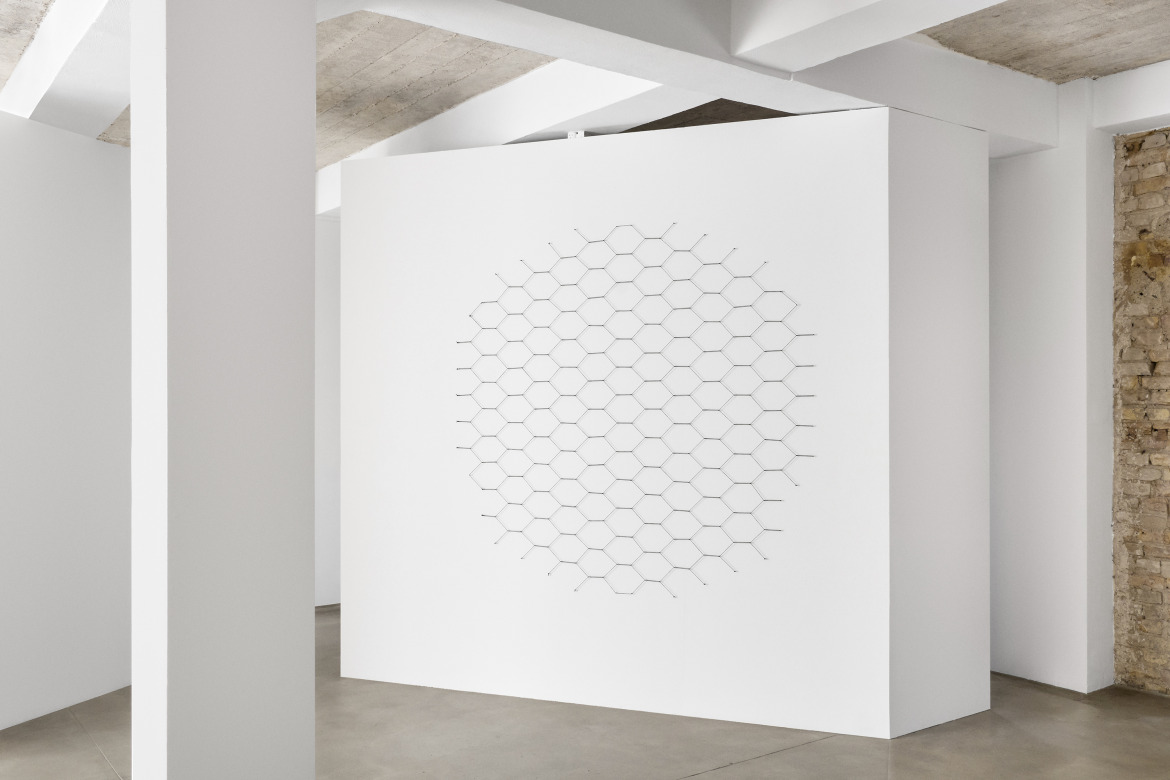
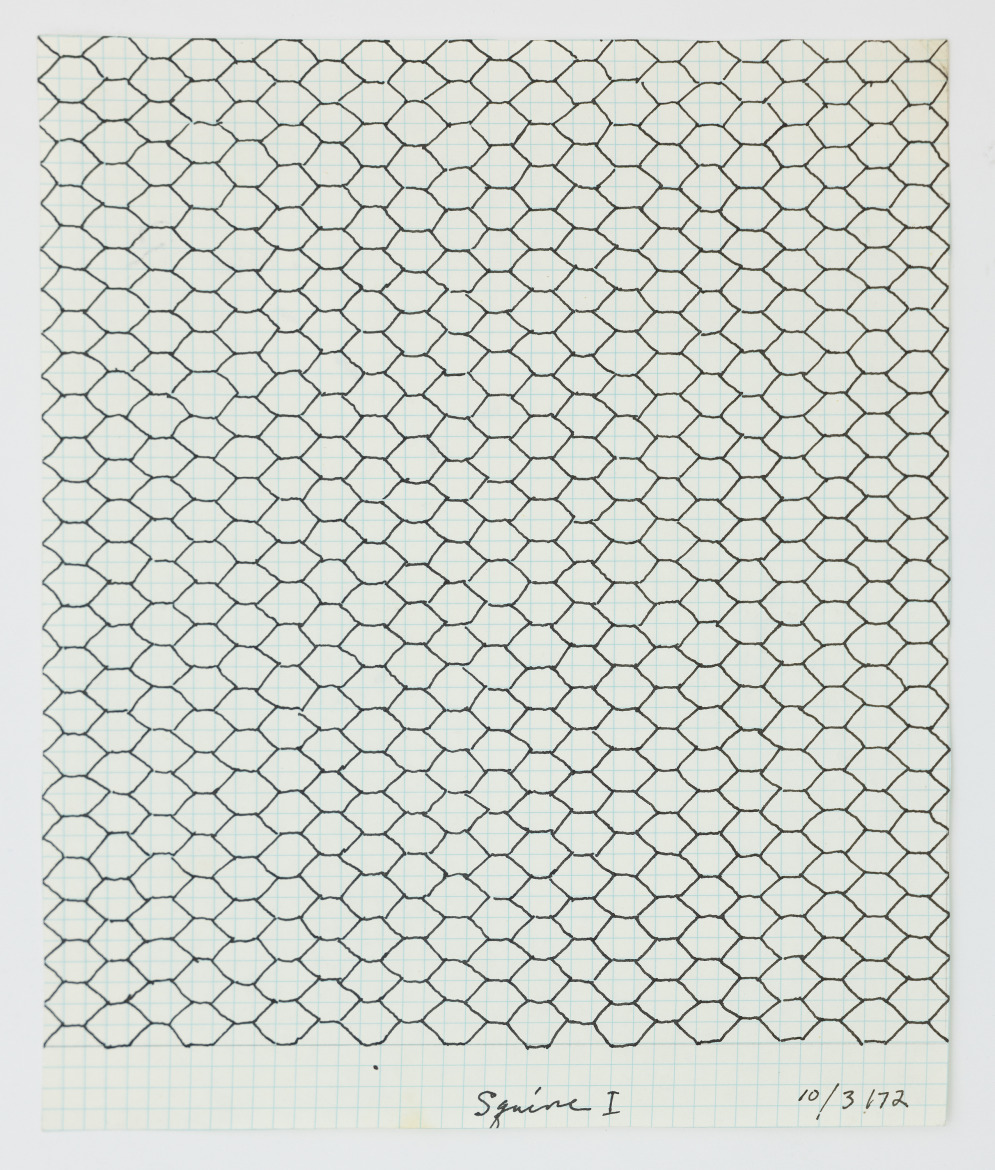
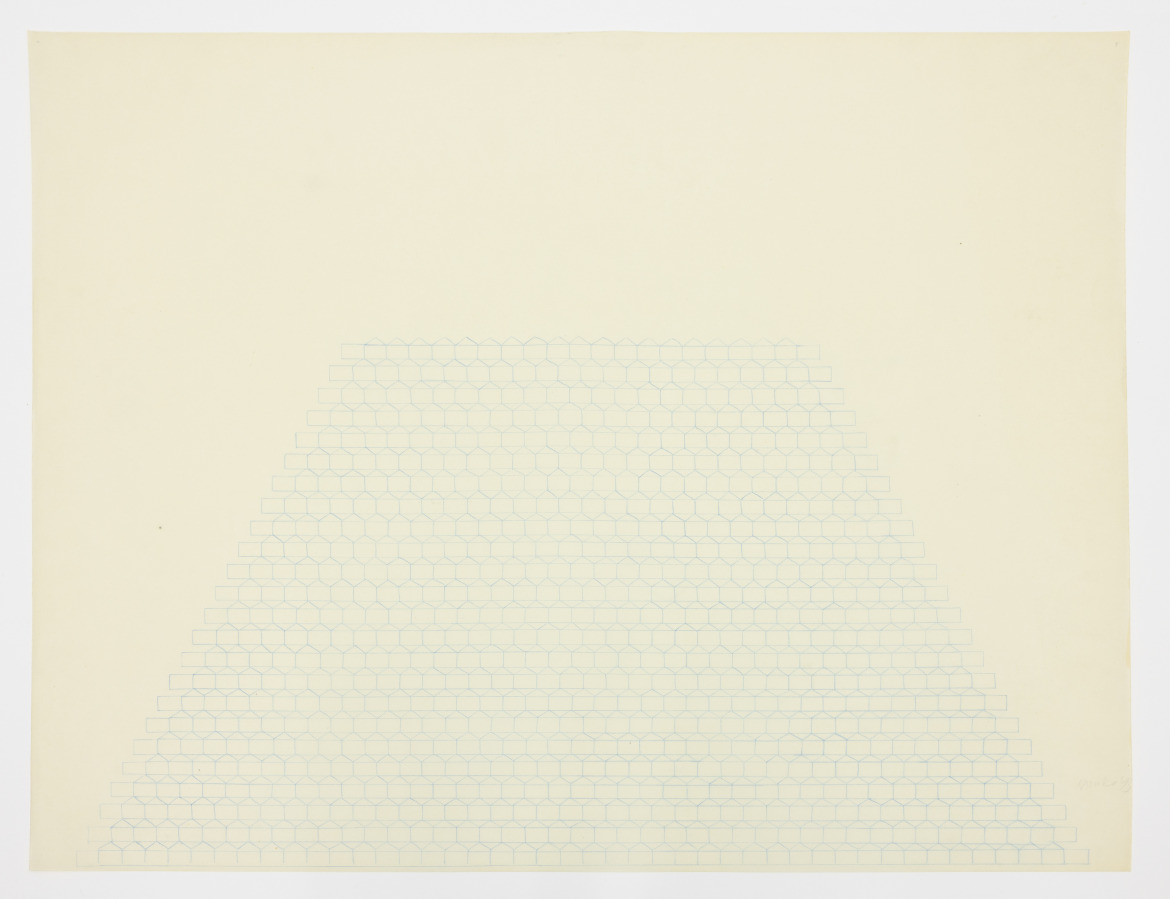
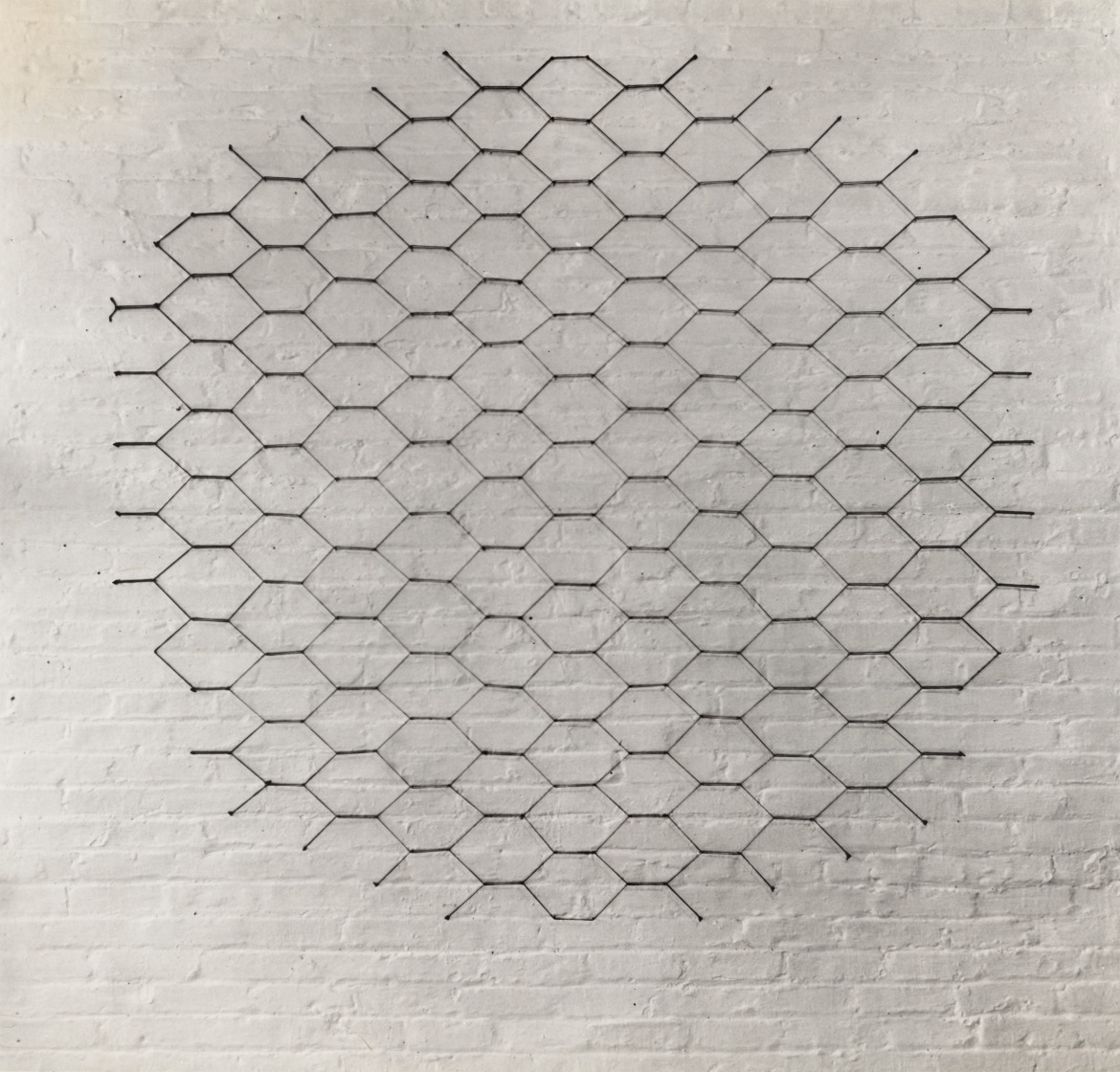
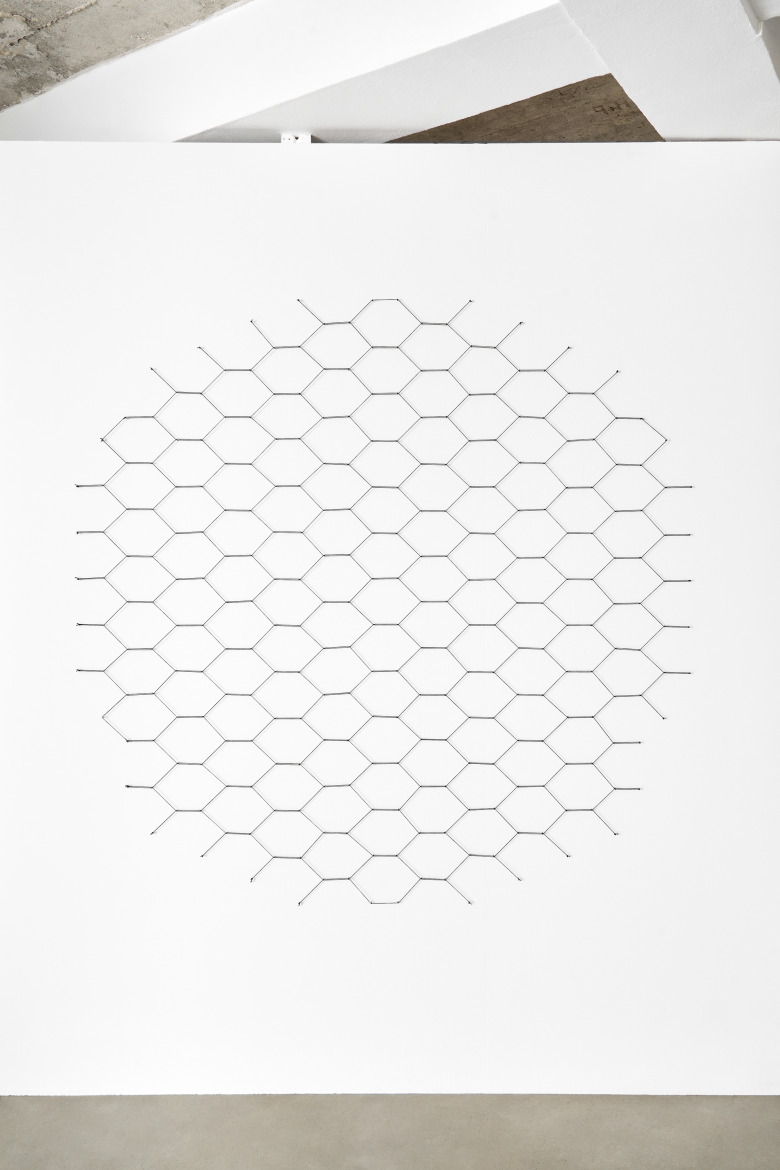
Dated October 3, 1972, the drawing Squire I shows Miyamoto combining vertical and 45-degree angled lines, reminiscent of a hexagonal honeycomb or cell-like structure. This geometric motif is then transferred to the second string construction on display, also entitled Untitled (1972). Here the strings double within the horizontal parts of each cell. The parallelism of the two horizontal strings accentuates the appearance of different line thicknesses. Once again, Miyamoto leaves the geometry of the work open-ended, with the hexagons remaining incomplete at the edges of the pattern, as if in anticipation of viral expansion. In both Untitled pieces, Miyamoto creates open and expansive patterns that suggest rhythm or progression, rather than finite shapes.

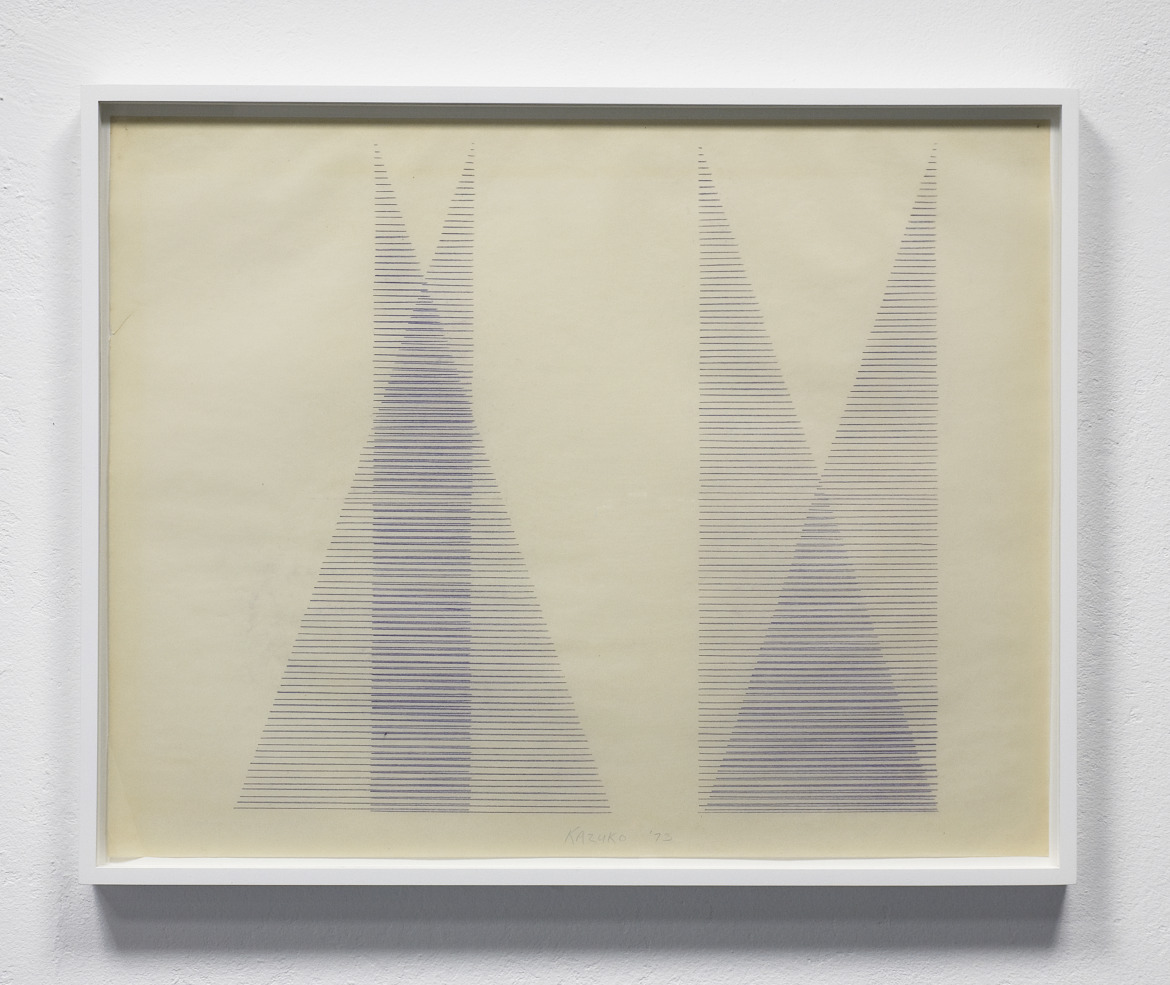
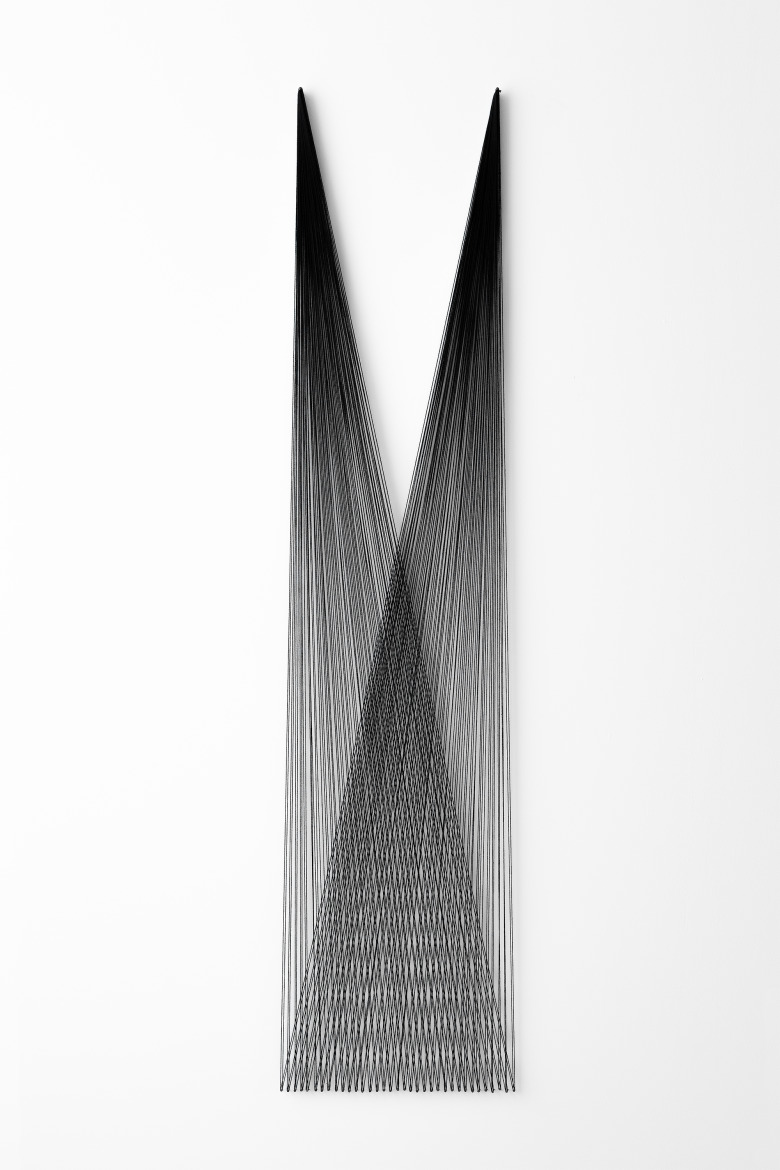
Eventually, in 1973, a new geometric motive appears. This would become essential to Miyamoto’s later, increasingly complex and spatial explorations. Many drawings from the time show Miyamoto moving towards triangular shapes, enhancing the visual as well as physical connection between individual strings. In the third exhibited string construction, Untitled (1973), Miyamoto creates two overlapping triangles that share a bottom row of nails, with each of the triangluar shapes referring back and forth to a solitary nail at the top. The result is an amplified spatial density. To further enhance this density, Miyamoto simultaneously uses two parallel strings on each side of a nail, creating a rich criss-crossing of lines and shapes. The juxtaposition of the two triangular forms now appears less geometric, bearing a stronger resemblance to a woven pattern. Created in the same year as her first major solo exhibition at 55 Mercer Street Gallery, Untitled (1973) lays the groundwork for her later, iconic, voluminous and spatial String Constructions. These constructions break free from their essential relationship with the grid of the brick wall in favour of independent volumes.

By expanding beyond the limitations of the painterly plane, these early String Constructions build upon the artist’s previous painting practice. While the two String Constructions from 1972 are still defined by the architectural pattern of the studio walls and brick dimensions inside 117 Hester Street, Untitled (1973) takes greater liberties, replacing previous geometric reference with a freer, more physical and expressive form. Gradually, the initial close spatial and conceptual relationship to the site gives way to Miyamoto’s larger, three-dimensional explorations. This process accelerates significantly when Miyamoto becomes a member of the women artists’ collective A.I.R. in 1974.

Curated by Christian Siekmeier.

Kazuko Miyamoto, String Constructions, KW Berlin, opening Oct 30, 2025

Works from Suitcases

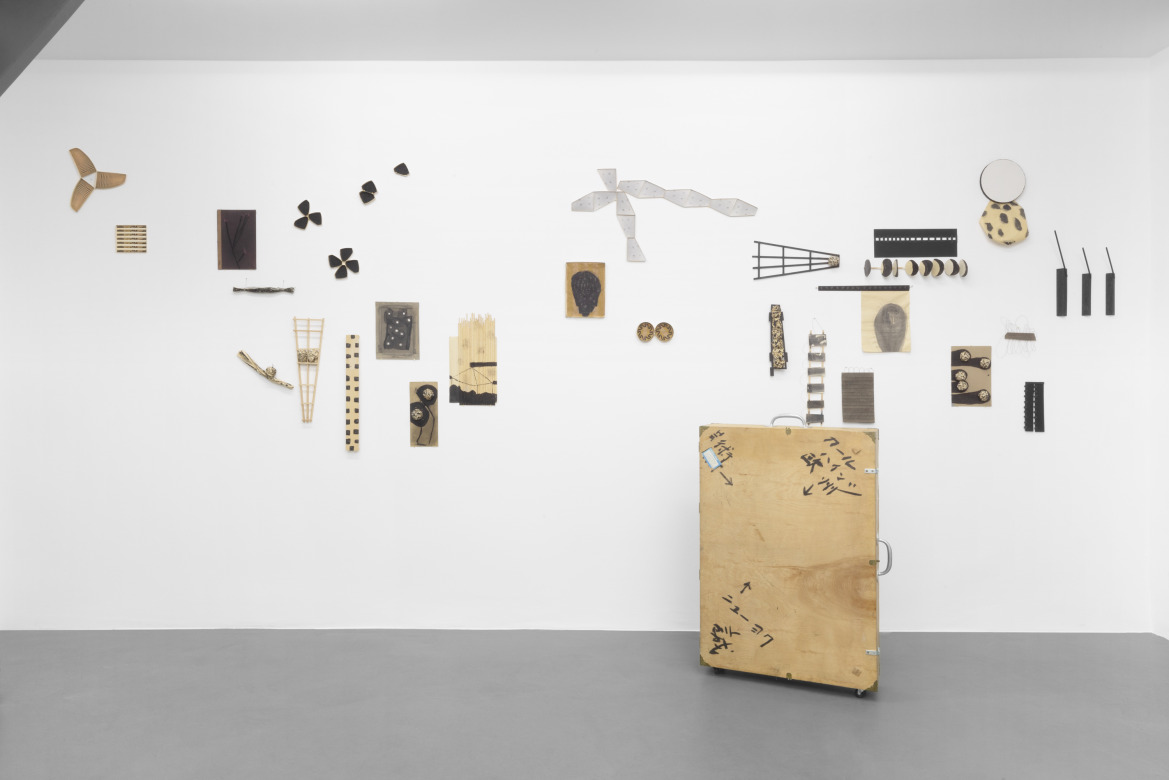
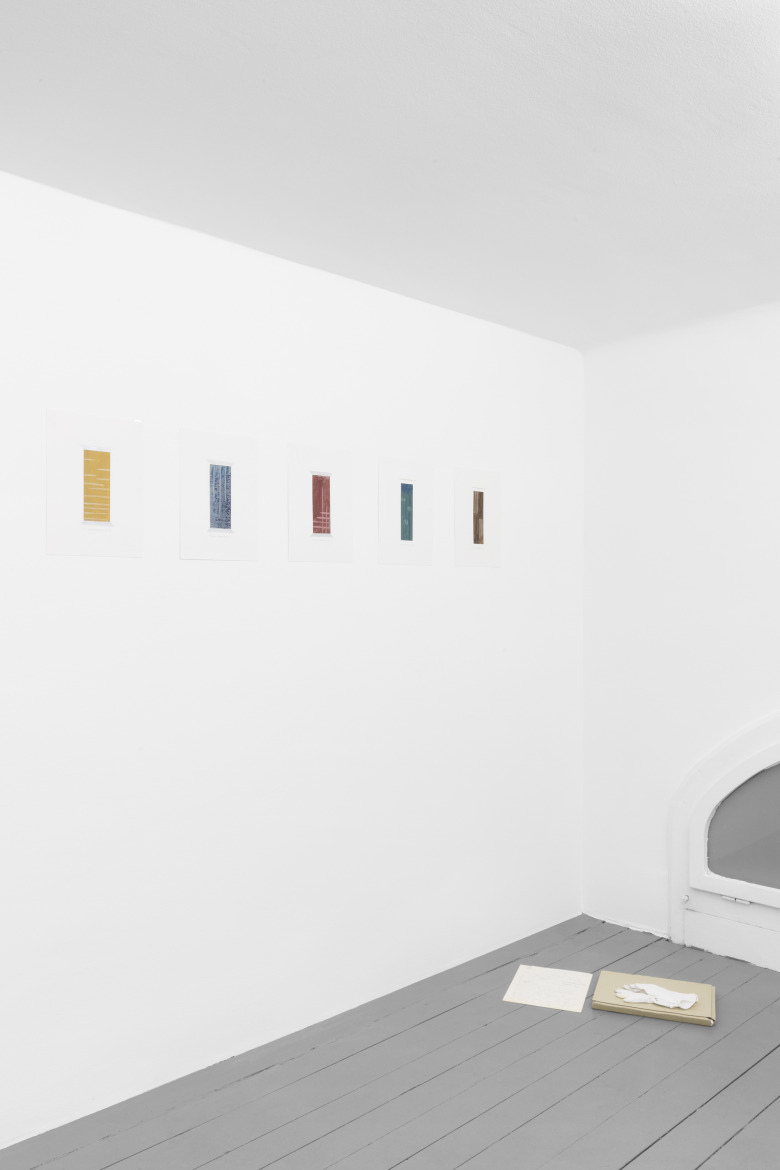
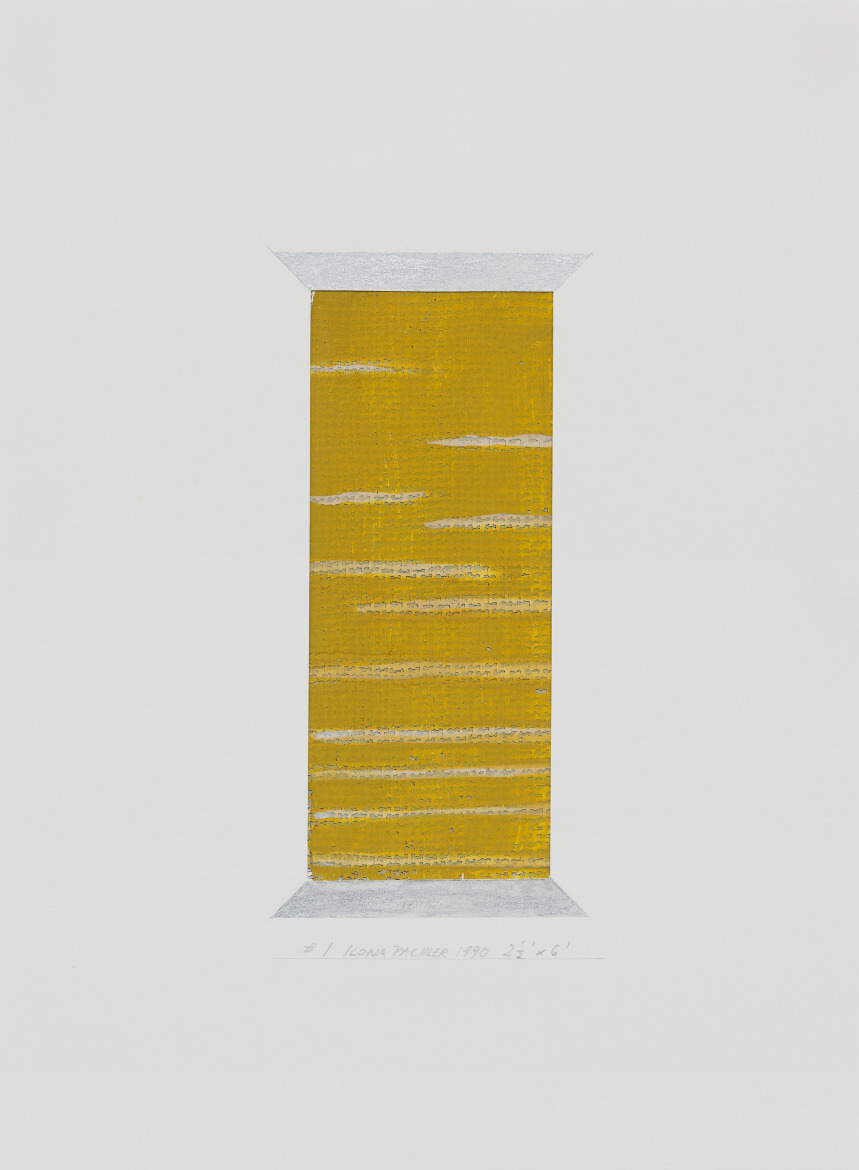
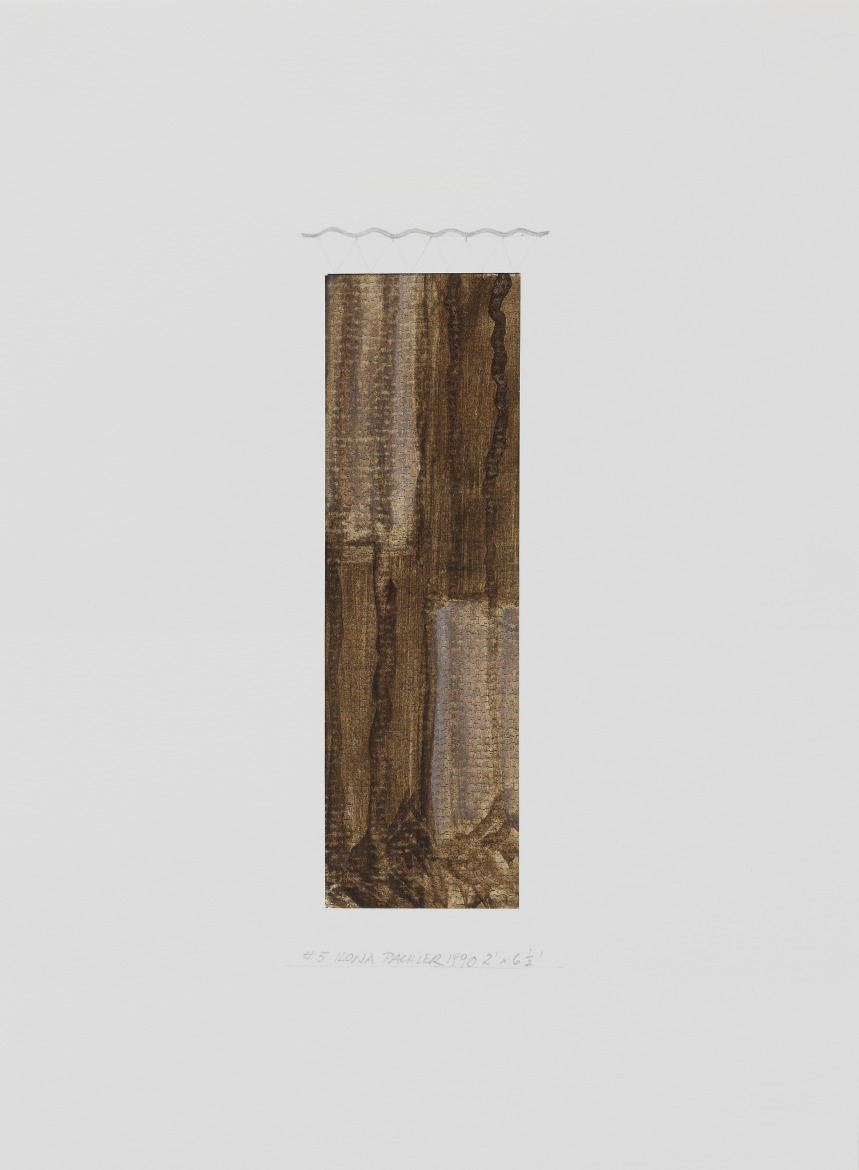
Concurrent to Kazuko Miyamoto’s retrospective exhibition on view at Belvedere 21 in Vienna until March 2025, Works from Suitcases presents a first, introductory insight into the creative exchange initiated by Kazuko Miyamoto in New York, and Paul Fischnaller in Linz, Austria. From the mid 1980s, Miyamoto’s loft, her community art space Gallery Onetwentyeight, and Fischnaller’s alternative art space Hofkabinett provided the locations for a flourishing artist exchange. Works from Suitcases takes its title from the eponymous exhibition held at Hofkabinett in 1987 and focuses on the initial exchanges until 1990. Rarely, or even previously unseen artworks by Austrian artists Peter Hauenschild, Karl-Heinz Klopf, Ilona Pachler, and Othmar Zechyr are exhibited alongside video documentation by Markus Fischer as well as a music video by the Austrian pop band Die Mollies. A collection of recently uncovered mid 1980s slides taken by Miyamoto of the Lower East Side give an insight into time and location.

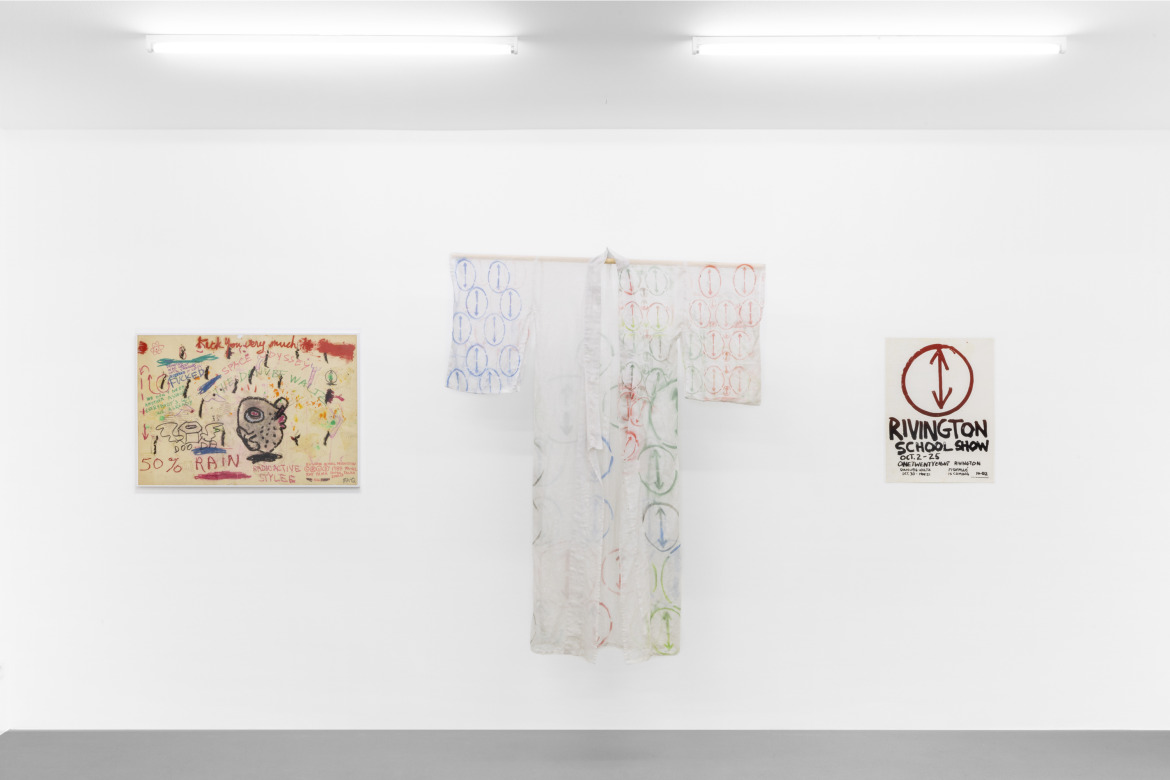
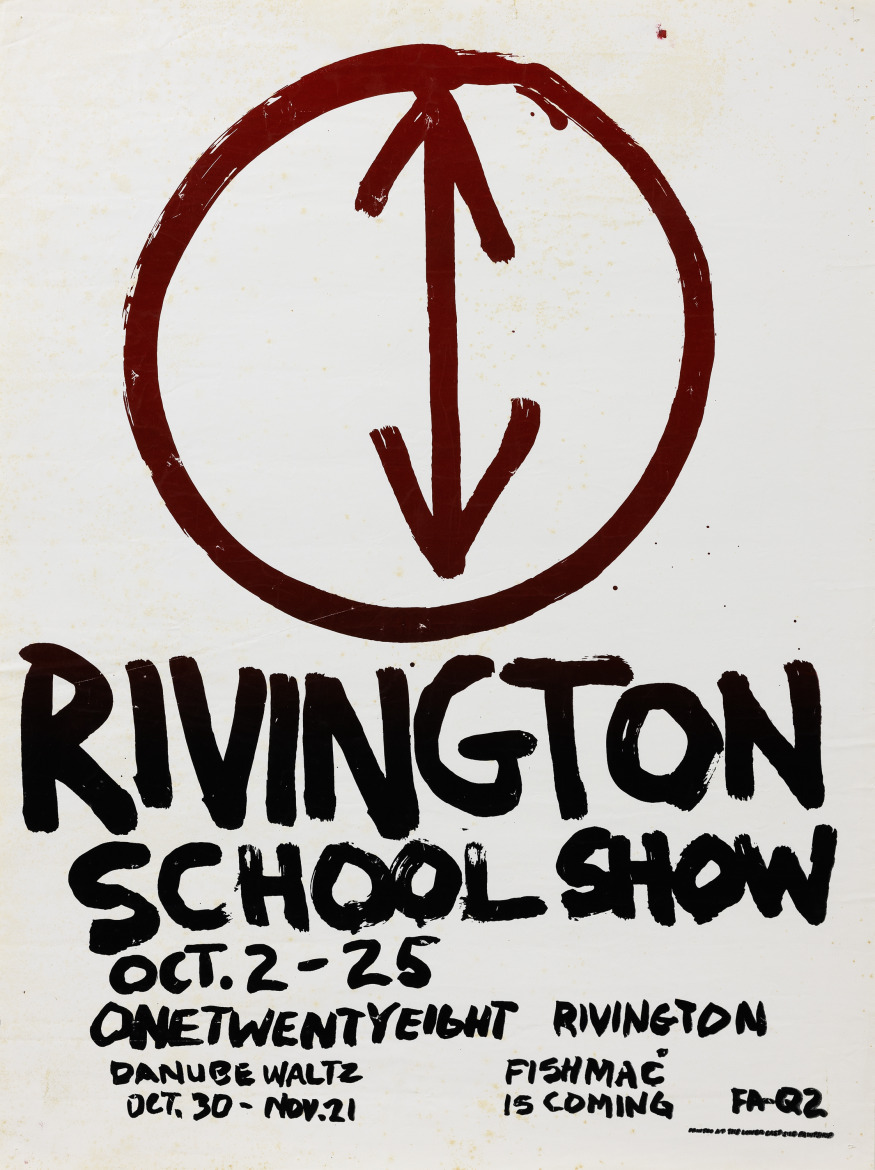
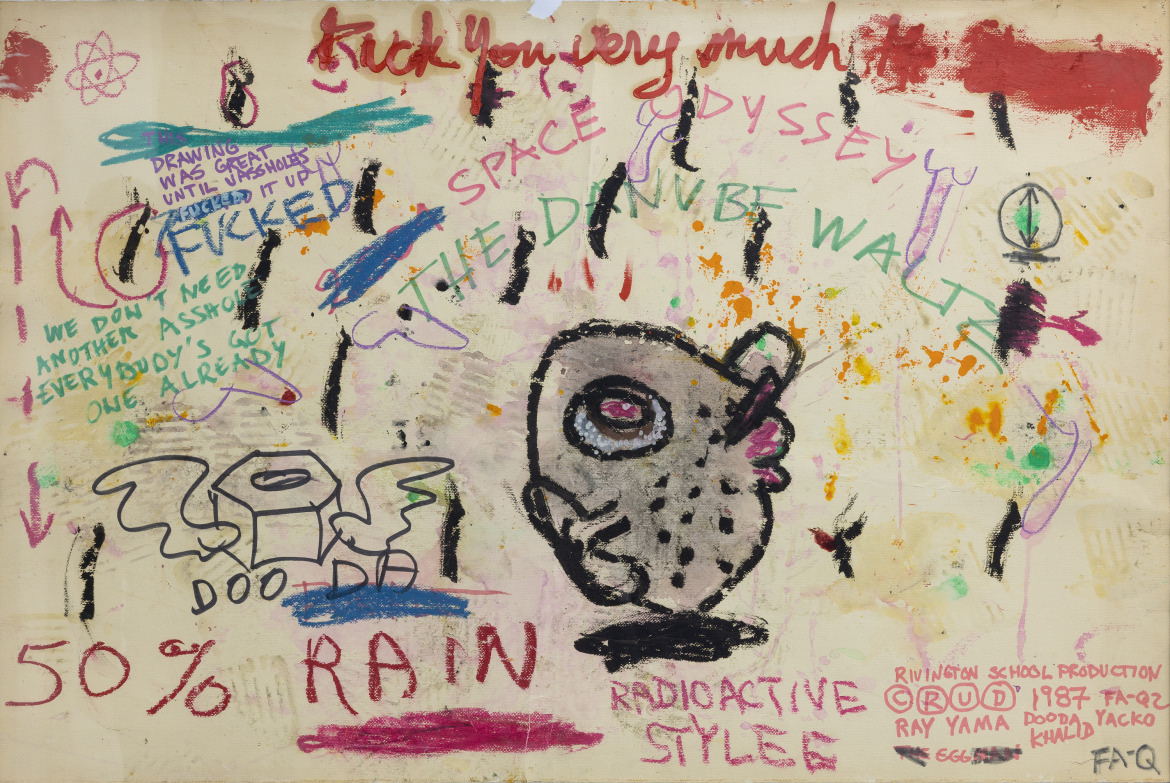
While being the unrivalled centre of the commercial art world, downtown Manhattan and especially the Lower East Side provided space for an immense variety of alternative creative venues ranging from the infamous CBGB, where Die Mollies performed in 1987, to art spaces such as ABC No Rio, No Se No, and from 1986, Miyamoto’s own Gallery onetwentyeight. Some of the exhibited works are by, or in reference to, the Rivington School, an alternative artist group founded in 1983. Predominantly involved in immersive social practices such as large-scale, waste-metal sculpture, performance or street painting the Rivington School fostered an artistic practice beyond the limitations of the white cube and deliberately integrated itself into the local neighbourhood. 

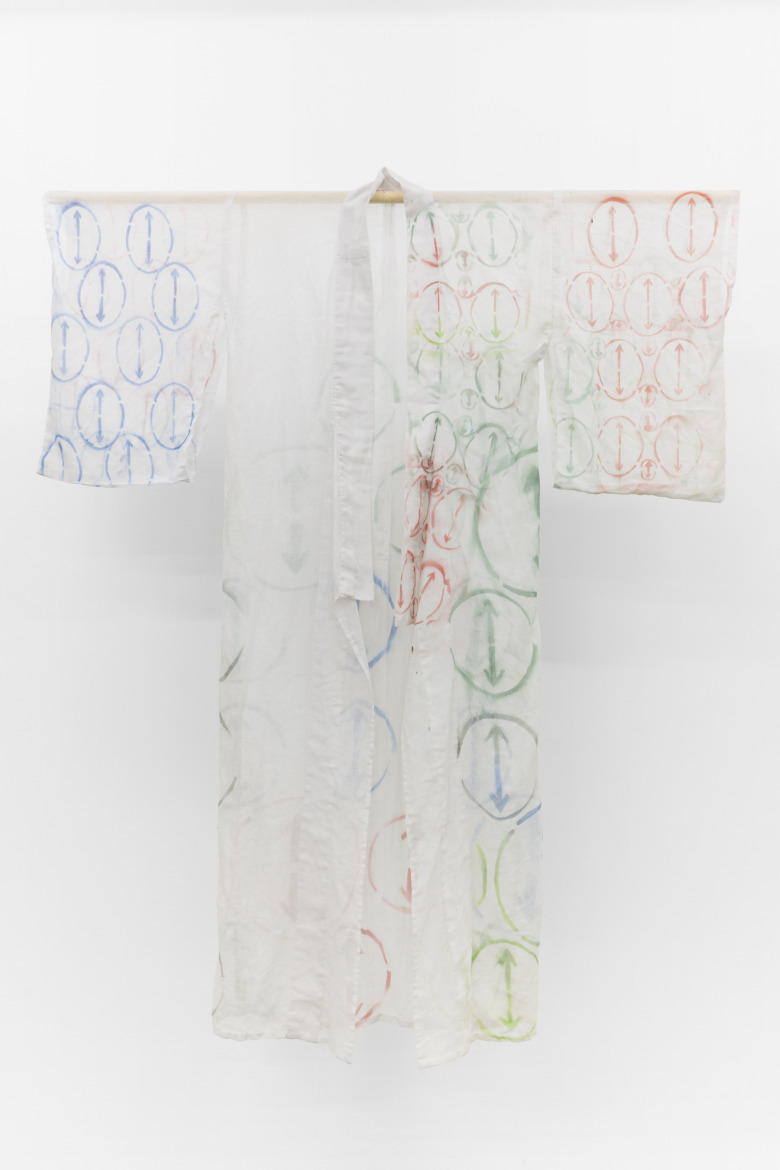
It is no coincidence that Miyamoto opened her own art space in 1986 on 128 Rivington Street. Here, she supported not only members of the Rivington School through numerous exhibitions but was able to envision and create her very own, inclusive artistic universe. Being a historically diverse and immigrant-based neighbourhood, Miyamoto identified her own biography, having moved from Tokyo to New York in 1964, with the identity of the Lower East Side and integrated its specifics into numerous of her artworks, some of which, such as the 6 o’clock Kimono are on display in this exhibition with other examples concurrently on display at Belvedere 21. Likewise, some of the exhibited works by Austrian artists were inspired either by Miyamoto’s practice or by other local creative movements.

At the same time in Linz, an alternative art world existed beyond the institutional and often exclusive one found in Austria’s capital Vienna. Artist-to-artist movements, spaces for experimentation and self-organised initiatives paralleled the developments in the Lower East Side, with Fischnaller’s art space Hofkabinett and Miyamoto’s Gallery onetwentyeight sharing many characteristics. Returning to Linz, Miyamoto might have enjoyed the consistency of the artist environment as her own home drastically gentrified becoming financially as well as creatively increasingly inaccessible to expanded creative visions.  

Works from Suitcases gives an initial insight into the activities and results of the early years of this artist exchange between New York and Linz. The exhibition and its set-up should be seen as a tribute to self-organised artist activism and celebrate expanded ideas of creative practice beyond commercial or institutional filtration.

Curated by Christian Siekmeier


Participating artists:

Austrian filmmaker Markus Fischer accompanied Die Mollies to New York in 1987 and filmed video interviews as well as the music video of Hot Love all of which are included in this exhibition.

Paul Fischnaller has been working in the Linz-based art space Hofkabinett since 1982. In 1987 he organised an exhibition of Linz-based artists at Gallery onetwenteight in New York. He is a member of a rock band Die Mollies. 

Peter Hauenschild graduated from Hochschule für künstlerische und industrielle Gestaltung, Linz in 1987. Consequently, he traveled to New York where he stayed with Miyamoto. His work is predominantly based in painting and drawing. As part of the exhibition a set of drawings created in New York and shortly thereafter are on display.

Austrian artist and filmmaker Karl-Heinz Klopf graduated from Hochschule für künstlerische und industrielle Gestaltung, Linz in 1982. During his stay with Miyamoto in 1987 he created a set of miniature works entitled Works for a Suitcase that are included in this exhibition.  

Kazuko Miyamoto, is a New York based artist whose practice emerged from minimalist influences of the 1970s upon which she expanded her oevre across multiple disciplines. Since 1986 she is directing the alternative art space Gallery onetwentyeight in New York. Concurrently to this exhibition Miyamoto is awarded with a retrospective solo exhibition on view at Belvedere 21 in Vienna.

Ilona Pachler graduated from Hochschule für künstlerische und industrielle Gestaltung, Linz in 1981 and consequently moved to New York. She has been engaged with the work of Miyamoto ever since and in 2020 became the artist’s archivist. She is a conceptual artist, living and working in Santa Fe, New Mexico. An unrealised exhibition proposal from 1990 is on display as part of the exhibition. 

Othmar Zeychr studied at the Staatsgewerbeschule, Linz from 1952-53. He predominantly worked with etching or ink on paper. Initiated by Miyamoto, he exhibited at Storefront for Art and Architecture in New York  in 1987. Two ink drawings from the exhibition are on display in this exhibition. 

Rivington School was an alternative artist movement that emerged from the East Village art scene in the 1980s in New York City. The group started in 1983 and named themselves after an abandoned public school house building located on Rivington Street. Their practice focused on street performance, graffiti and large-scale public sculptures.

Die Mollies are a Linz-based music band founded in 1977 that in 1987 performed at CDBG during their stay with Miyamoto in New York. The screened music video of Hot Love was partially filmed on Miyamoto’s roof top.

Gallery Onetwentyeight

Hofkabinett

Kazuko Miyamoto at Belvedere 21 (until March 2, 2025)

Monument Error

Du warst in allem einer ihrer Besten,
erschrocken fühl ich heut mich dir verwandt;
du schwelgtest gerne bei den gleichen Festen
und zogst wie ich oft wochenlang durchs Land.
Es füllte dich wie mich der gleiche Ekel
vor dem Geklügel ohne innern Drang,
vor jedem Wortgekletzel und Gehäkel;
nichts galt dir als der schöne Überschwang.

So zog es dich zu ihnen die marschierten;
wer weiß da, wann du auf dem Weg ins Nichts
gewahr der Zeichen wurdest, die sie zierten?
Du liegst gefällt am Tage des Gerichts.
Ich hätte dich mit eigner Hand erschlagen;
denn unser keiner hatte die Geduld,
in deiner Sprache dir den Weg zu sagen:
dein Tod ist unsre, ist auch meine Schuld.

Ich setz für dich am Abend diese Zeilen,
da schrill die Grille ihre Beine reibt
wie du es liebtest, und der Seim im geilen
Faulbaum im Kreis die schwarzen Käfer treibt.
Daß wir des Tods und Ursprungs nicht vergessen,
wann jeder Brot hat und zum Brot auch Wein,
vom Überschwang zu singen wie besessen,
soll um dich, Bruder, meine Klage sein.

Theodor Kramer: Requiem für einen Faschisten, 1945


Monuments cast shadows, depending on the light and time of day, as much as the course of history, either as hard-edged contrasts or as faint and blurry shapes of fading light and time. Meanings of, and relationships to, particular monuments are in flux alongside socio-political or cultural changes within the society they are embedded in. Old and new discourses, reactions, and conflicts arise around certain personalities on bronze-cast public display while others remain tolerated, ignored or forgotten, often in plain sight.

One such monument, placed on a public square in close proximity to the gallery, throws its shadow onto the exhibition space and becomes the distant anchor around which the works by Zuzanna Czebatul and Jobst Meyer oscillate. The memorial bust in question, positioned less than 200 meters from the gallery on Schillerplatz, was created in 1940 by sculptor Josef Bock and shows the head of the novelist and poet Josef Weinheber.

Weinheber’s blurry image, a side product of the rendering process for Czebatul’s work Untitled (2022), becomes the exhibition’s access point and invisible ghost – on one side asking question about the role, urgency and legitimacy of the specific persona on public display, on the other, broader questions around meaning and handling of static monuments as signs for politically enforced systemic doctrine and dominance in contrast to shifting values in transitional times. Arranged in two rooms, the selected works in the exhibition by Zuzanna Czebatul and Jobst Meyer approach such questions. 

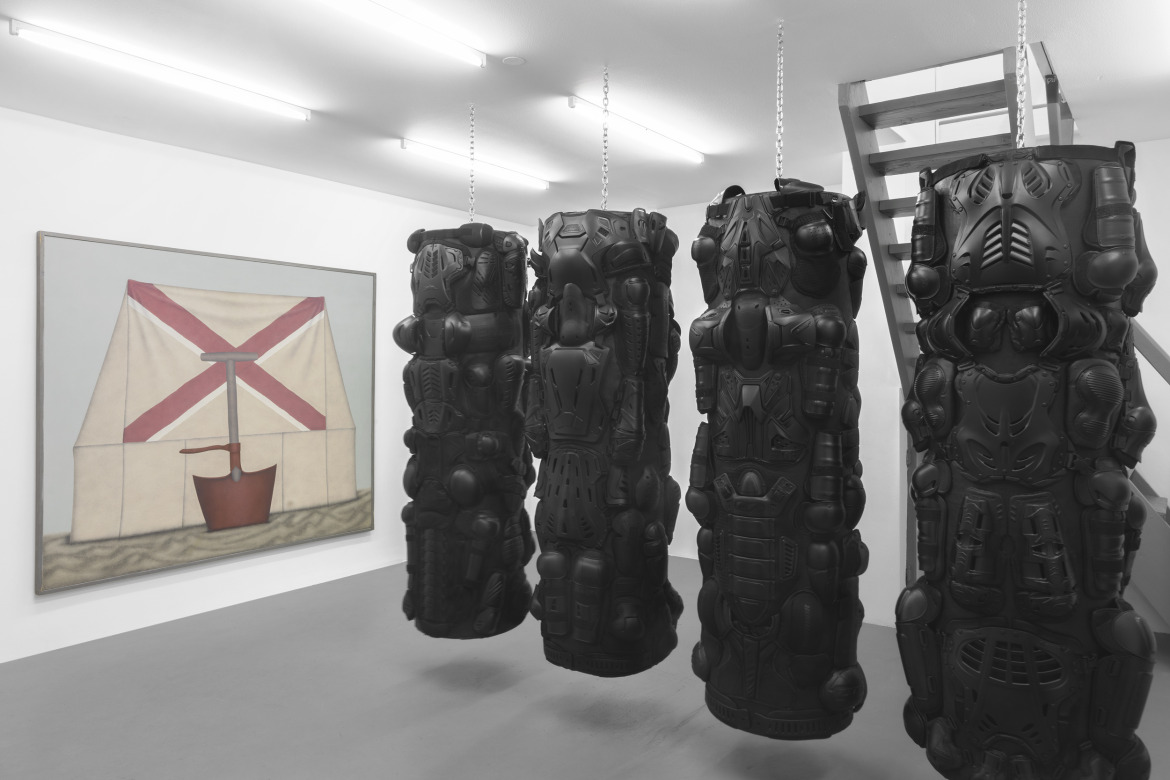
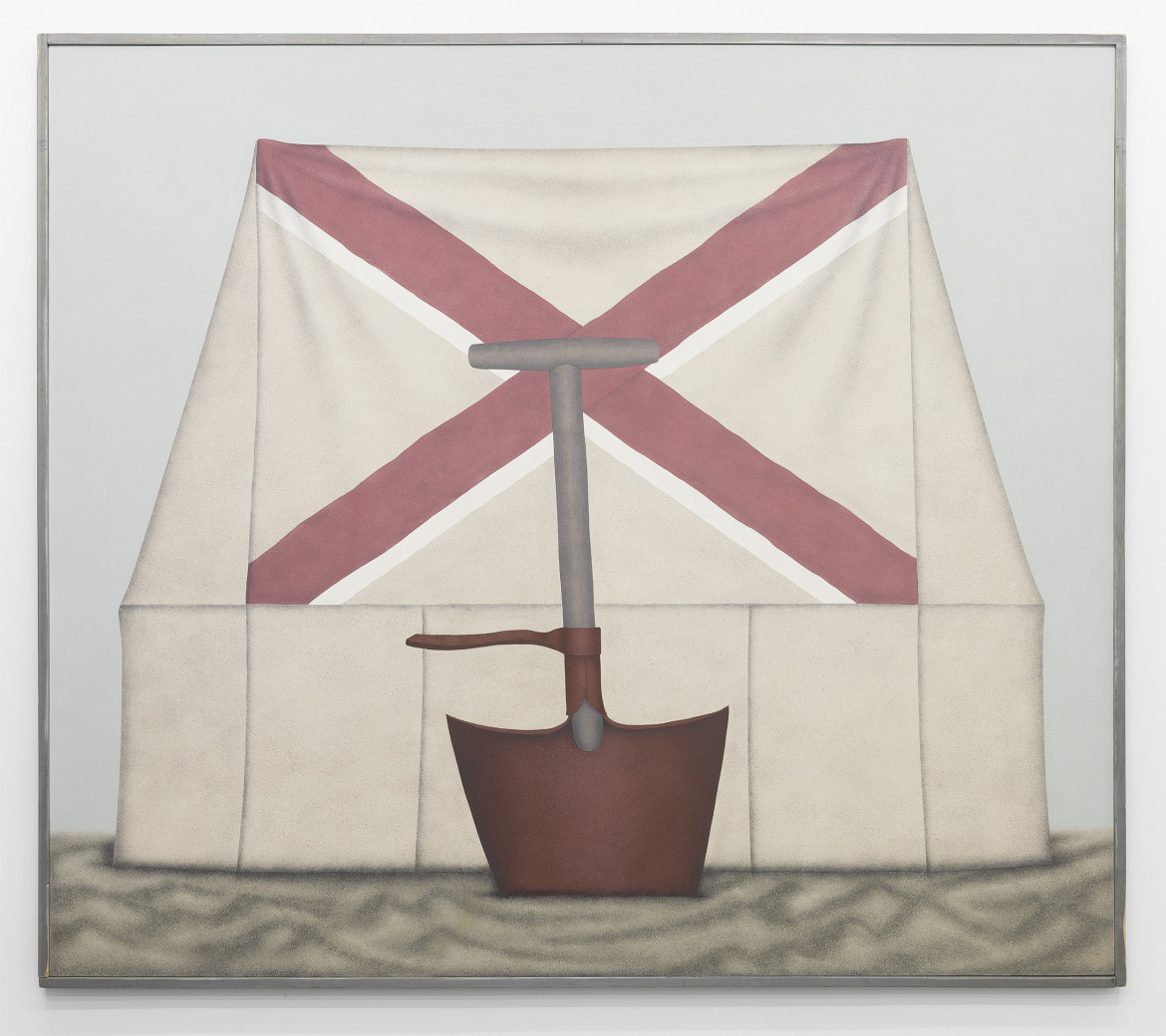
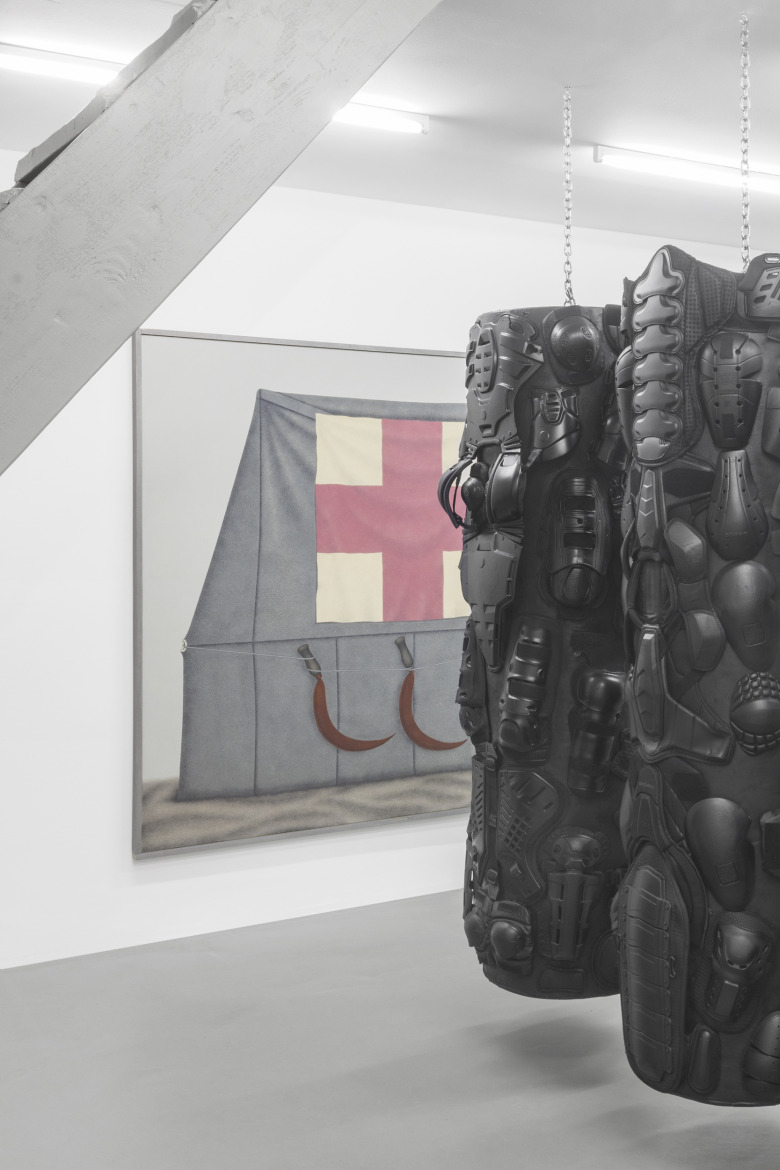
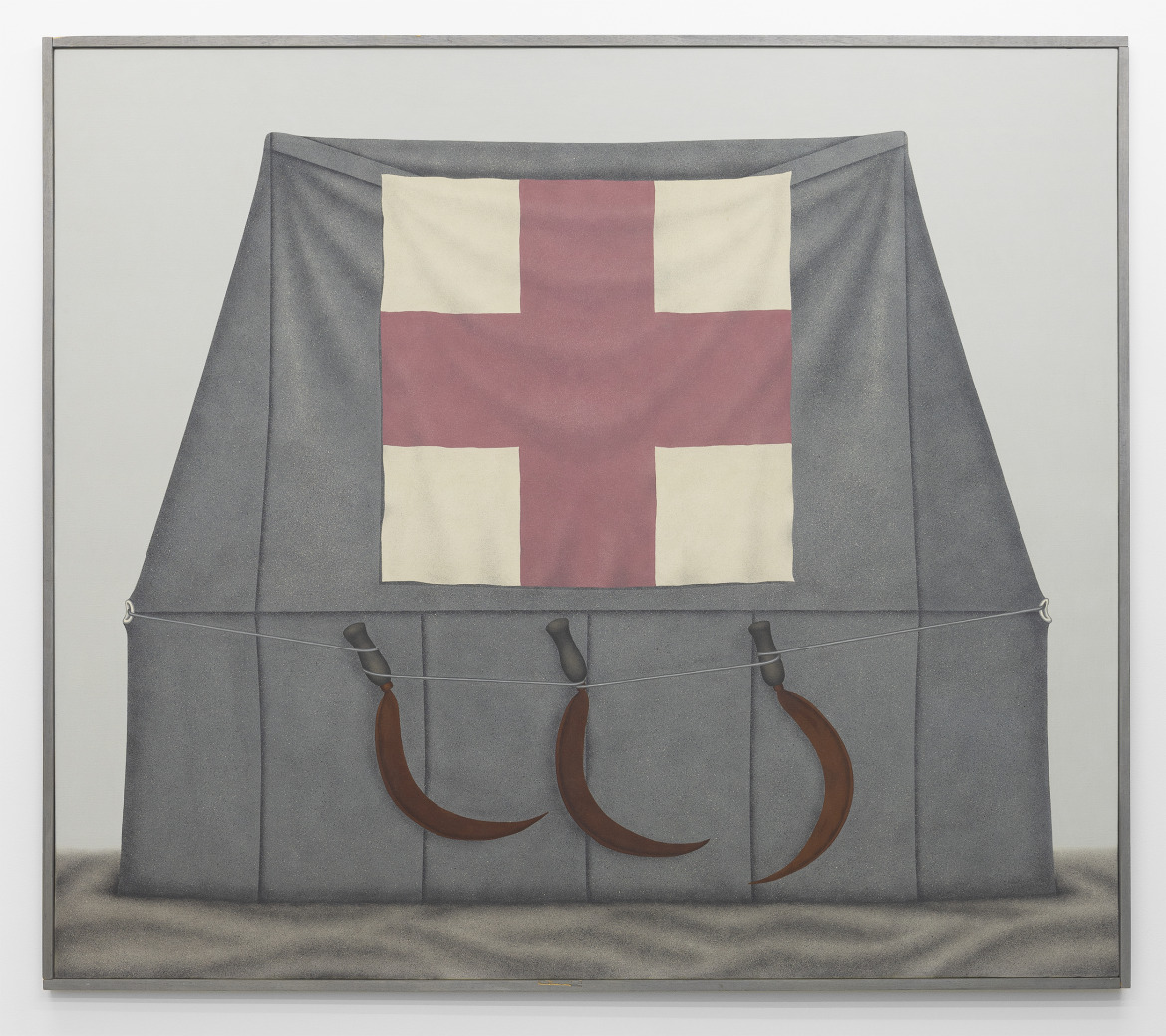
The ground floor space is confined by two large-scale paintings by Jobst Meyer, entitled Zelt, Kreuzfahne und Sicheln (1973) and Kreuzzelt und Spaten (1973). Both works show lazarett-like hospital tents placed in a nondescript landscape. Each tent is decorated with a cross symbol, either painted directly onto the tent or attached to the tent in the form of a Red Cross banner. Placed in front of the tents, or attached to them by rope, are either a single spate or a set of sickles. These collected iconographies of battlefields, war, civil unrest or other traumas cover most of the canvas and act as barriers that block deeper insight into the landscape behind. Painted in the early 1970s, the imagery of such temporary tent structures remains familiar from various global war-zones, refugee camps or increasingly also as aftermaths of natural disaster. What is happening inside the tent is visually hidden, yet known to the viewer regardless. In a sense, these tents act like mirrors reflecting back onto the viewer, turning them into the actor within this otherwise static setting.

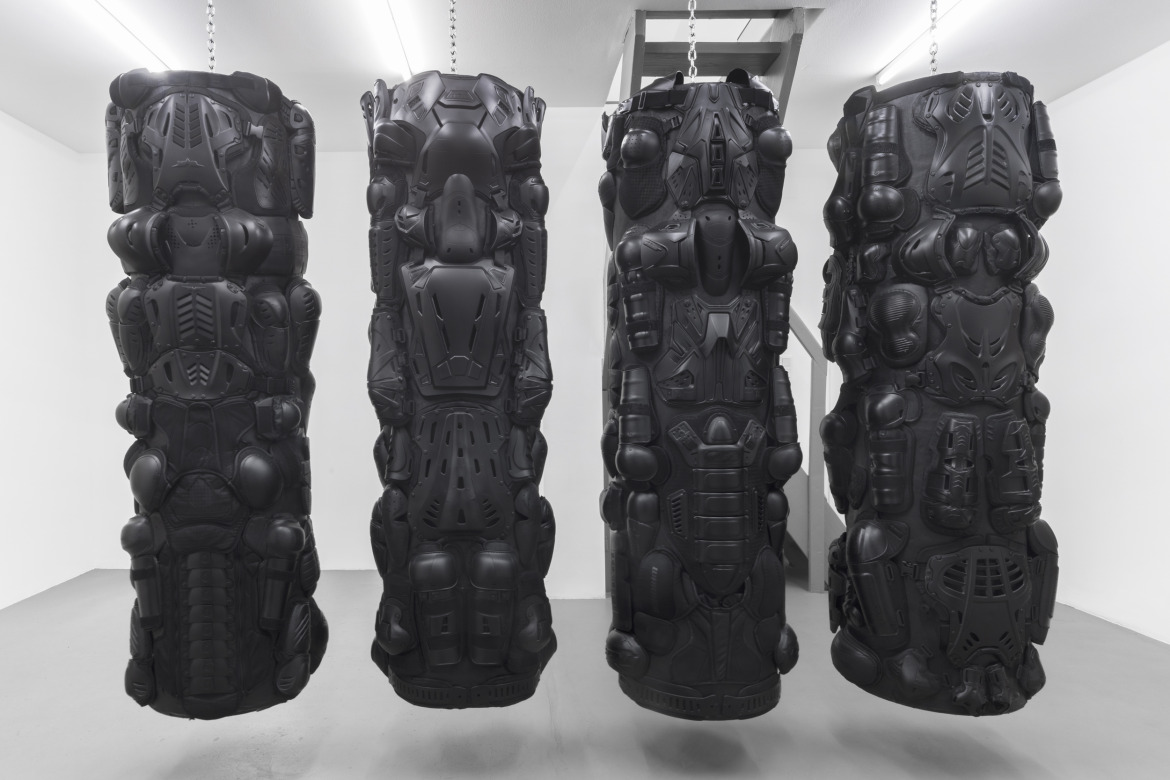
Placed in a straight line inbetween the two paintings are Zuzanna Czebatul’s quite monumental Columns of Empire (2021). Assembled from various parts of protective sports and riot gear, these punching bag-like structures hover low above the floor. Spray-painted black and in scale relational to the human body, their appearance is reminiscent of ancient warrior uniforms or indigenous ritualistic artifacts while simultaneously suggesting contemporary riot gear police uniforms. In Columns of Empire as well as in the paintings by Meyer, the individual is subsumed beneath a meta structure with the unclear purpose of protecting or harming the individual. 

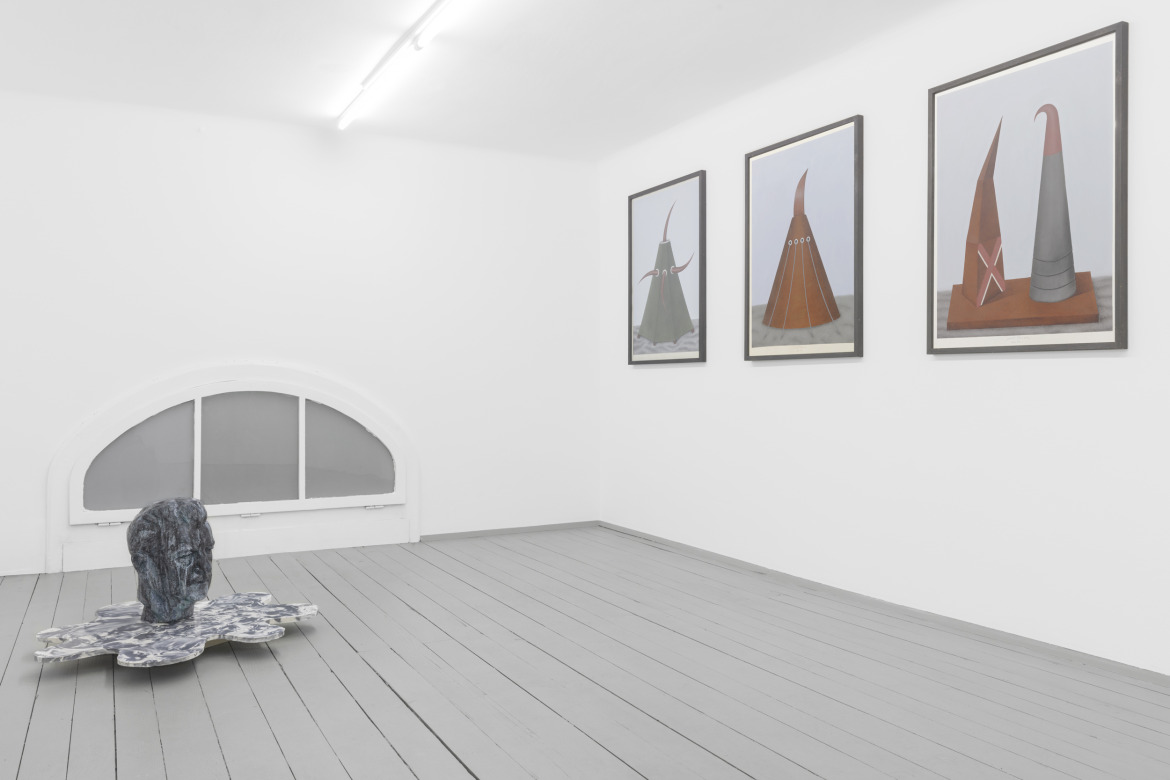
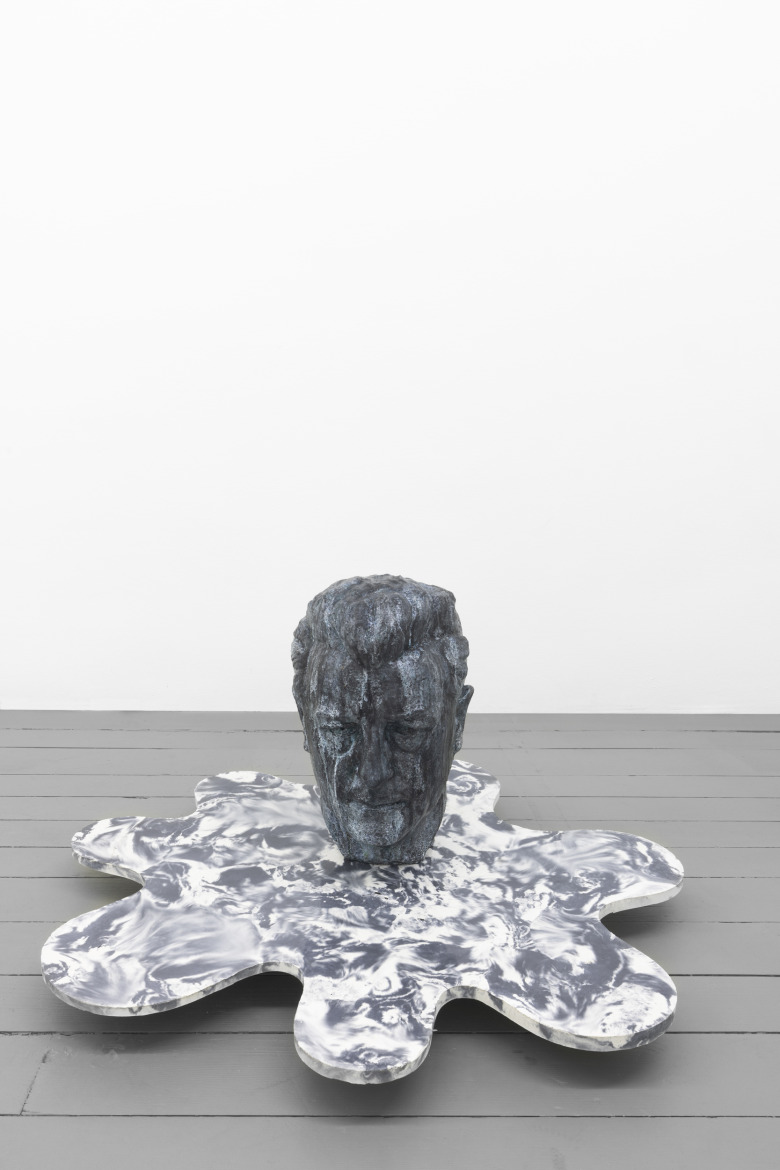
In the second room, Weinheber, until now only present as a ghost within the exhibition space, appears in the form of a replica of the source memorial on local display on Schillerplatz. Produced via a digital 3D printing process, the originality of the source bust becomes a mundane, low-tech replica. Czebatul’s oxidized copper application process though gives Untitled (2022) the surface of a painterly, almost hyper-real, or battered patina, as if the source bust’s precious metal was projectiled into a distant, uncertain future. 

The replicant bust is placed on top of a low floating pedestal whose black and white, marble-esque pattern and shape suggest the original pedestal’s integrity as disrupted, melted or in the process of dissolving. Untitled (2022) liquefies Weinheber’s stale bronze-cast authority, though instead of morally denouncing Weinheber, the work deliberately trivializes the source bust’s authority and asks questions about the legitimacy of the original memorial. With Untitled (2022) Czebatul asks which version, if any, is the appropriate monument. 

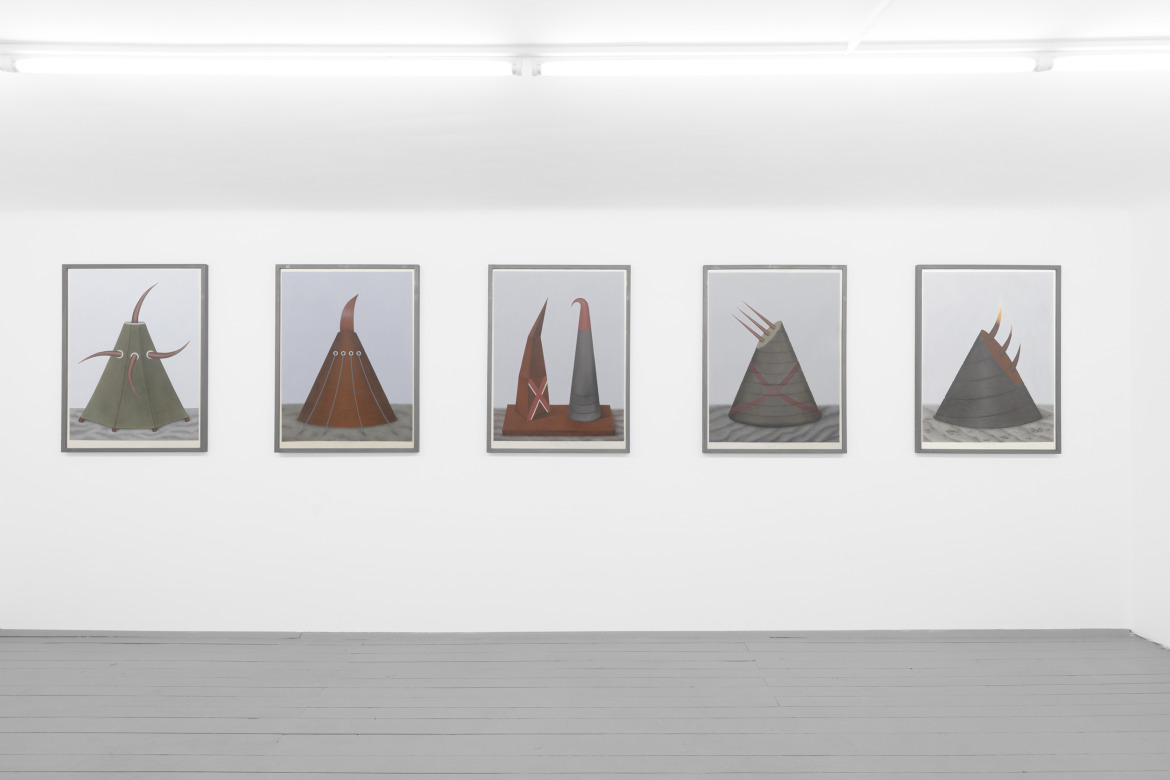
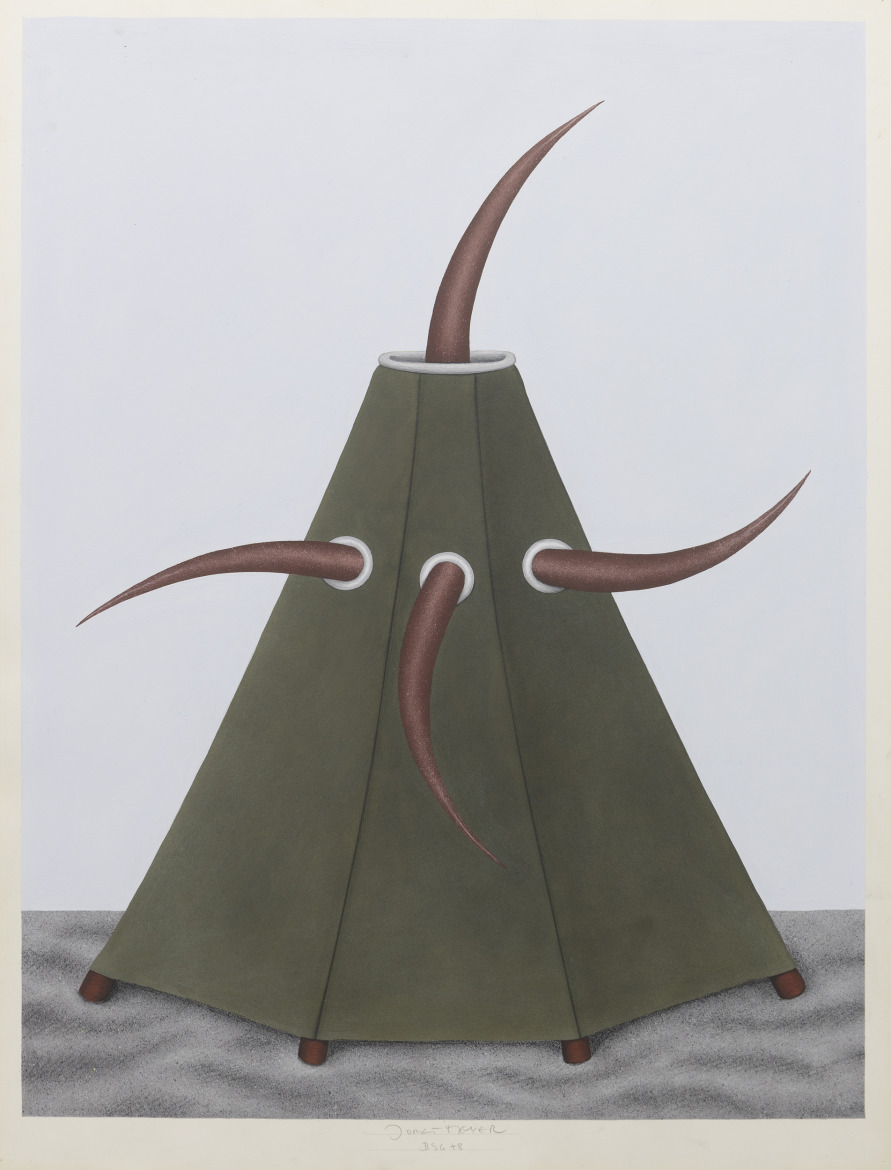
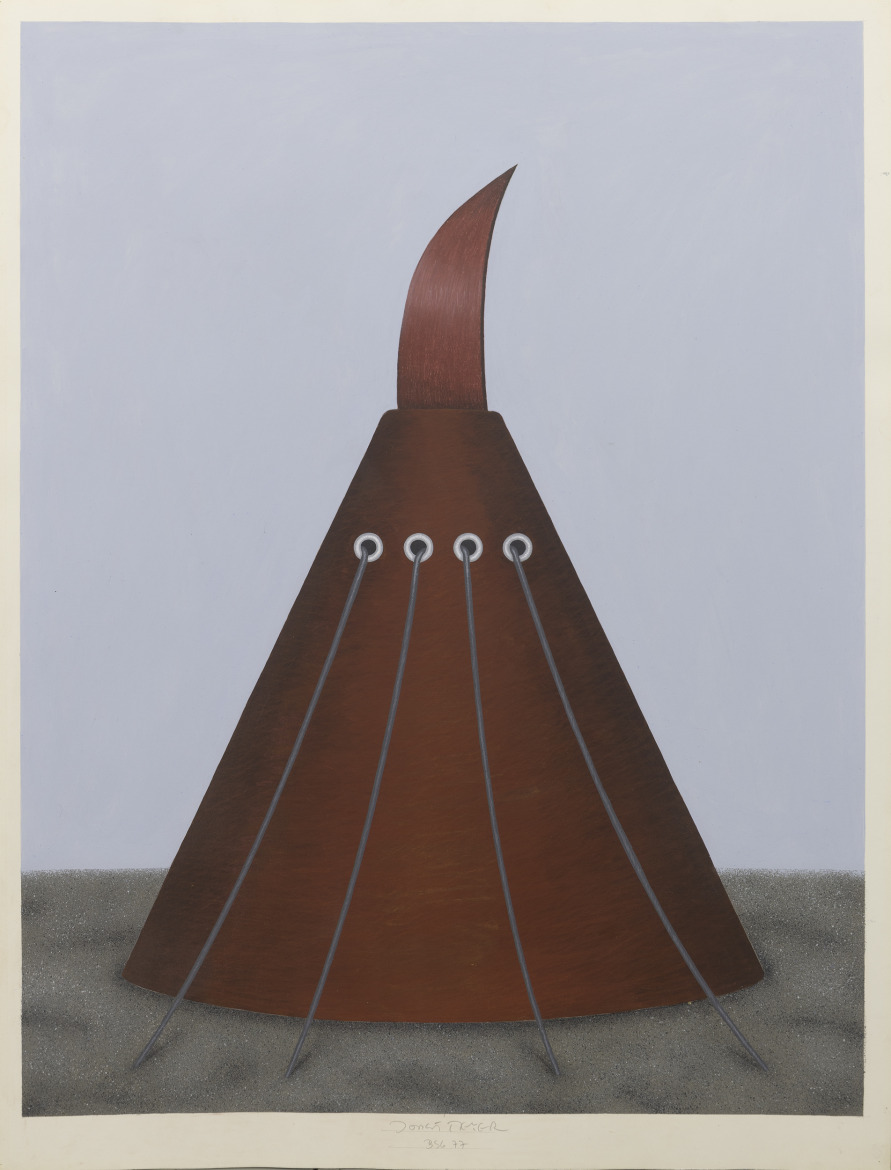
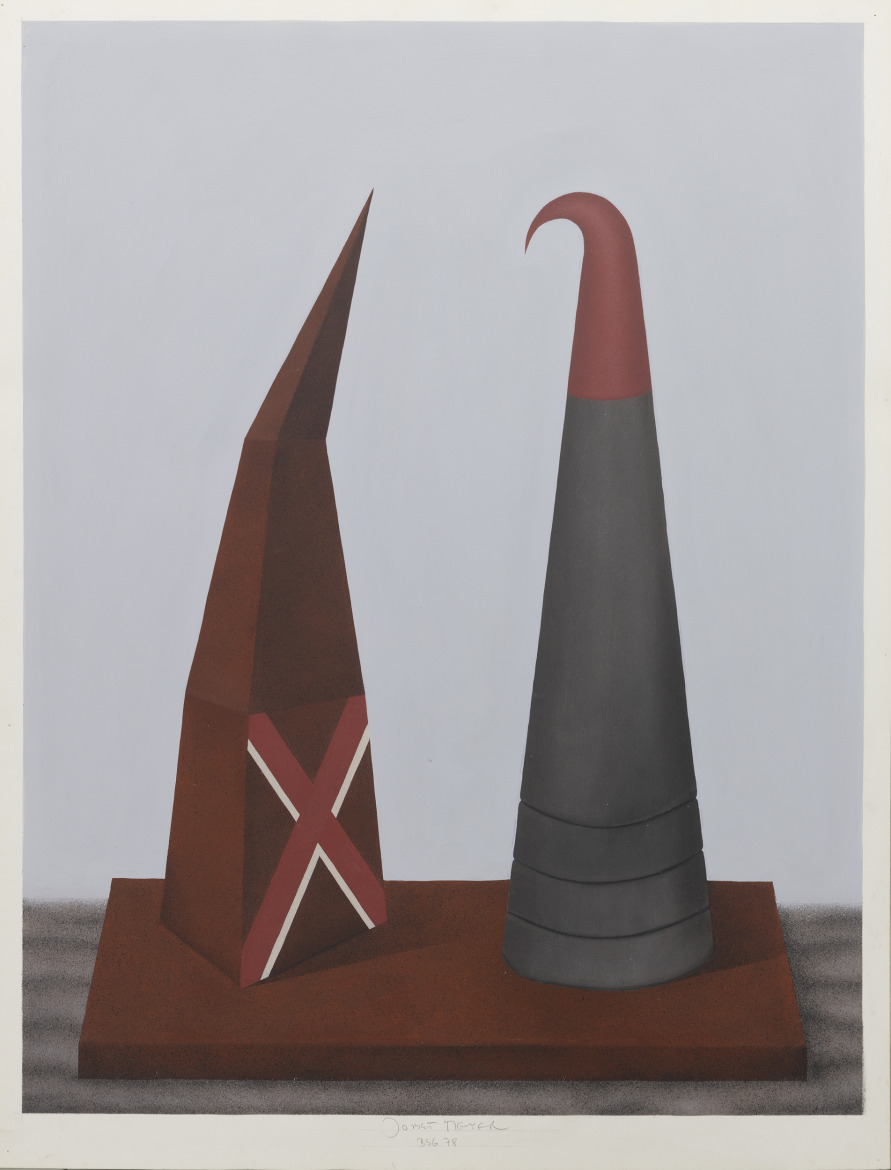
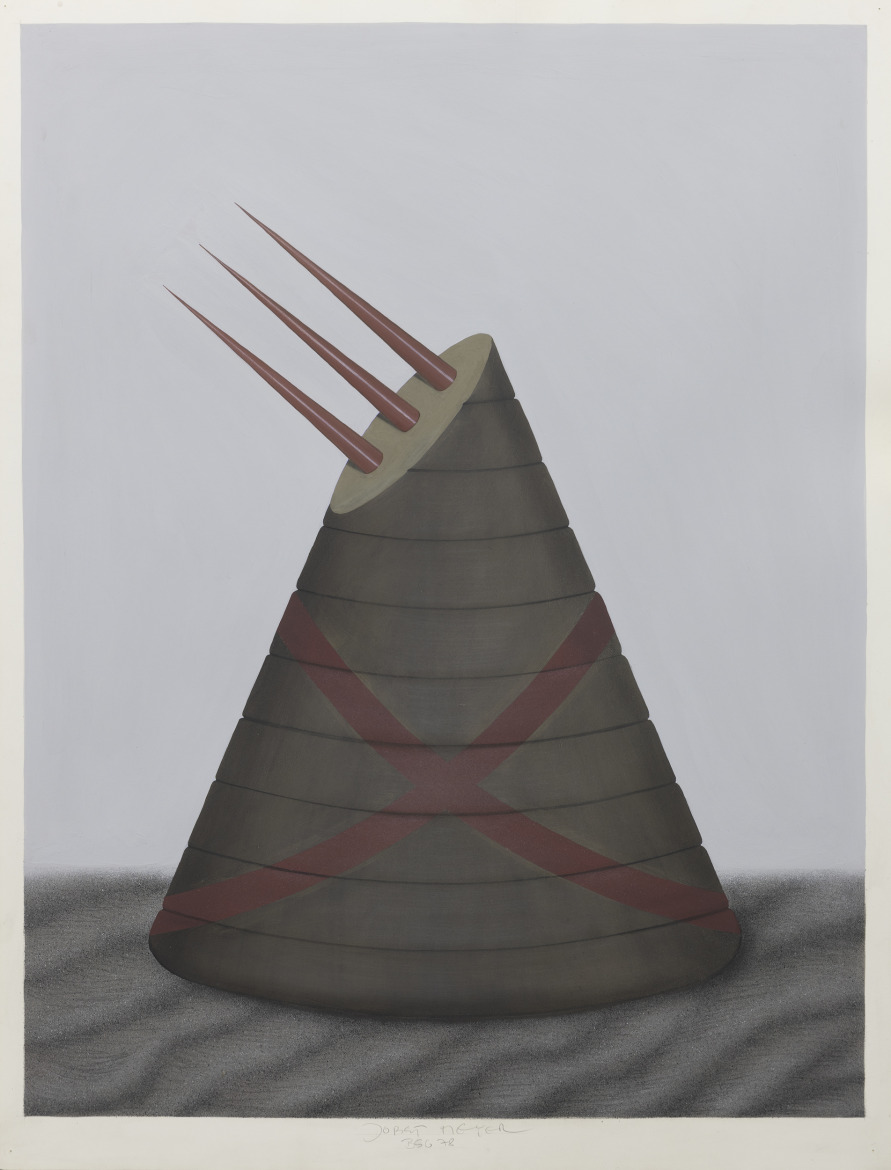
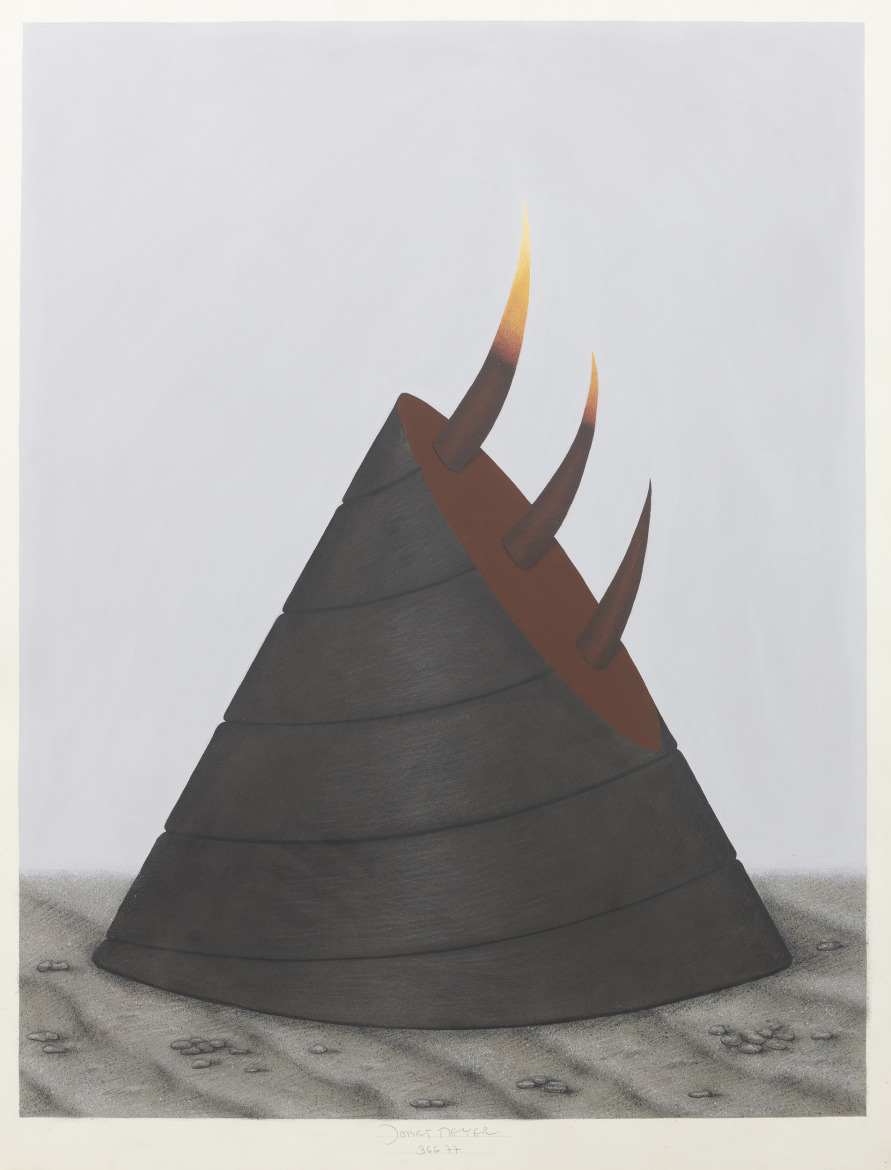
Placed alongside the work by Czebatul are five Untitled (1978) works on paper by Jobst Meyer. These show various conical or pyramidal forms, always cut, pierced or otherwise distorted by thorns, spikes or bent shapes. Similar to Meyer’s paintings downstairs, the artist asks about the socio-political meaning of such structural shapes that are deeply ingrained in human history and conscience. Viewed collectively, the works in this room appear as if presenting the results of an architectural competition for a fictional monument that asks the viewer how to respond and relate to the current debate about such problematic monuments on public display. 

Zuzanna Cebatul’s and Jobst Meyer’s works, as much comical phantasies of absurdist monuments as serious metaphors for social injustices, allegorically point to the complexities, challenges and difficulties of any monument on public display. No singular reading, no clear opinion, no monolithic response, no black and white answer is certain within such a memorial  itself. Instead, an open and critical discourse is required around each monument within the public sphere. To physically remove a monument is easy, to deal with its complex legacy is a continuous challenge. The ghost of Weinheber remains, yet it is Theodor Kramer’s poem that this text began with and refers back to. 

Curated by Christian Siekmeier


Theodor Kramer (1897-1958) was an Austrian poet who was forced into exile in 1939. In May 1945, in response to his former peer’s Josef Weinheber suicide, he wrote Requiem für einen Faschisten. Kramer returned to Vienna in 1957 and is buried in Zentralfriedhof.

Josef Weinheber (1892-1945) was a popular German-language poet under the Nazi regime. An early member of the NSDAP, Weinheber was a passionate anti-Semite and devout Nazi. Ideologically blinded, and unable to face the defeat of the Nazi regime and ideology, he committed suicide in advance of the Russian troops to Vienna in April 1945.

Zuzanna Czebatul (b. 1986, Międzyrzecz) lives and works in Berlin. She graduated from the Städelschule Frankfurt in 2013, and later attended the MFA program at Hunter College as a Fulbright Fellow. Czebatul has had solo exhibitions at Kunstpalais Erlangen (2021); CAC Synagogue de Delme (2020); Sans titre (2016), Paris (2020); GGM1 Municipal Gallery, Gdańsk (2019); FUTURA Center for Contemporary Art, Prague (2018); CCA Ujazdowski Castle, Warsaw (2017) and others. Czebatul has participated in group exhibitions at Athens Biennale (2021); Baltic Triennial, Vilnius (2021); Museum Morsbroich, Leverkusen (2021); Berlinische Galerie, Berlin (2021); Wrocław Biennale (2021); CAN Centre d’art Neûchatel (2020); Somerset House, London (2019); Muzeum Śląskie, Katowice (2019); Kunsthalle Lingen (2019); Kunsthalle Bratislava (2019); BWA Lublin (2018); Muzeum of Modern Art Warsaw (2017) and the Contemporary Art Museum St. Louis (2016). In 2022 the artist will participate in the Geneva Biennale: Sculpture Garden, curated by Devrim Bayar, and will have a solo exhibition at Arthur-Boskamp-Stiftung, Hohenlockstedt amongst others.

Jobst Meyer (1940-2017) studied at Akademie der bildenden Künste, Karlsruhe (1960-63), and at Hochschule für bildende Künste, Berlin (1963-68). From 1982-2010 Meyer taught at the Hochschule für bildenden Künste, Braunschweig. In 1973, he received the Villa Romana award and residency in Florence, Italy where the two paintings on display were created. Meyer exhibited in numerous solo exhibitions, amongst them Galerie Junge Generation, Hamburg (1967); Forum Stadtpark, Graz (1969); Galerie Klang, Cologne (1973, 1974), Galerie Thomas Wagner, Berlin (1975), Galerie Niepel, Düsseldorf (1981, 1991) and Landesmuseum Oldenburg (1998). He participated in many group exhibitions, amongst them at Kunsthalle Baden-Baden (1966), Kunsthalle Recklinghausen (1967, 1969), Kunsthalle Nürnberg (1968), Kunstverein Salzburg (1970),  Haus der Kunst, Munich (1970), Akademie der Künste, Berlin (1973), Kunsthalle Kiel (1977), Kunstpalast, Düsseldorf (1982), Ludwig Forum, Aachen (1992), and Kunstmuseum Mülheim an der Ruhr (2016). His work is in the public collections of Museum Boijmans van Beuningen, Berlinische Galerie, Rheinisches Landesmuseum, and Bundeskunstsammlung, Germany.

Further research
de.wikipedia.org/wiki/Theodor_Kramer_(Lyriker)
theodorkramer.at
Requiem für einen Faschisten read by Kramer
de.wikipedia.org/wiki/Josef_Weinheber
weinheber.net
Weinheber Memorial location

Press
Nicole Scheyerer: Fragwürdiges Denkmal in Reichweite, FALTER 07/22
Ema Ograjensek: Threatening Tips and Protective Films; The Gothic Ontology of Political Strife

Features
OFLUXO
Mousse Magazine
Art Viewer
Contemporary Art Daily


Wall Drawing 731 and five inserts by Martins Kohout

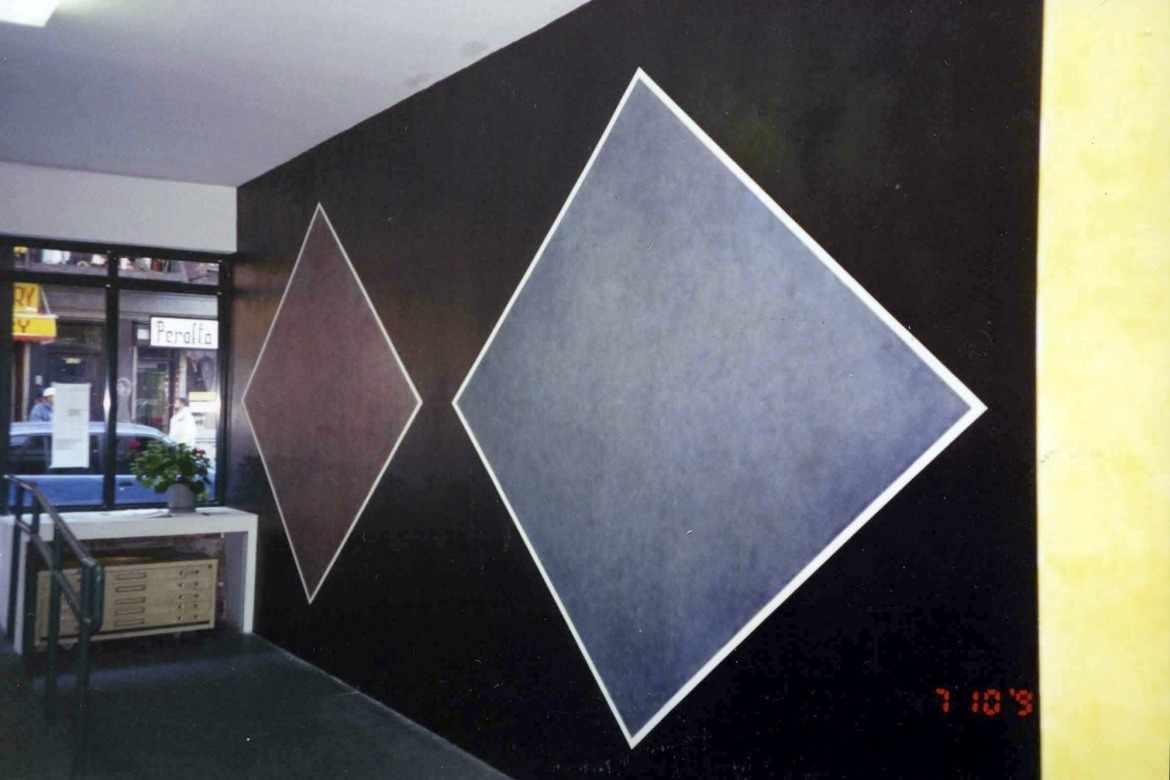
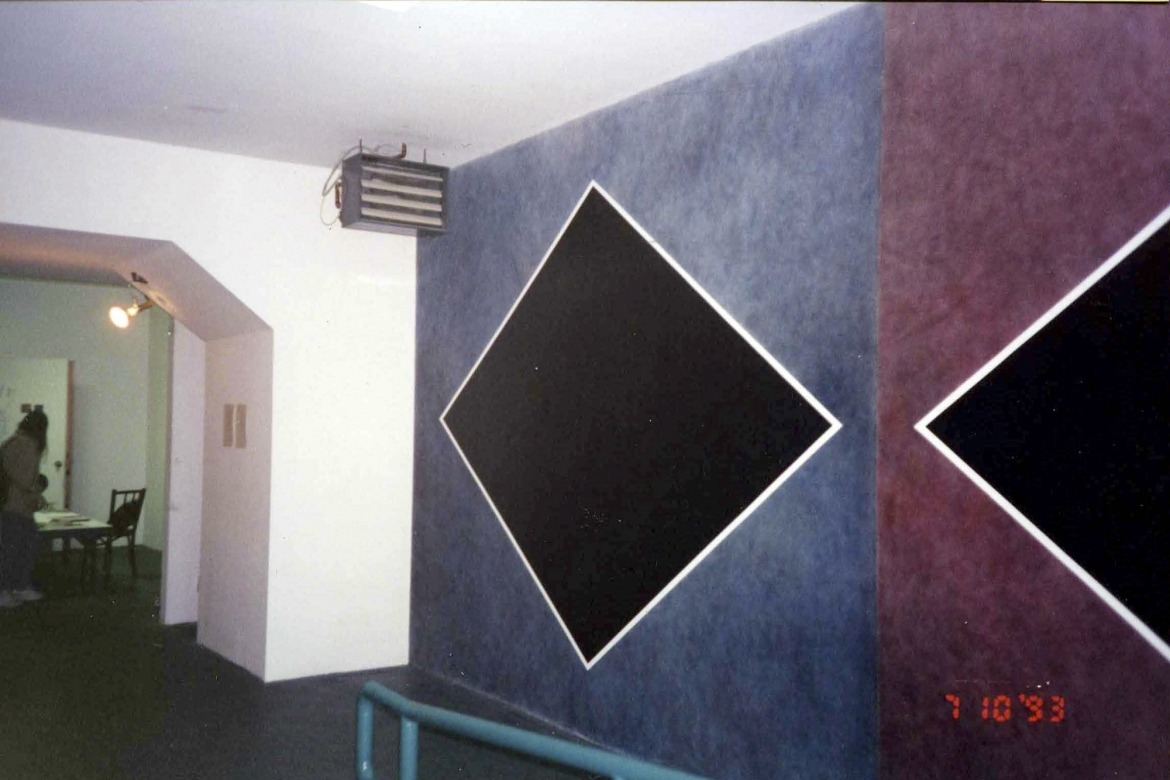
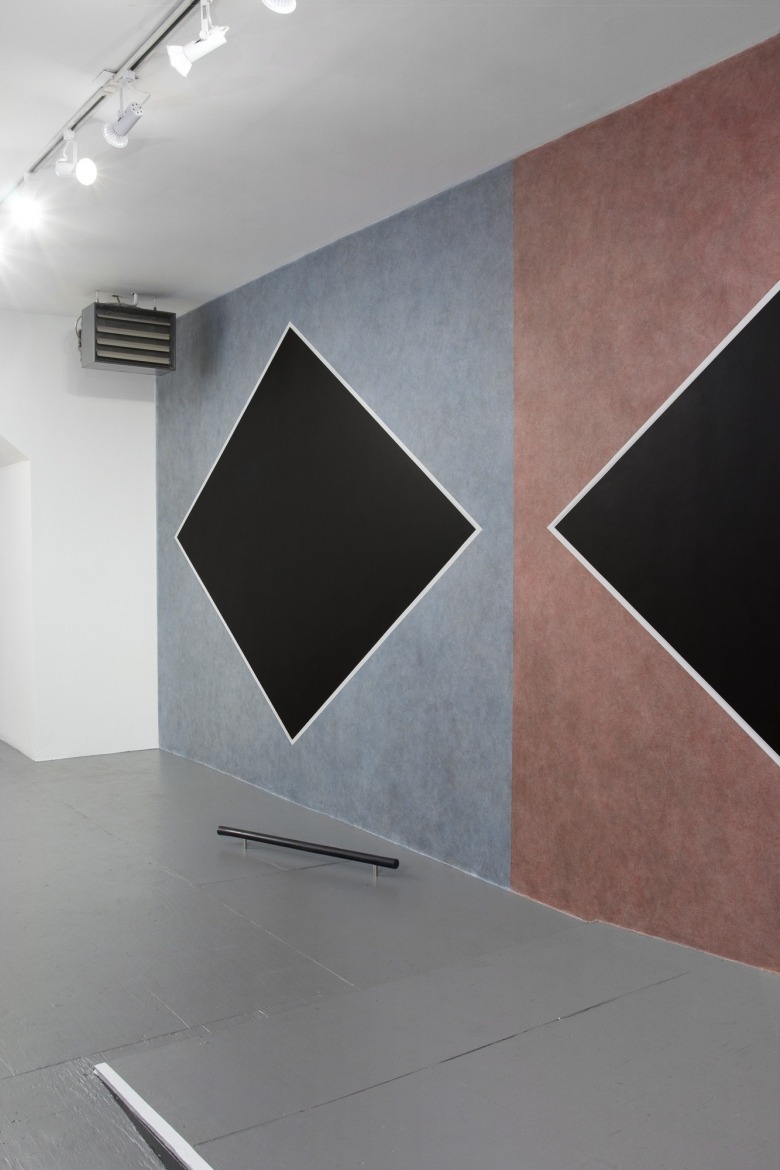
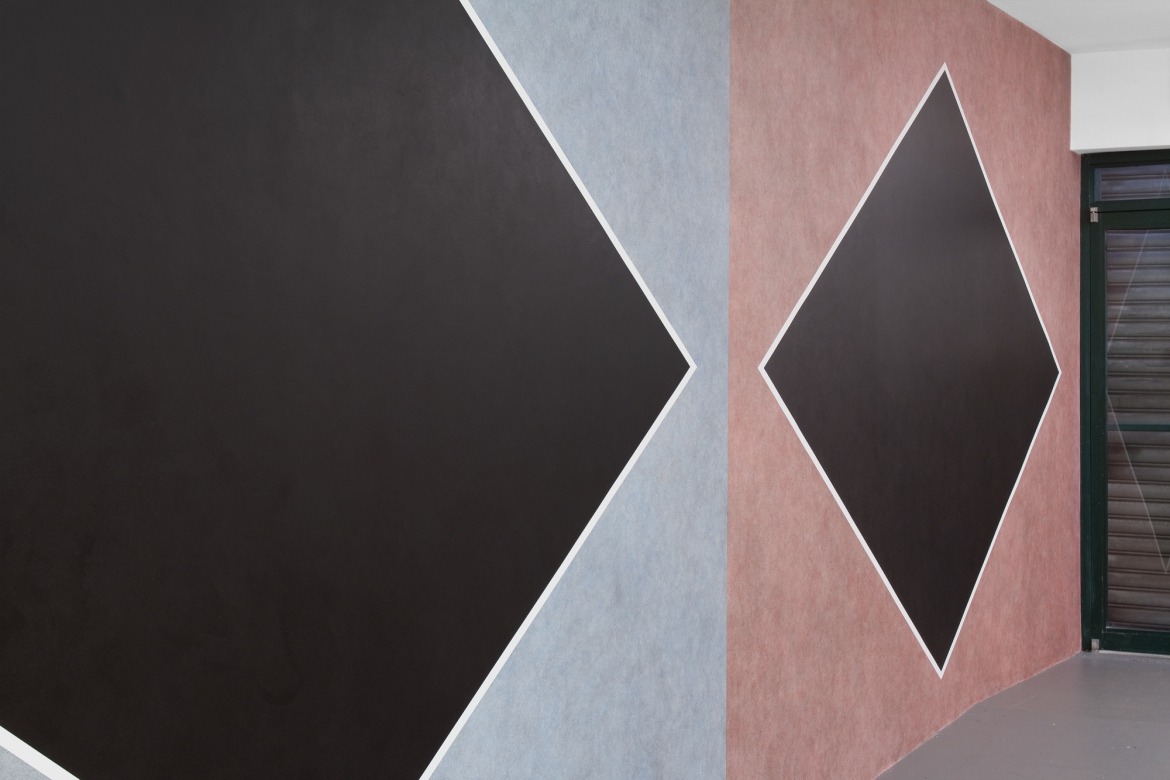
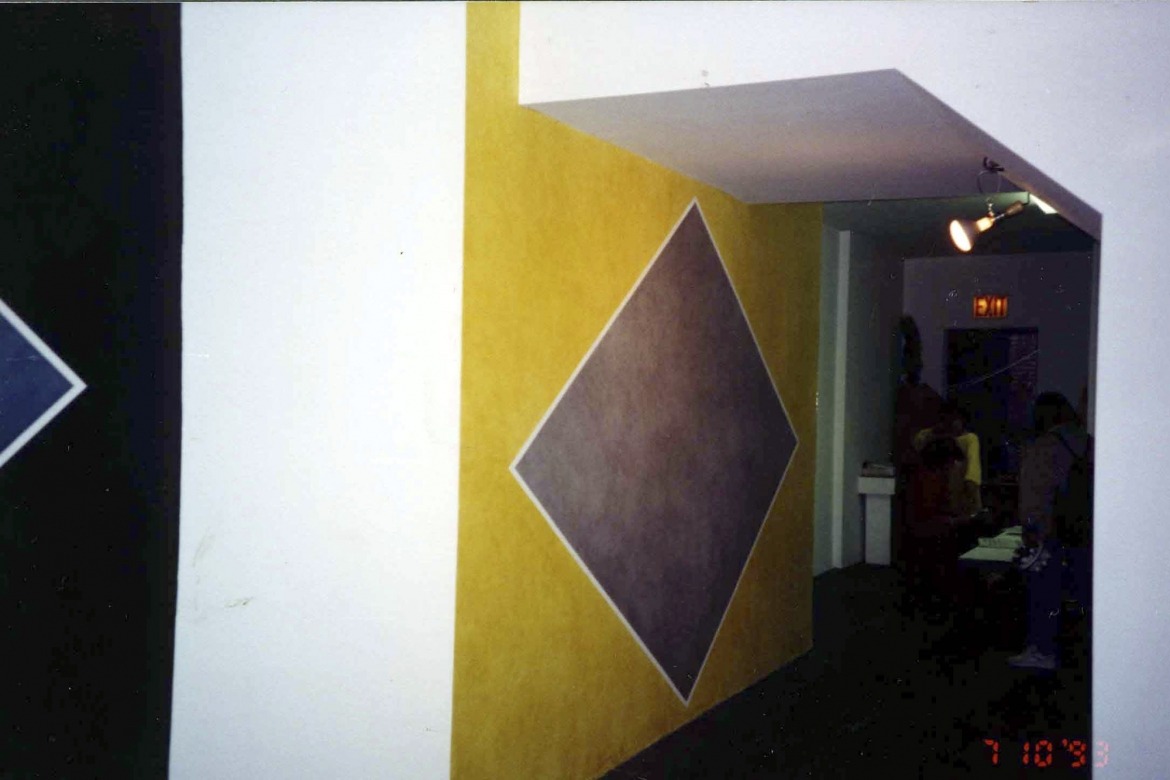
In July, 1993, GALLERY ONETWENTYEIGHT presented Sol LeWitt’s Wall Drawing 731 as part of the gallery’s exhibition program. Now, twenty one years after its first and only installation, EXILE and GALLERY ONETWENTYEIGHT collaborate to once again install this particular Wall Drawing in its original space.

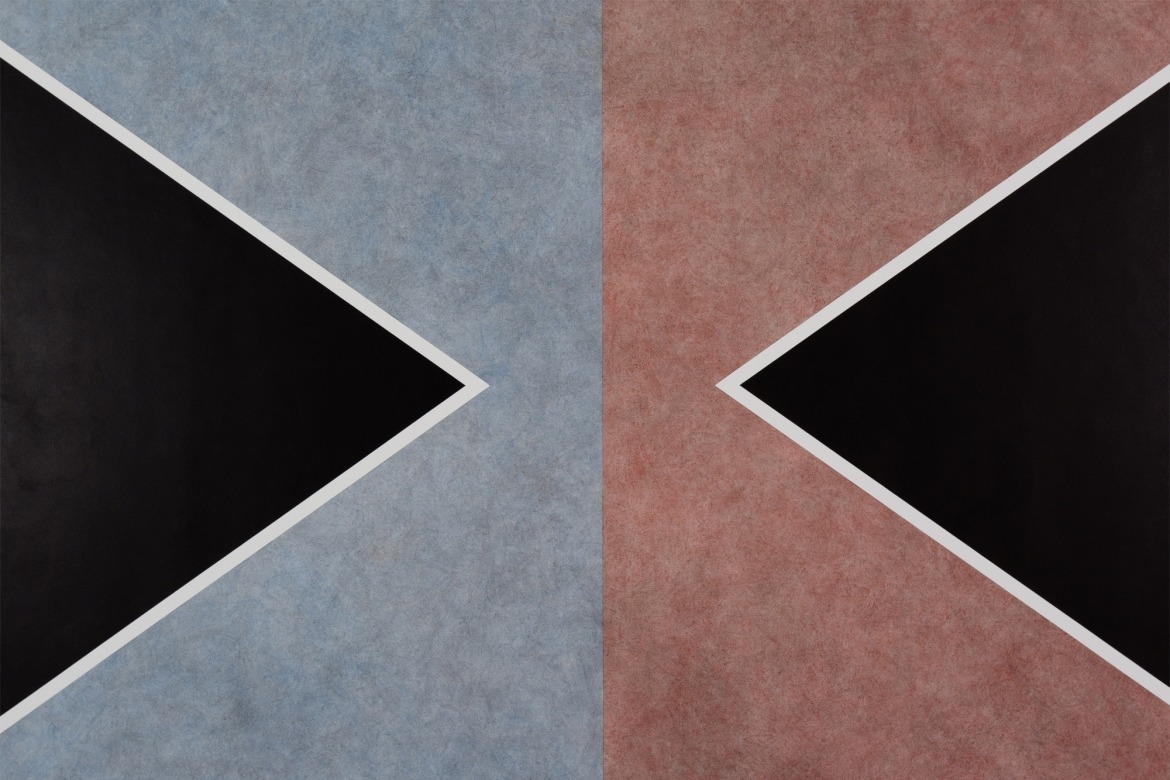
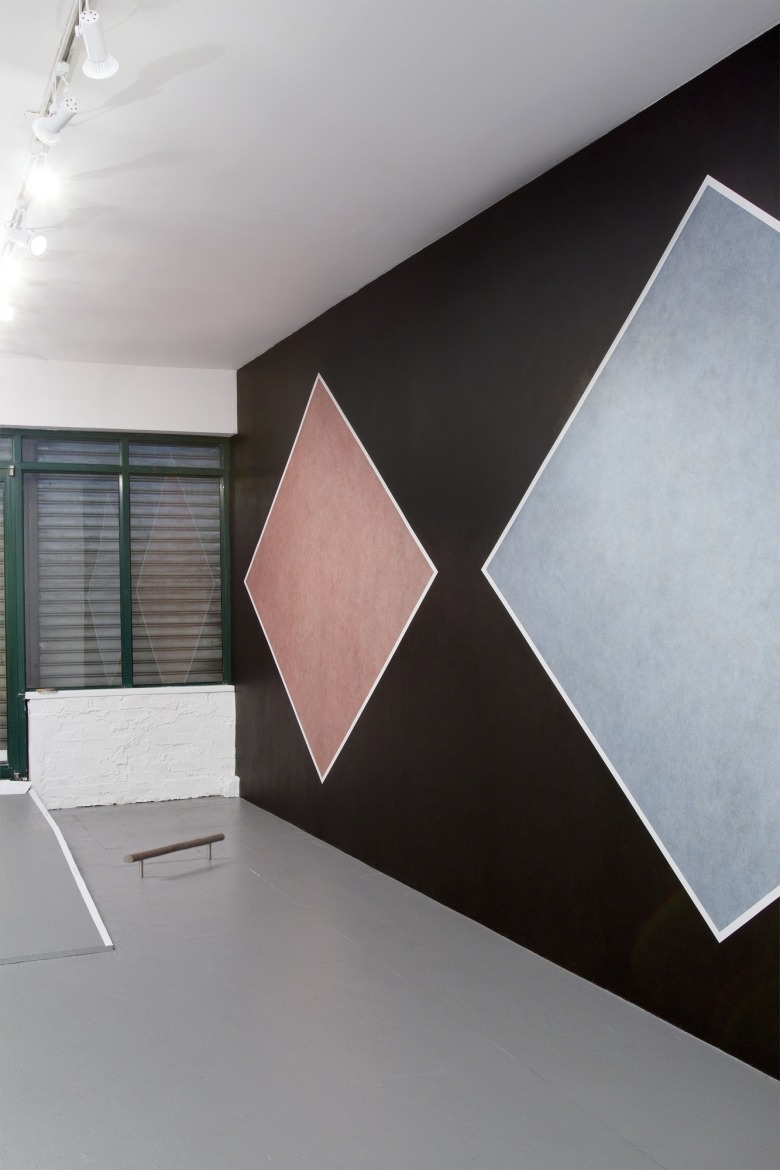
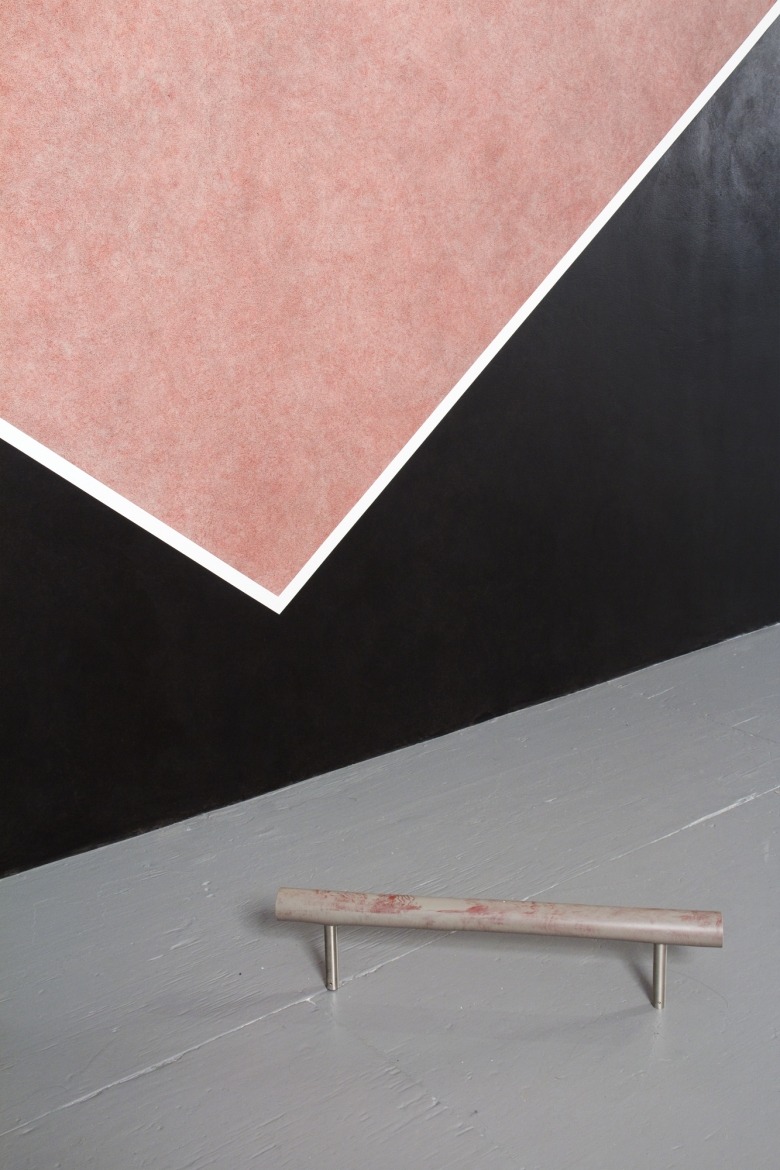
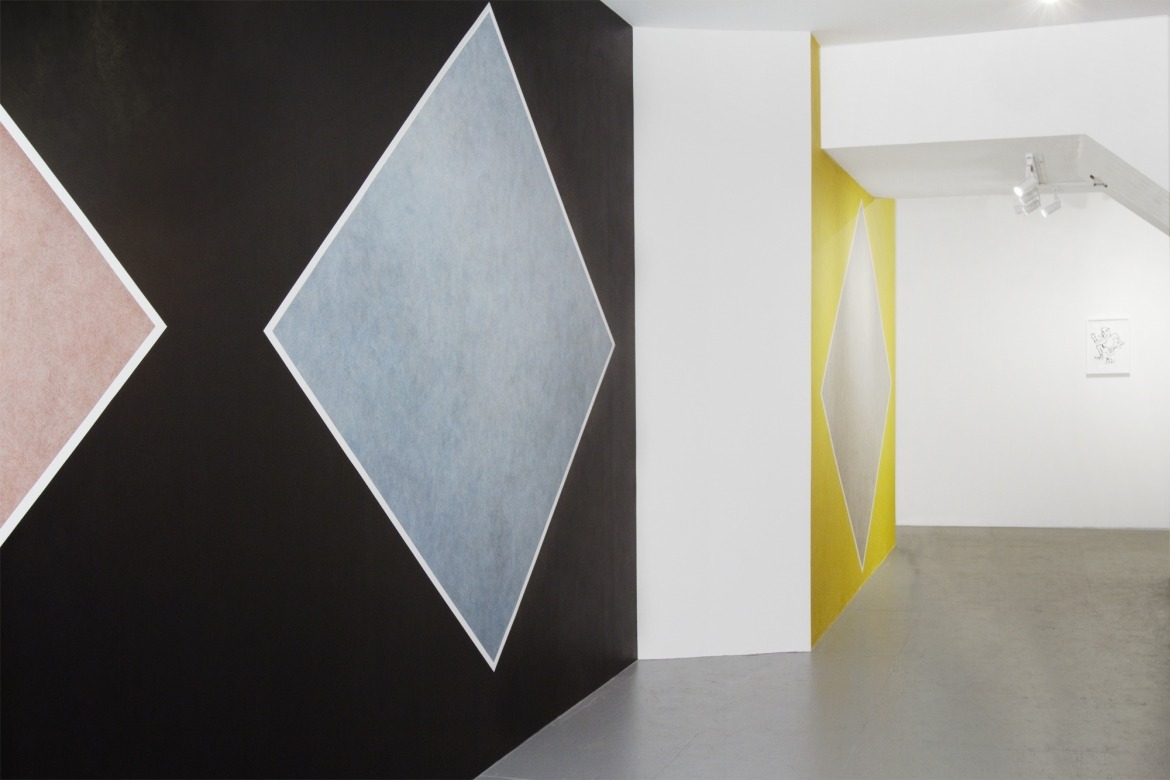
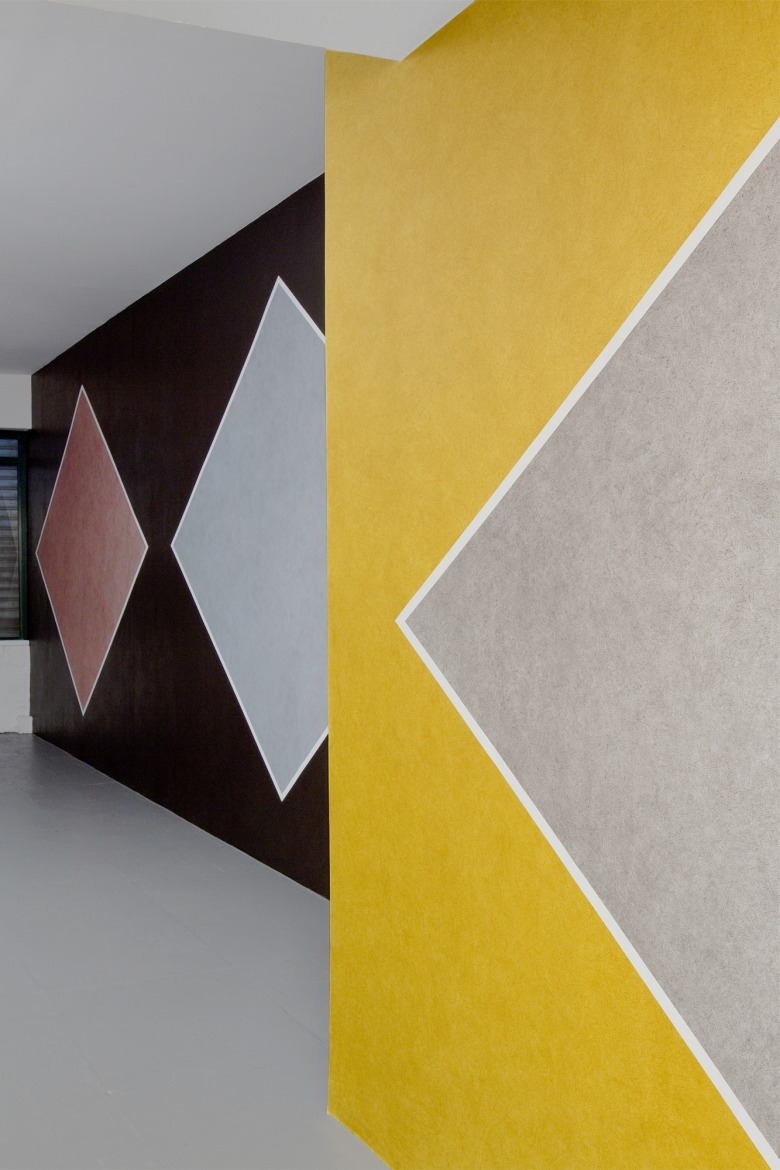
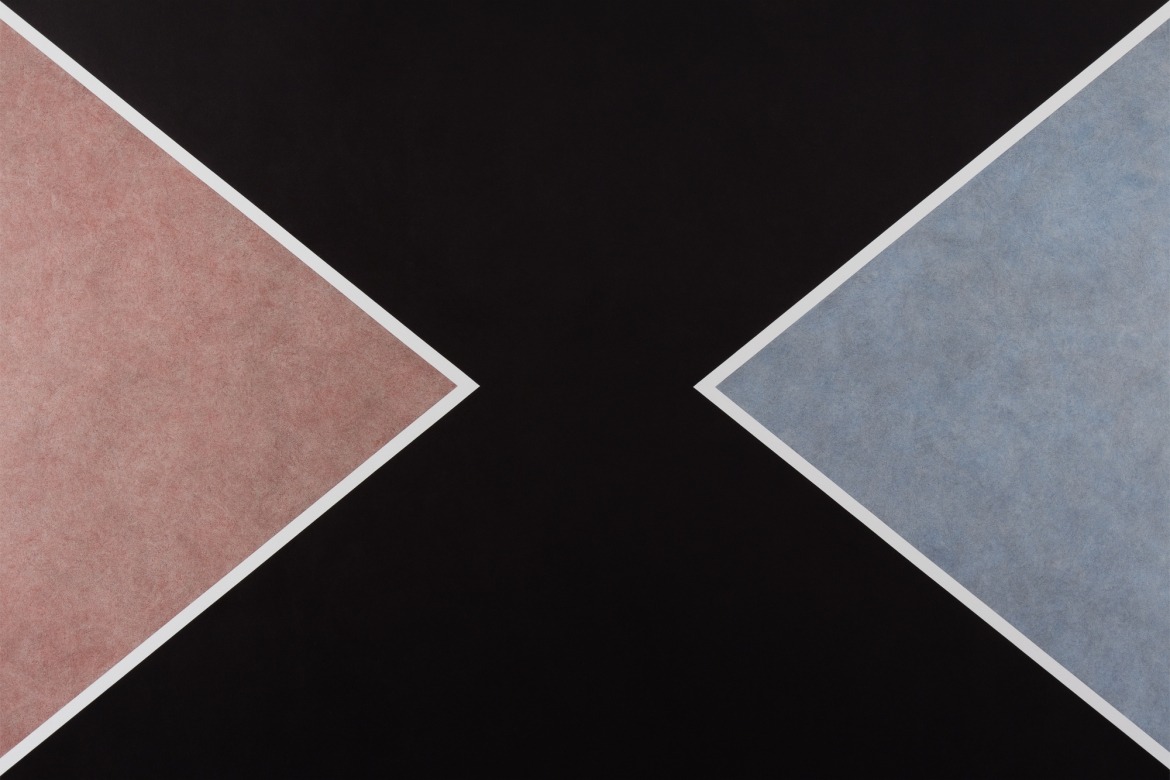
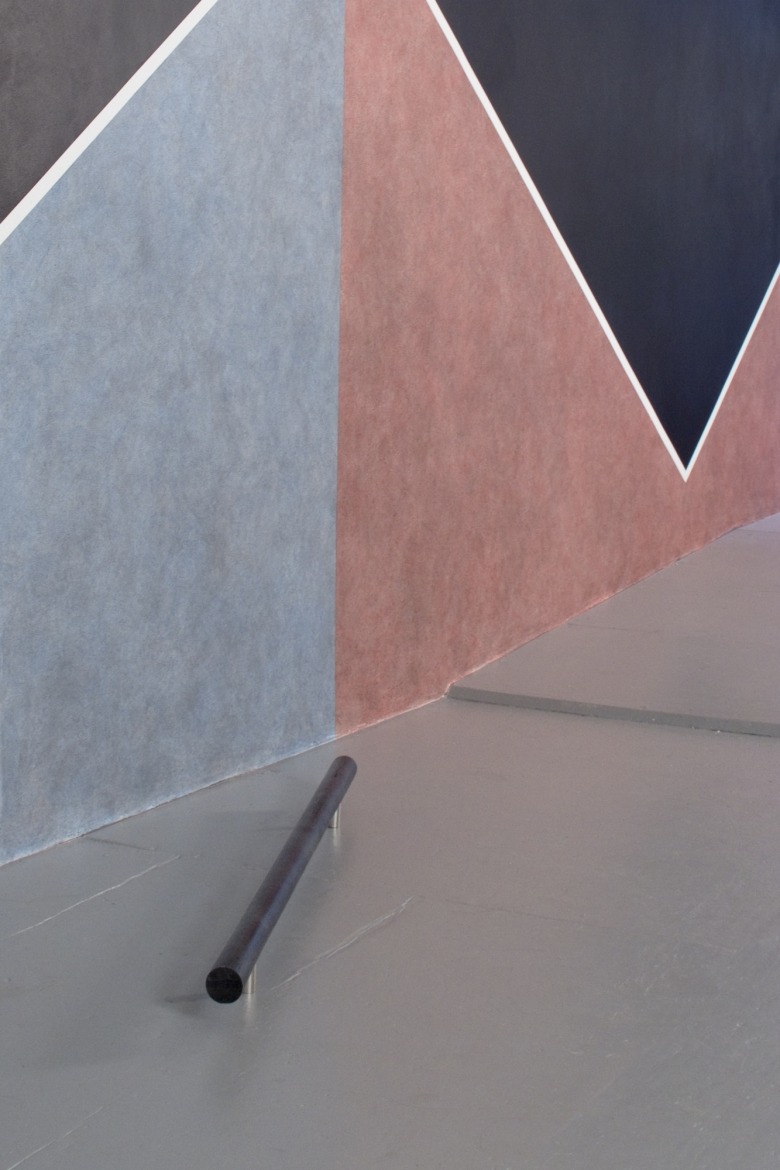
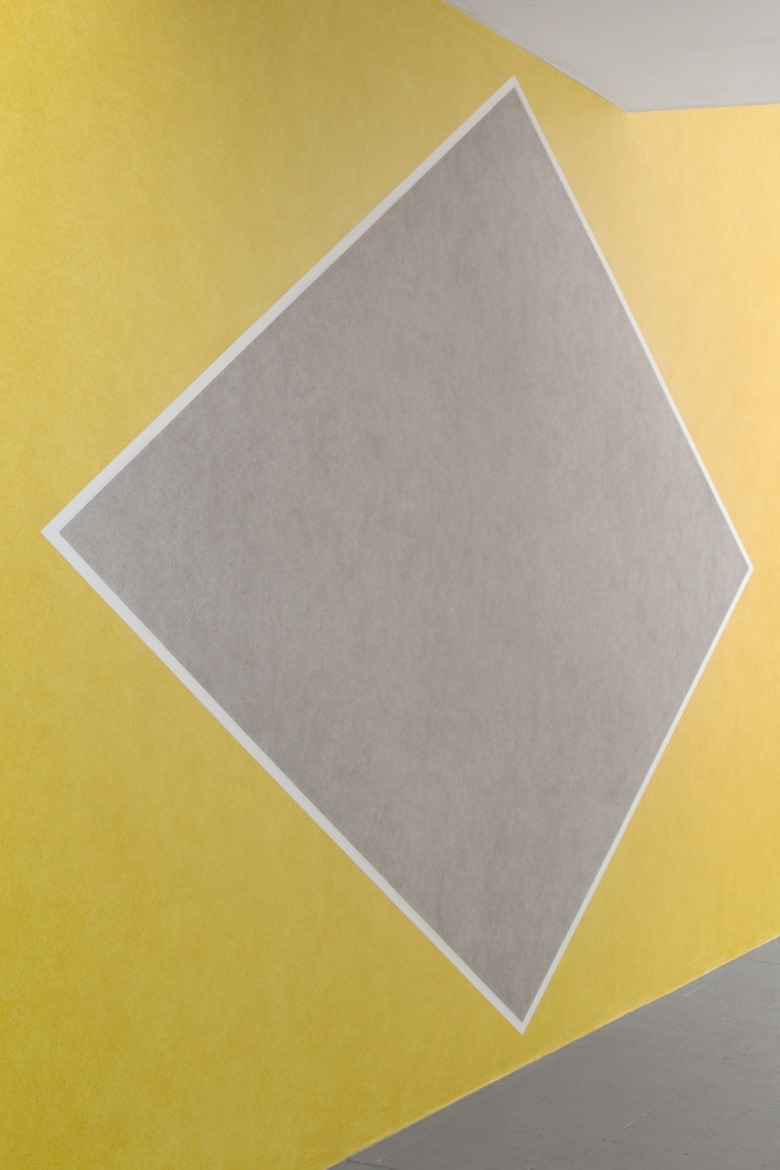
Wall Drawing 731 consists of three individual parts: A, B, and C. 731 A (two black diamond shapes with white bands on blue and red ink-washed split wall) and B (one blue and one red ink-washed diamond shape with white band on black wall) are installed on opposing walls in the front room of the gallery and, through their symmetry and color scheme, form a visual dialogue with each other. Part C (red ink wash diamond shape with white band on yellow wall) ruptures this symmetry with its singular location on an irregularly shaped wall adjacent to Part B and it’s newly introduced yellow color.

The re-installation of LeWitt’s Wall Drawing 731 in its original and architecturally almost unchanged location presents an exceptional opportunity to re-evaluate the piece within an otherwise completely different cultural, architectural, social, as well as art-historical sphere. The two versions of the drawings, both in 1993 and now in 2014, if to be understood in their material sense as two thin layers of paint, can be seen as a beginning and an end in which twenty one years of history are encapsulated. But the exhibition’s cyclical reappearance is in fact a lure. While the conceptual source of the work remains unchanged, its re-execution is always unique due to a constantly shifting set of variables.

When imagining the two drawings of Wall Drawing 731, as if they are transparently one on top of the other, for example, in form of their photographic reproductions, their subtle differences would become evident. These differences represent the identity of the drafts people who execute the work, as well as the subtlety of LeWitt’s thought and artistic process. Each viewer is invited to approach the exhibition on a cultural, personal, as well as social level reflecting upon myriads of changes that have occurred since the first drawing of the original work in 1993. Repetition becomes a strategy for reflection upon continuity and change.

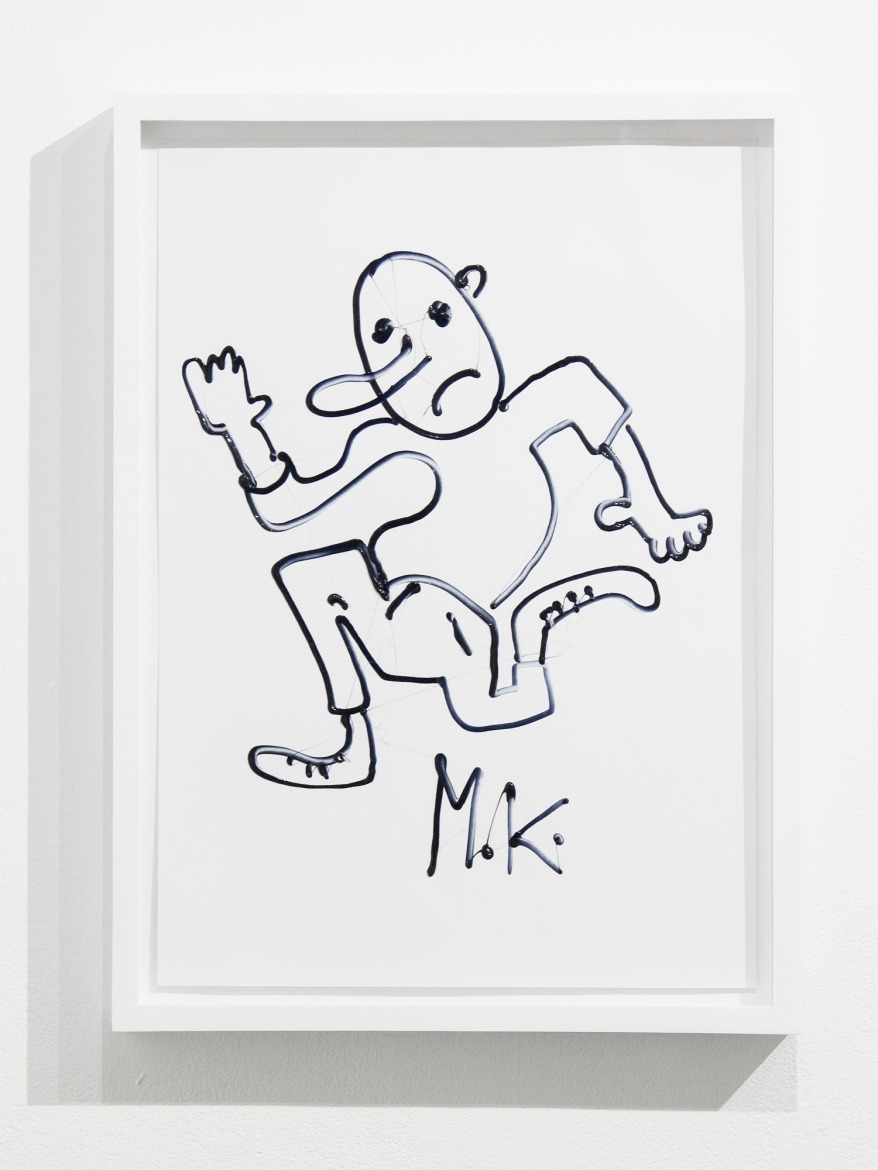
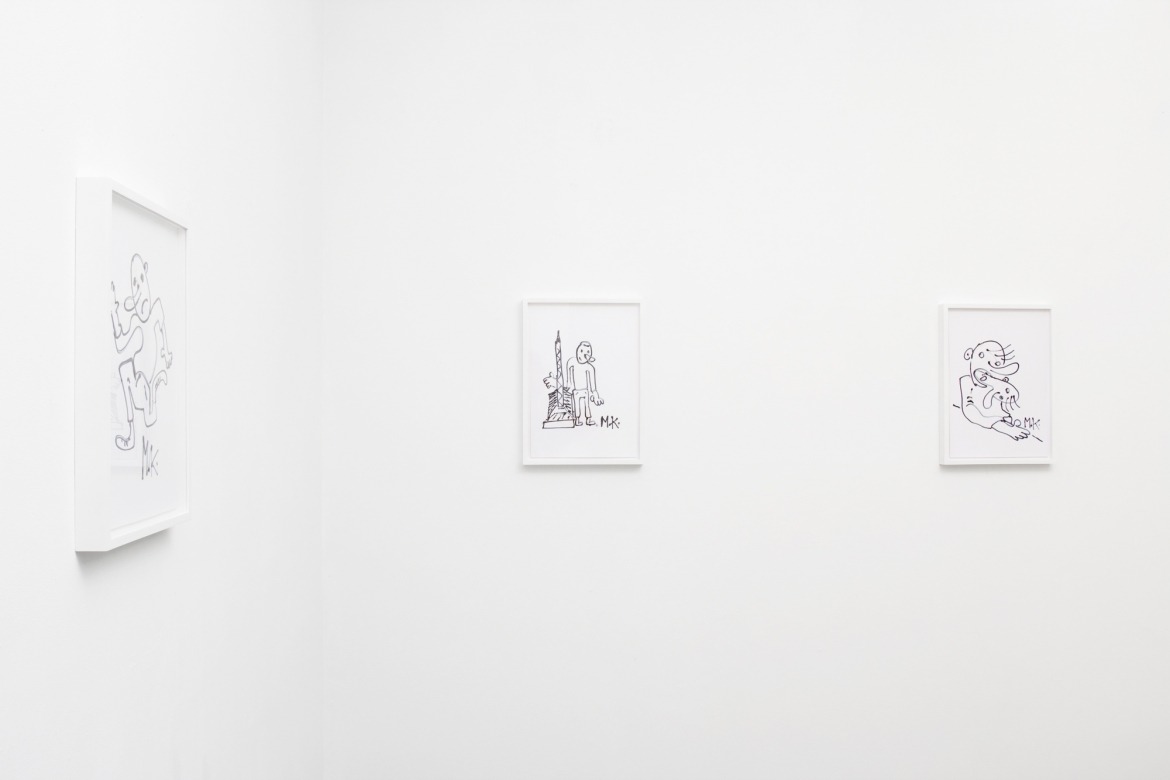
The five insertions by Martin Kohout create complexity beyond simple historical reconstruction. While referencing the work of LeWitt, Kohout’s insertions provide a kind of quiet irritation – the artist’s personal response and contemporary interpretation to the work on display and the process of Lewitt.

Curated by Christian Siekmeier.

nameless

Isolation as practice. An act of physical withdrawal might refer back to ancient times of aiming to achieve ulterior states of self awareness through utmost reclusion. The historical figure of the hermit remains the most prominent narrative in various cultural and predominately religious contexts. With advancing societal secularization such performative acts of seclusion were increasingly considered redundant if not trivial. Within the late 18th century Habsburg Empire the practice was outlawed, while in 19th century English aristocratic circles it was considered fashionable to hire a so called ornamental hermit to enact isolation as part of a romanticized notion of solitude. In its contemporary form, the practice of social withdrawal possibly relates less to spiritual but ecological motives as an escapist attempt from the complexities of destructive capitalism. Forms of self-sufficiency, of self-sustaining reintegration into the environment might appear as the only way forward if not to join the accelerating global extinction rally.

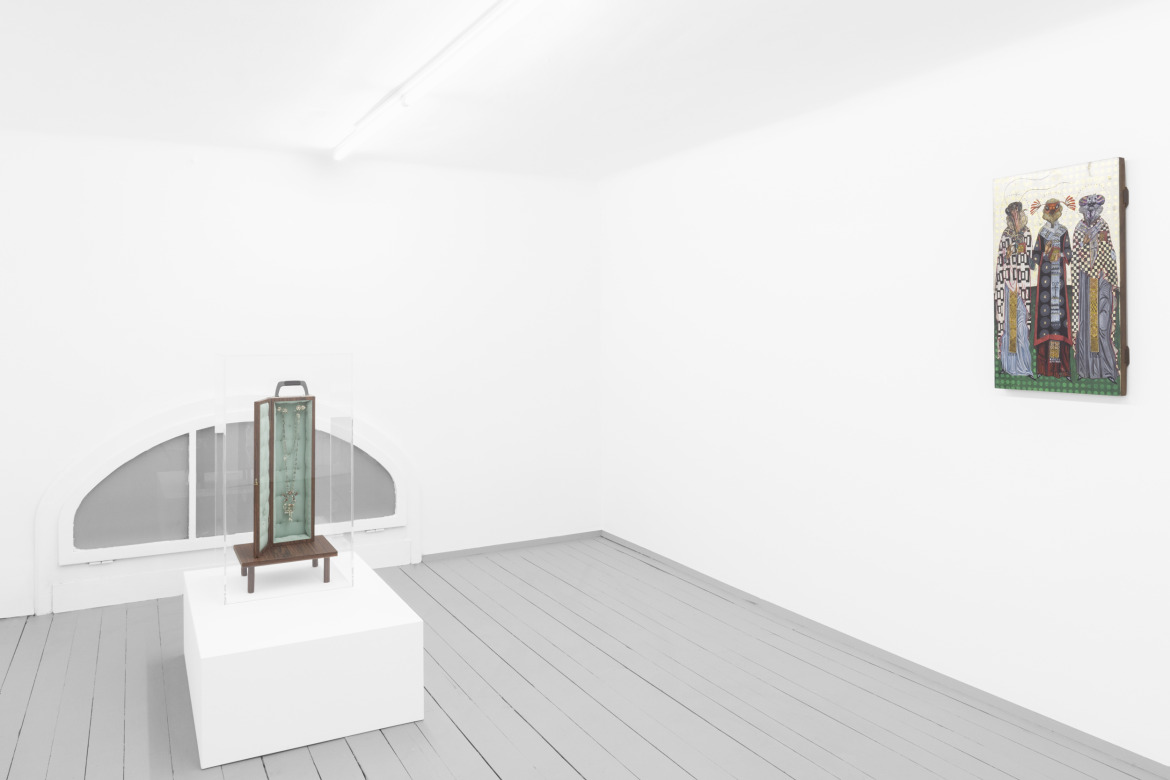
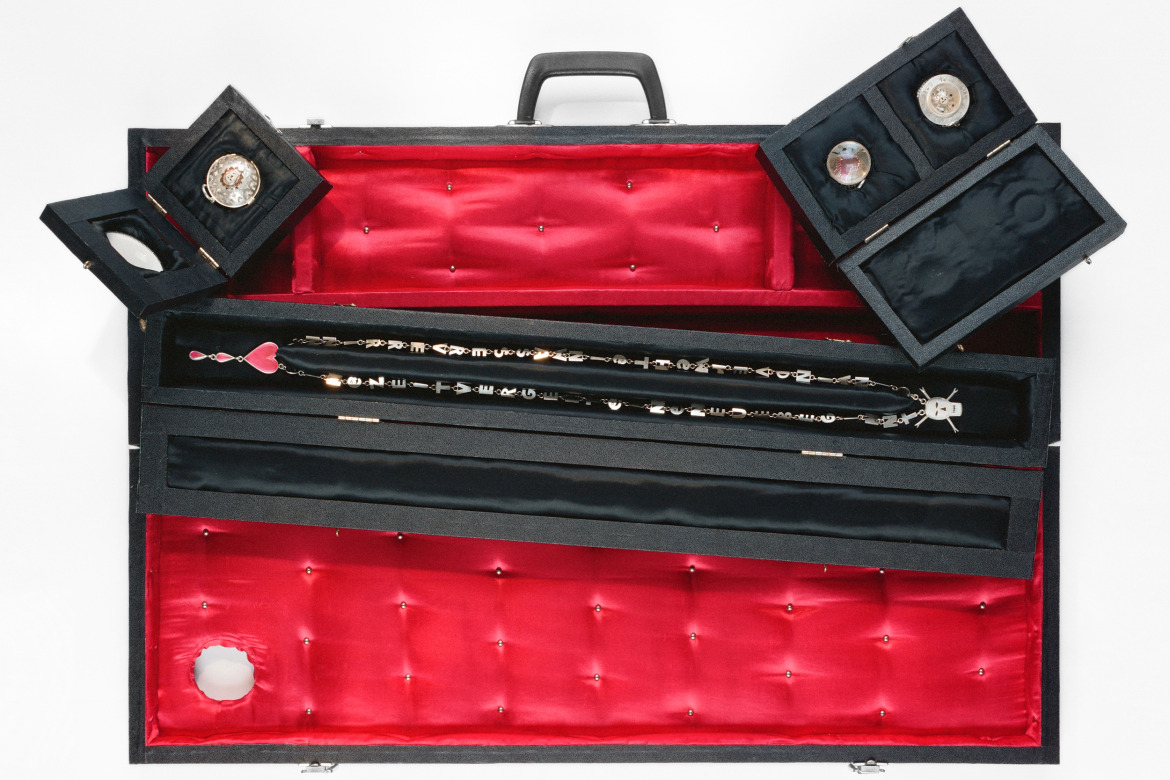
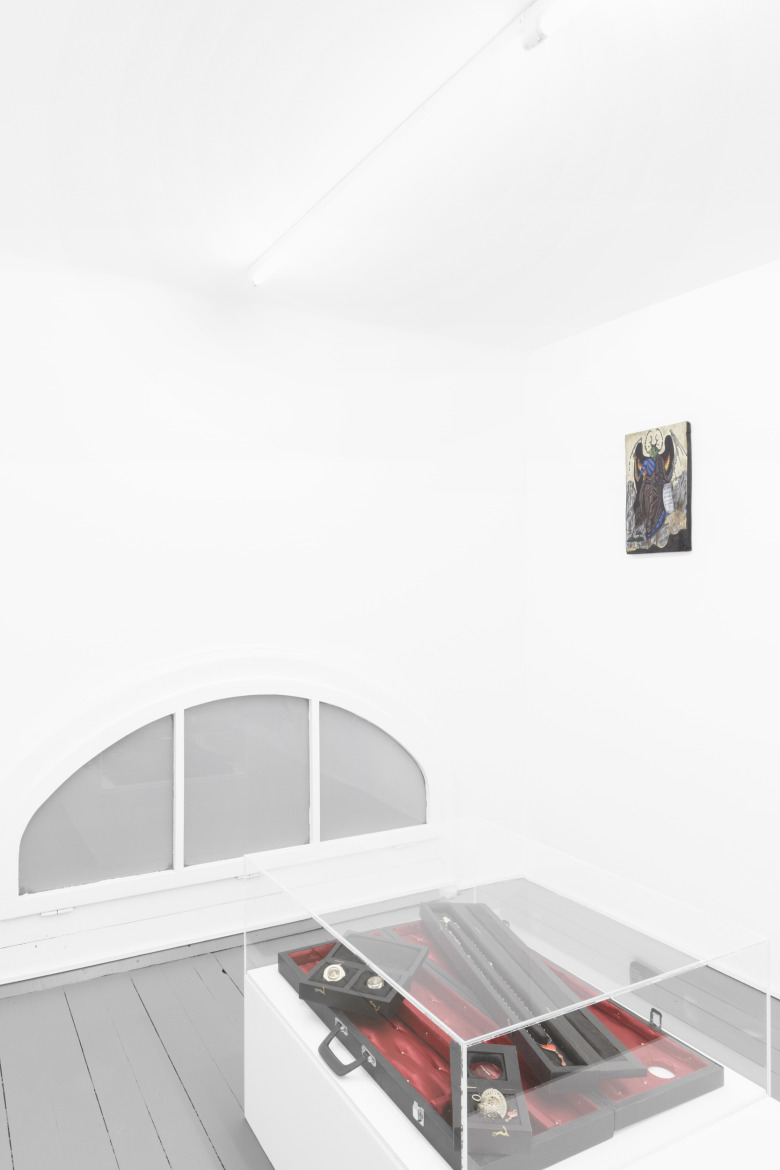
Isolation as artistic practice. The works by Ulrike Johannsen and Anton Stoianov metaphorically relate to the figure of the reclusive hermit and appear as if created in a self-reflexive echo chamber, an inaccessible, therefore non-contextual cave. Though, what just a second ago seemed so familiar through established art historical trajectories, is in fact a rather unknown and refreshing visual. Within the harshly neon-lit gallery space the works seem somewhat misplaced as if to rather aspire to be seen within a dimly-lit, ornate art history museum. Upon closer inspection the familiar lure of the works’ initial appearance shatters and reveals a specific relation to the contemporary. Possibly it is this juxtaposition of the works’ material presence to the bleak global reality that allows the viewer another, more visceral response. These two strongly independent creative visions offer some, if not devotional, but immediate  and magical, almost hallucinating pleasure. We must be tripping or how else can we grasp these works’ contemporary relevance and inherent complexities?

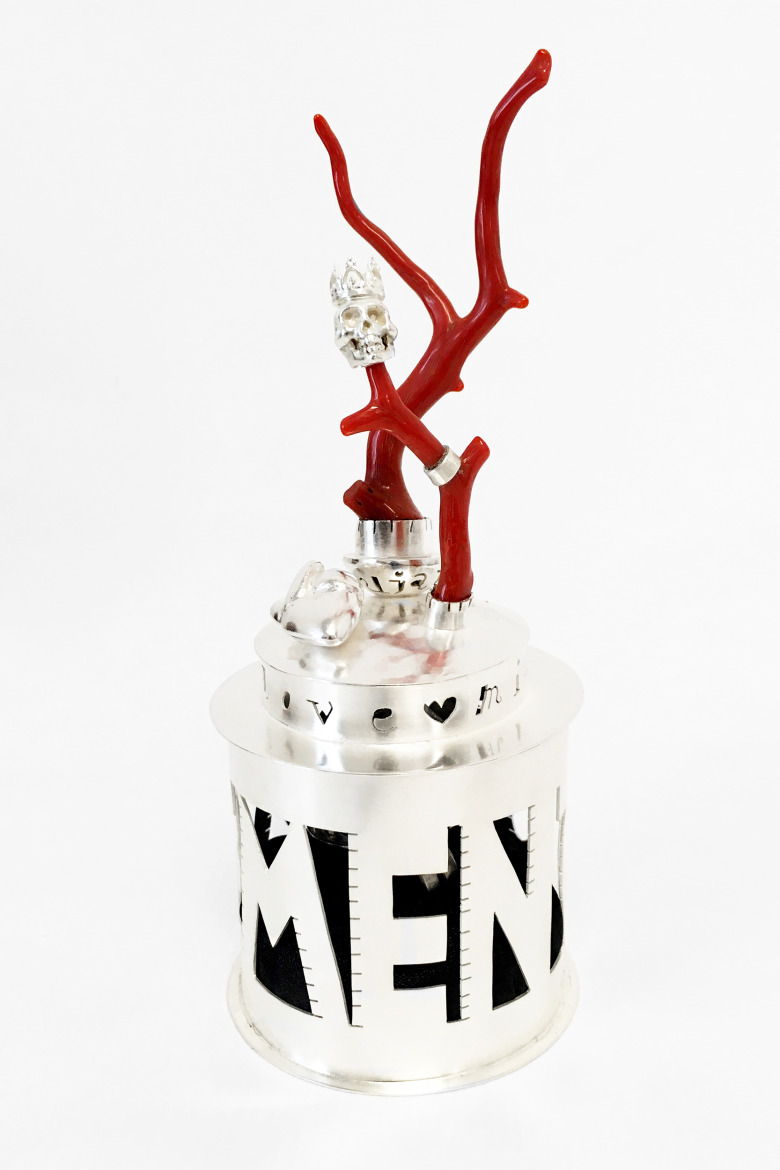
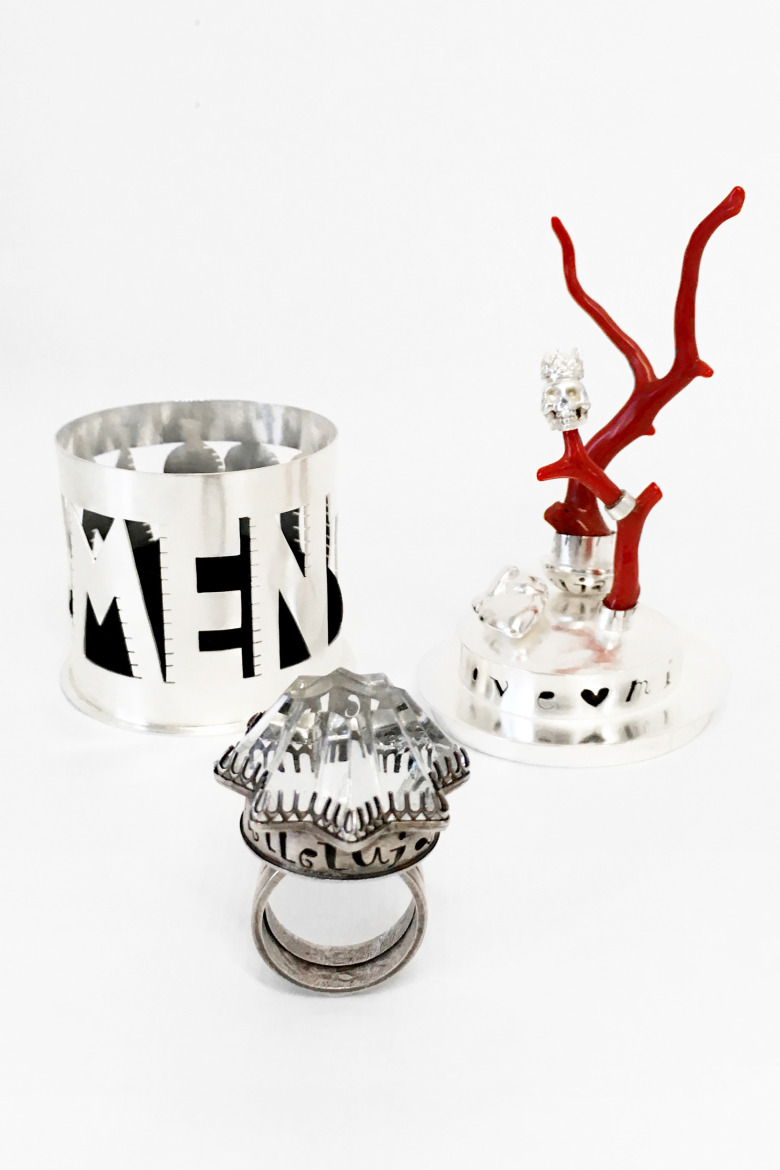
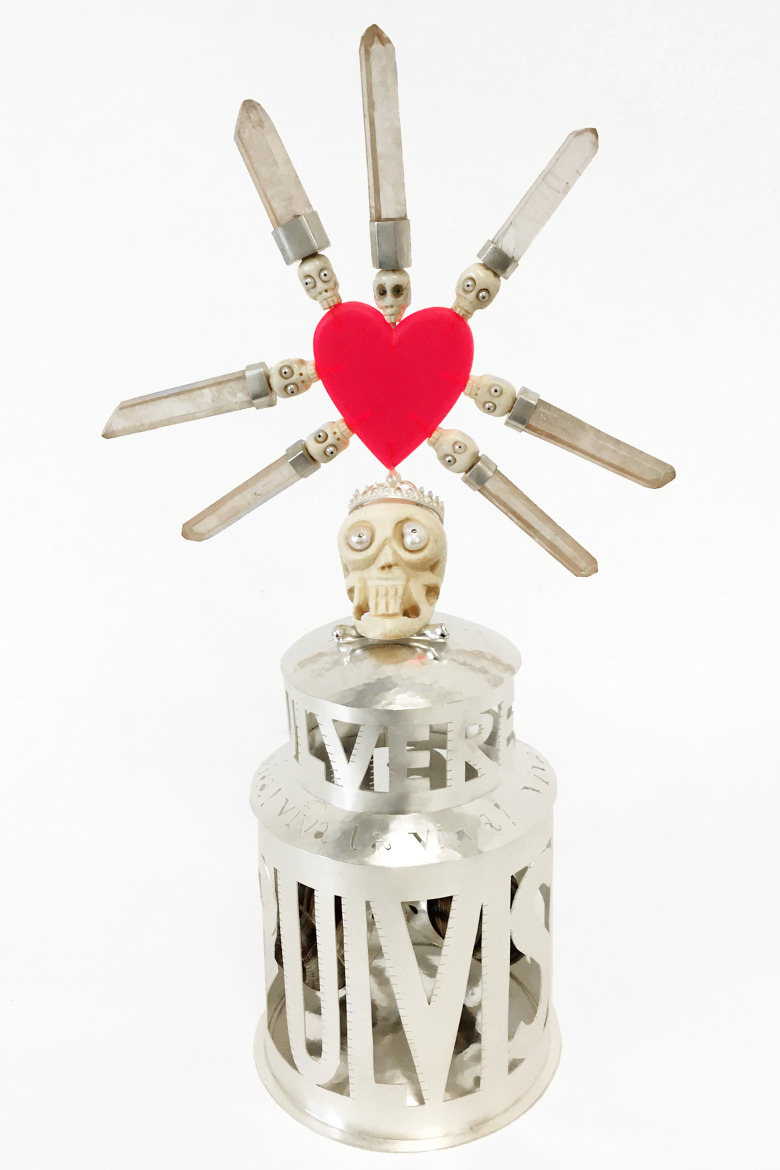
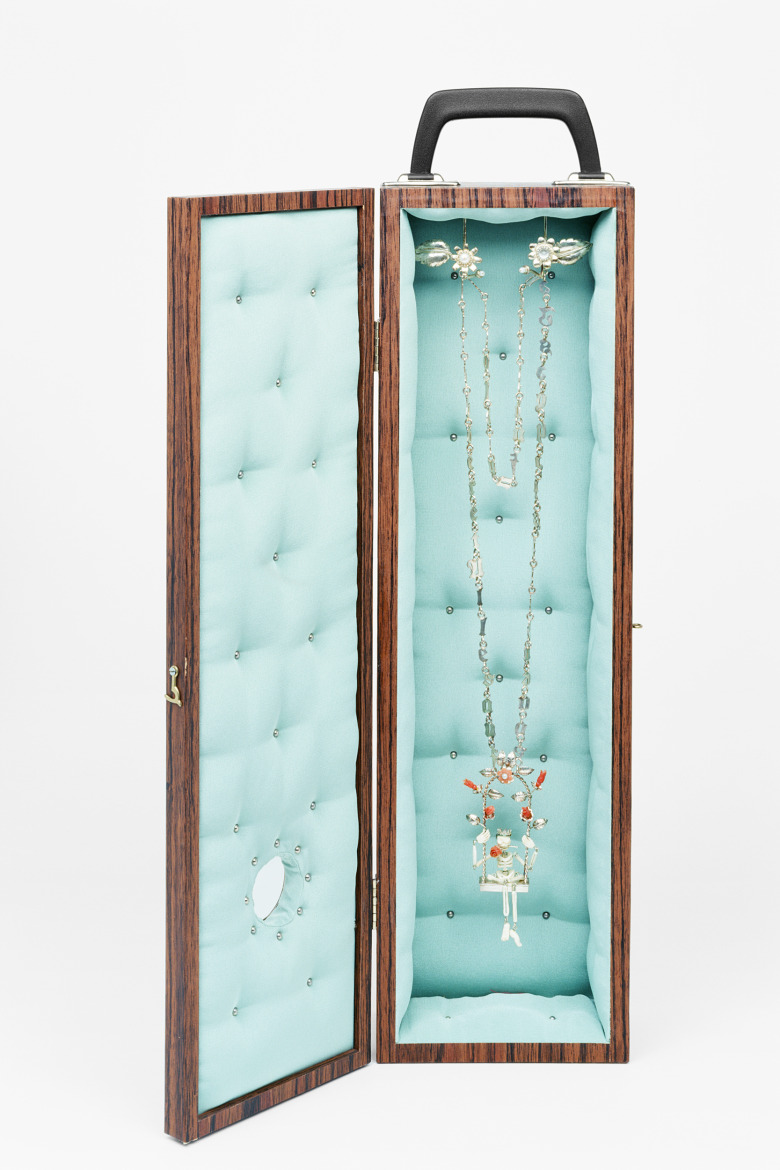
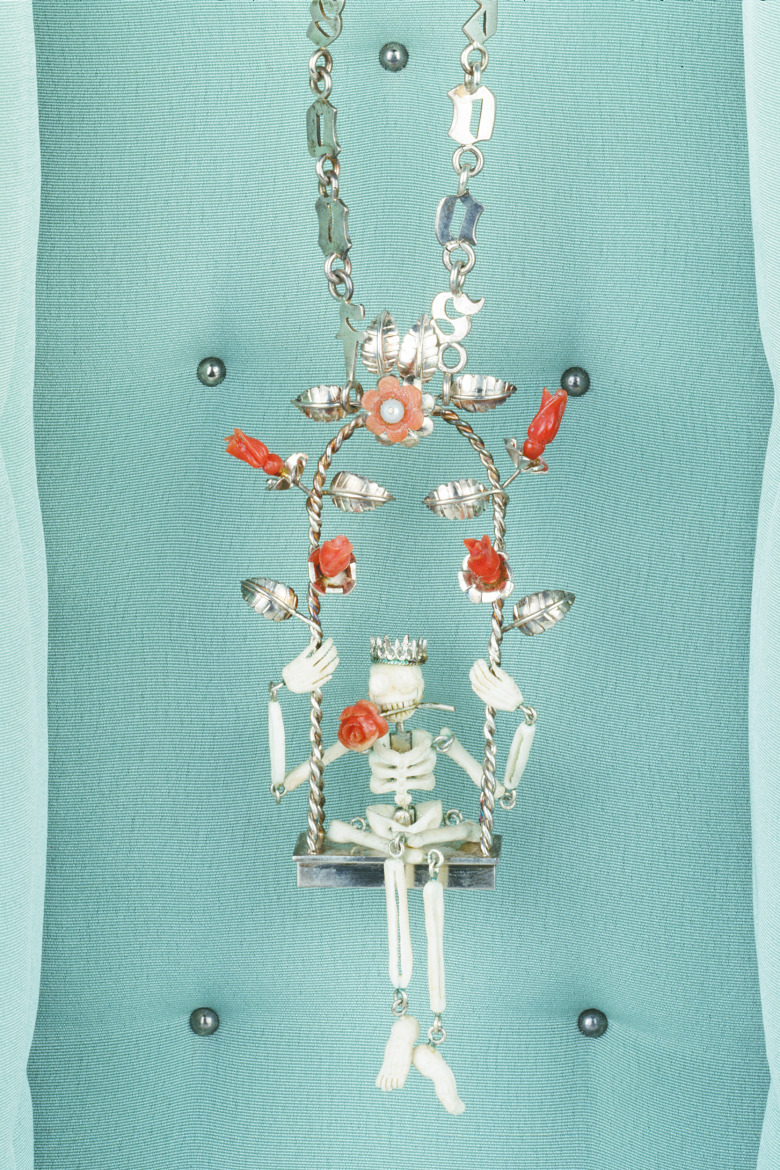
The small-scale but intricately crafted objects by Johannsen, some recent, some from the early 1990s, don’t refer to, but confidently are themselves travel reliquaries set in a historical lineage dating back millennia. Seemingly identical to their historical predecessors in material, craft and precision, what makes these works different is their relation to feminist practice expressed through inscriptions and phallic form as well as their context of presentation. All sense of mystery, of status and knowledge that the historical predecessors projected onto their owners has been transformed by the artist into a pop-ritualistic procession. Within the fully deciphered, analysed and exploited contemporary, these works are poignantly anecdotal and encourage an open, humorous and playful reading. Historical mystery has given way to irony or even tragic comedy. Where and with whom should these works travel to? Who might need their protection? What do we want to carry to the grave? Johannsen’s works harbour an unexplainable magic, a metaphorical weight as much as a comical narrative, a playful precision that leads any attempted conceptual deconstruction ad absurdum. On life’s inevitable rollercoaster crashing due to technical fault, Johannsen’s travel reliquaries can give necessary guidance, identical to the magic embedded in these works’ historic predecessors. 

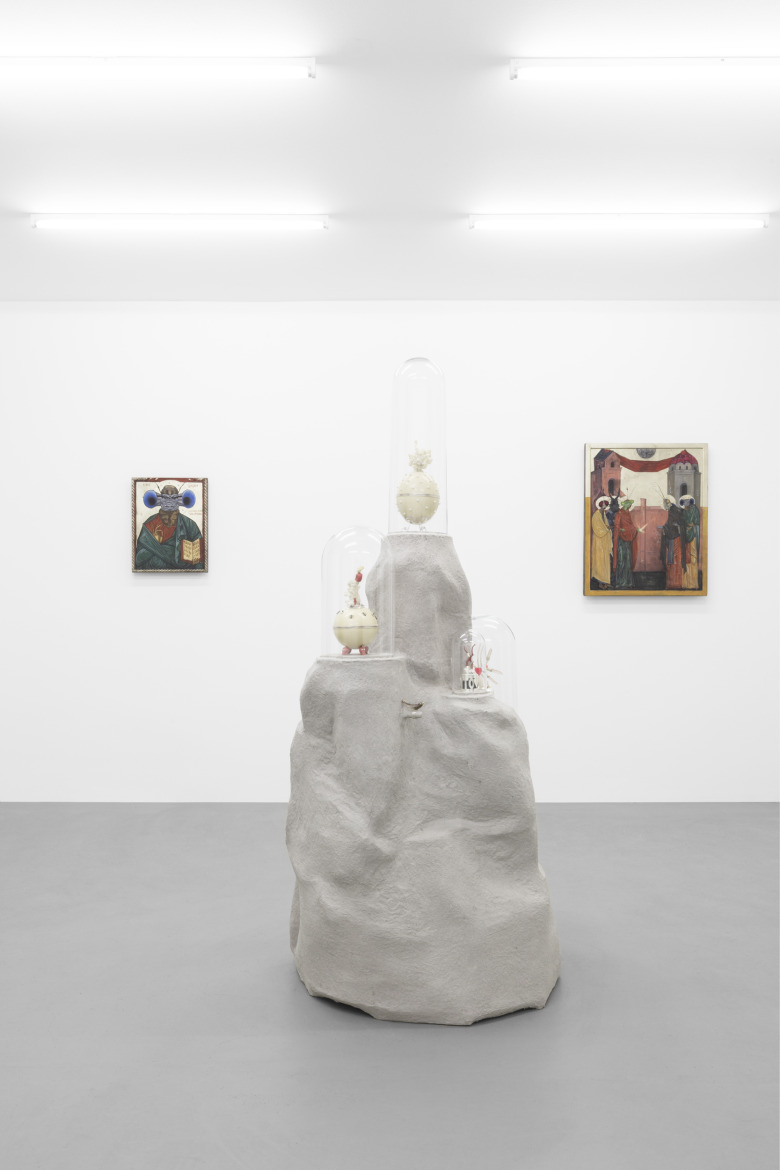
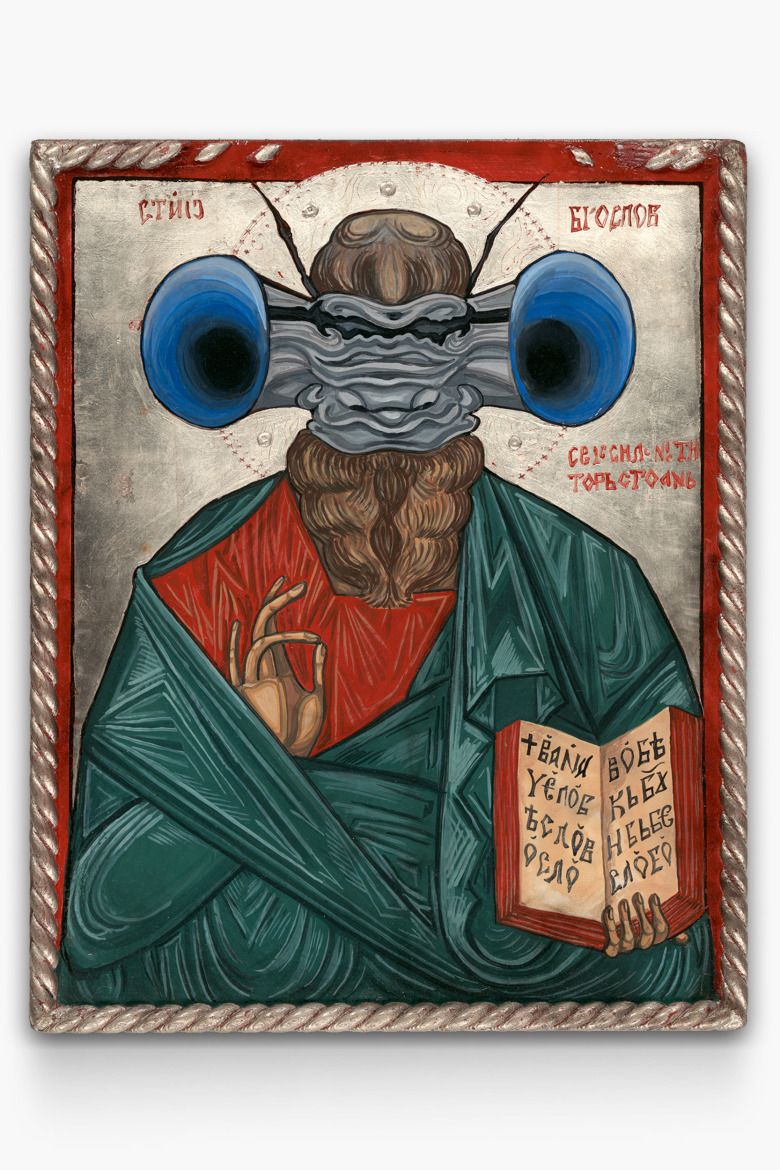
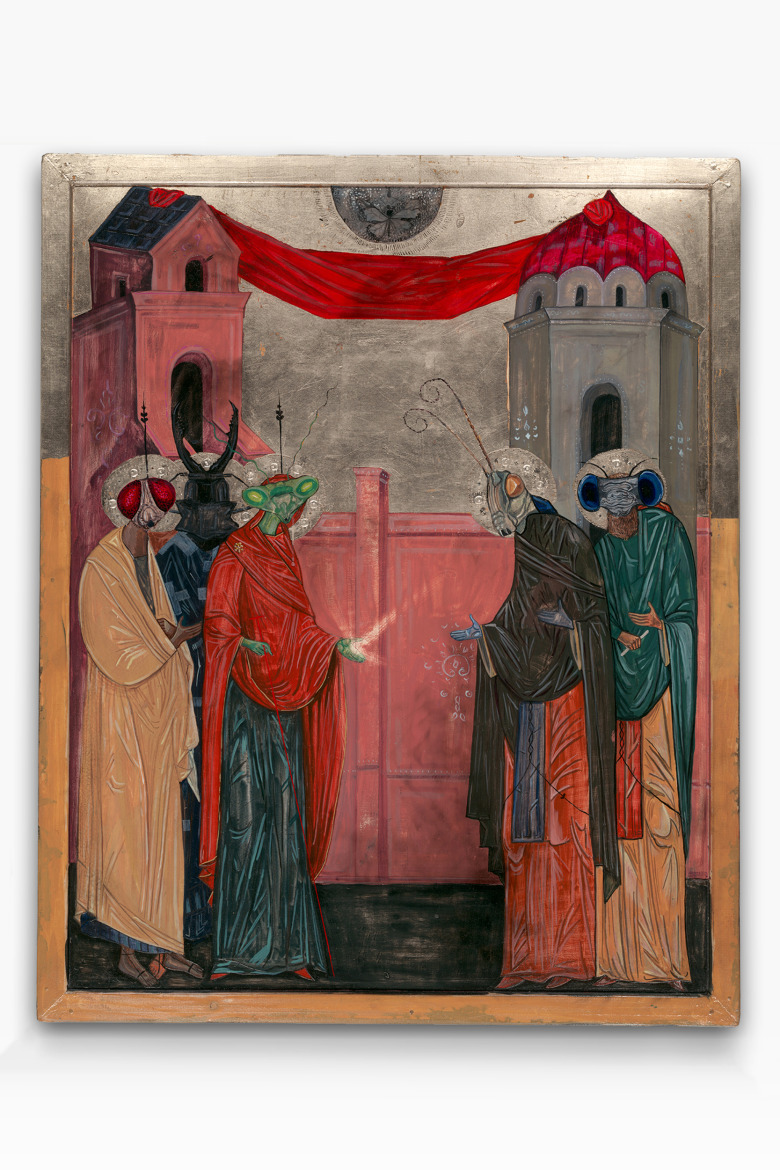
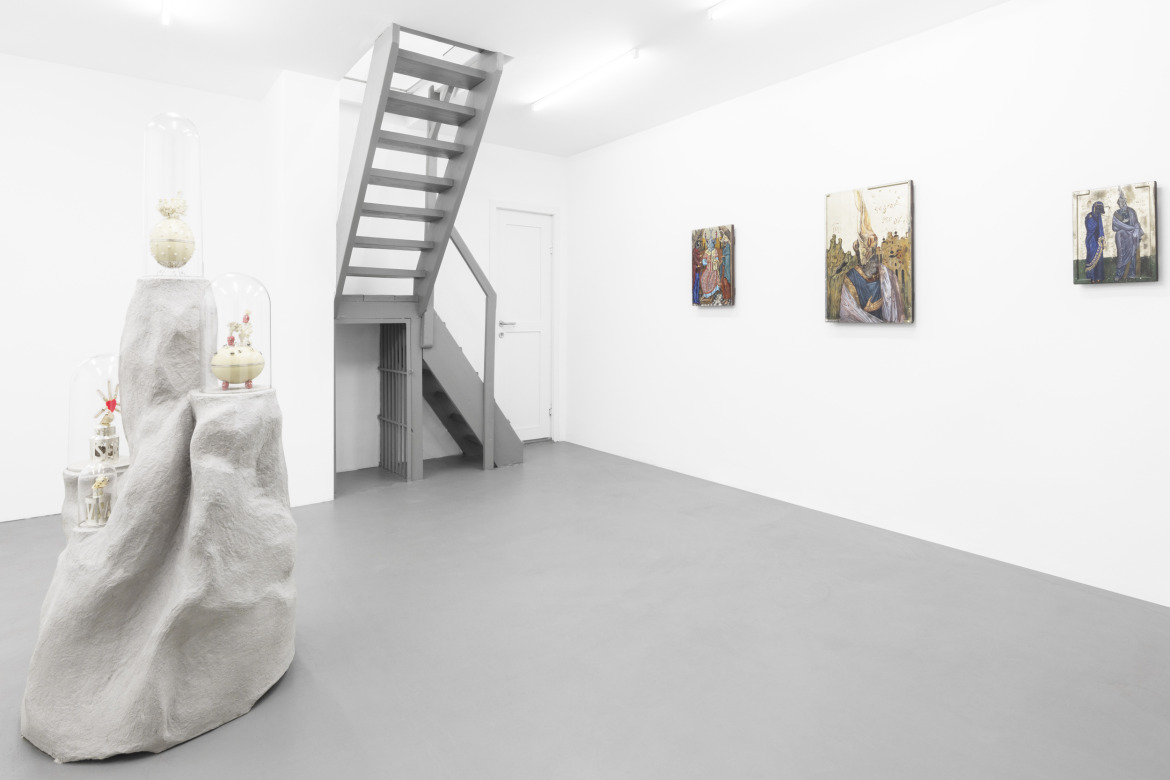
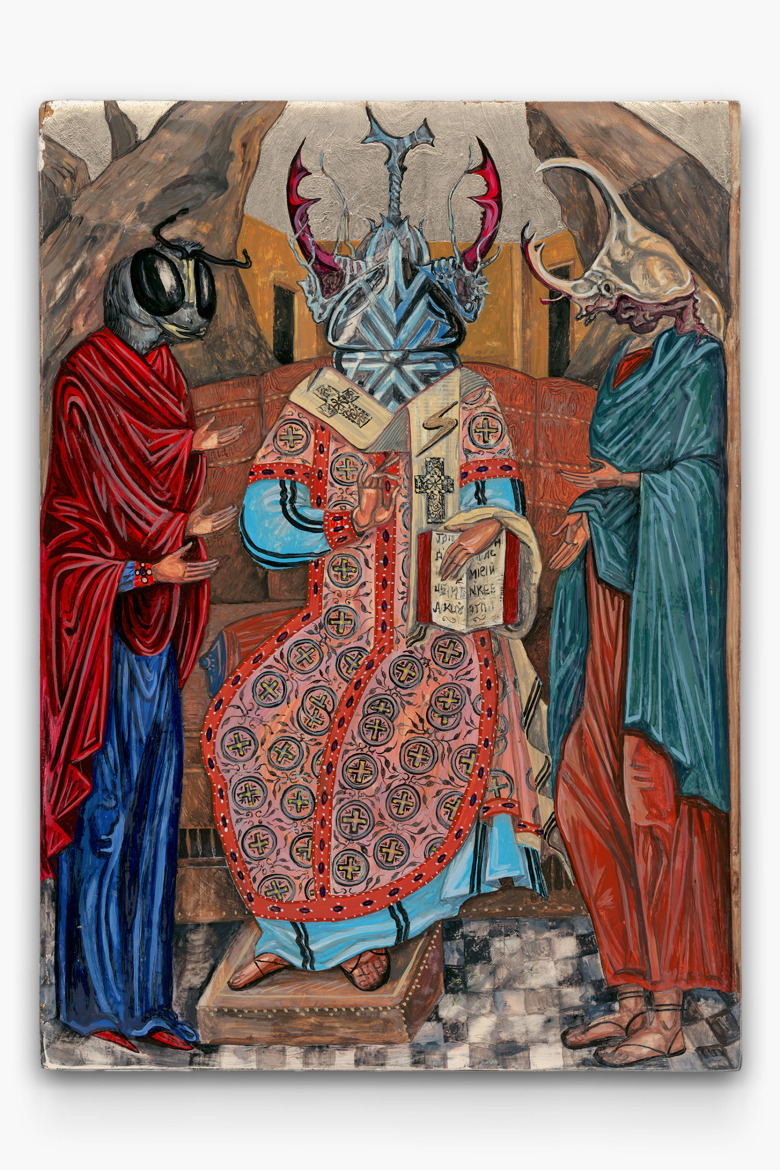
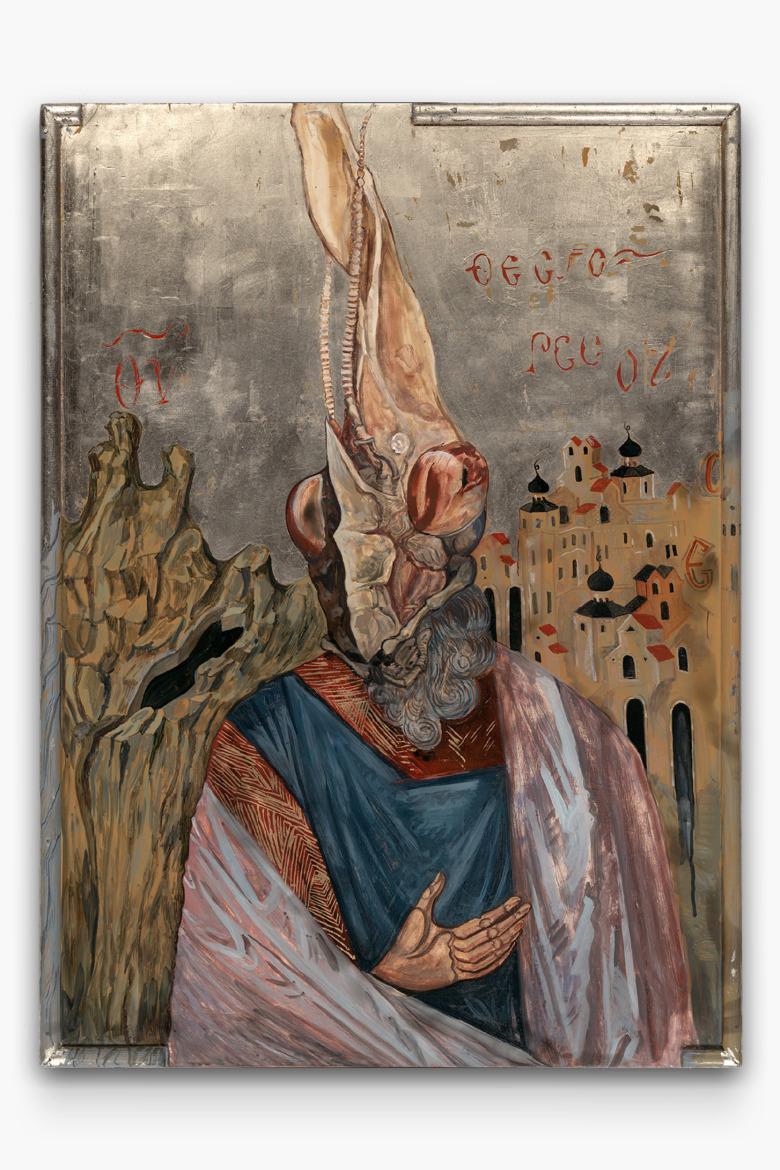
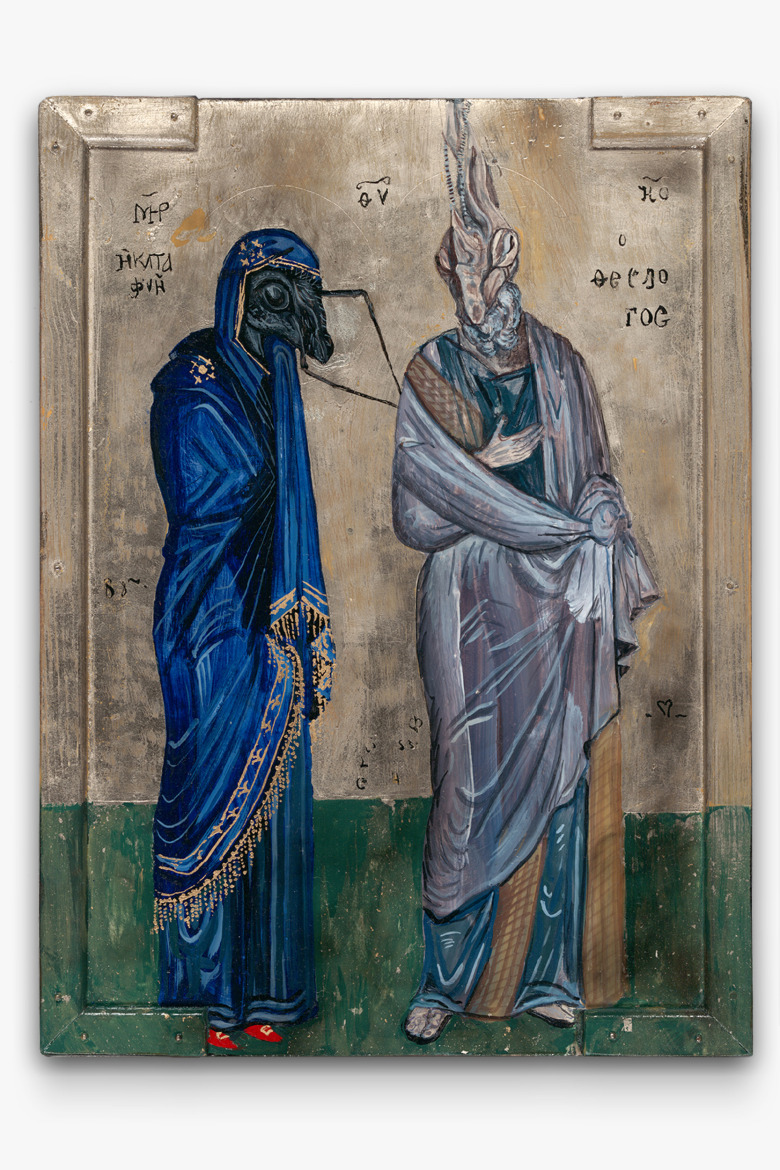
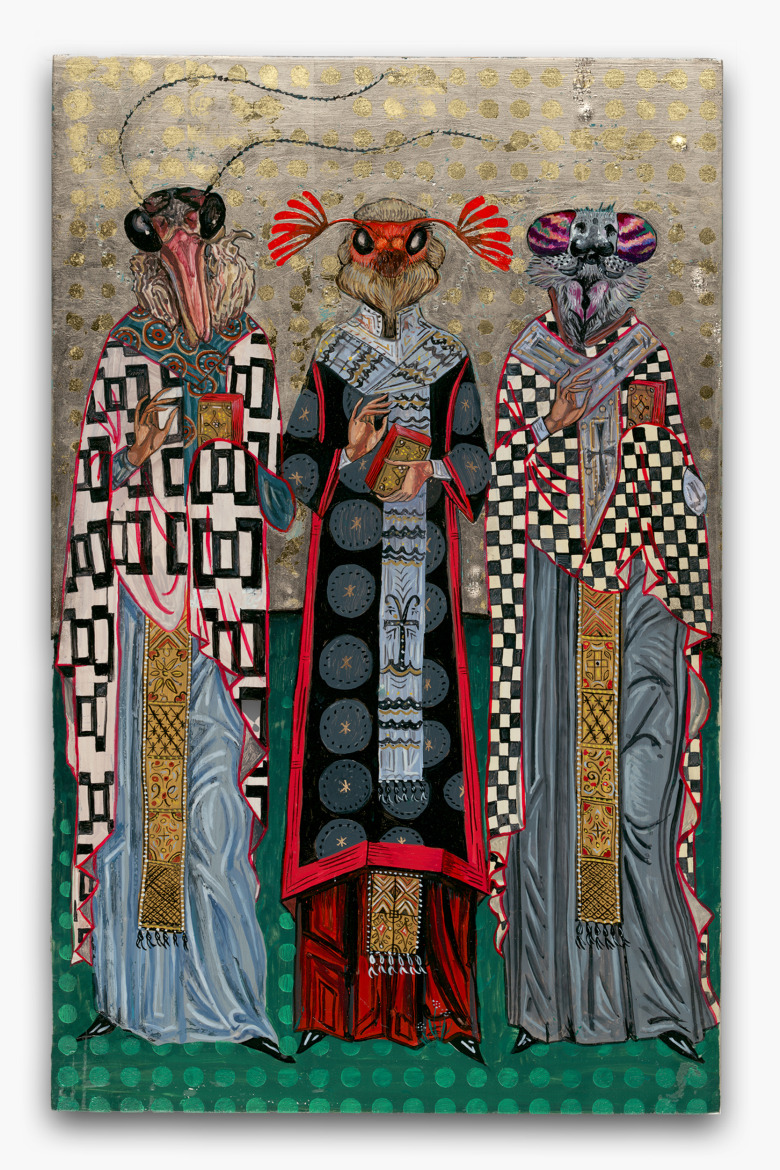
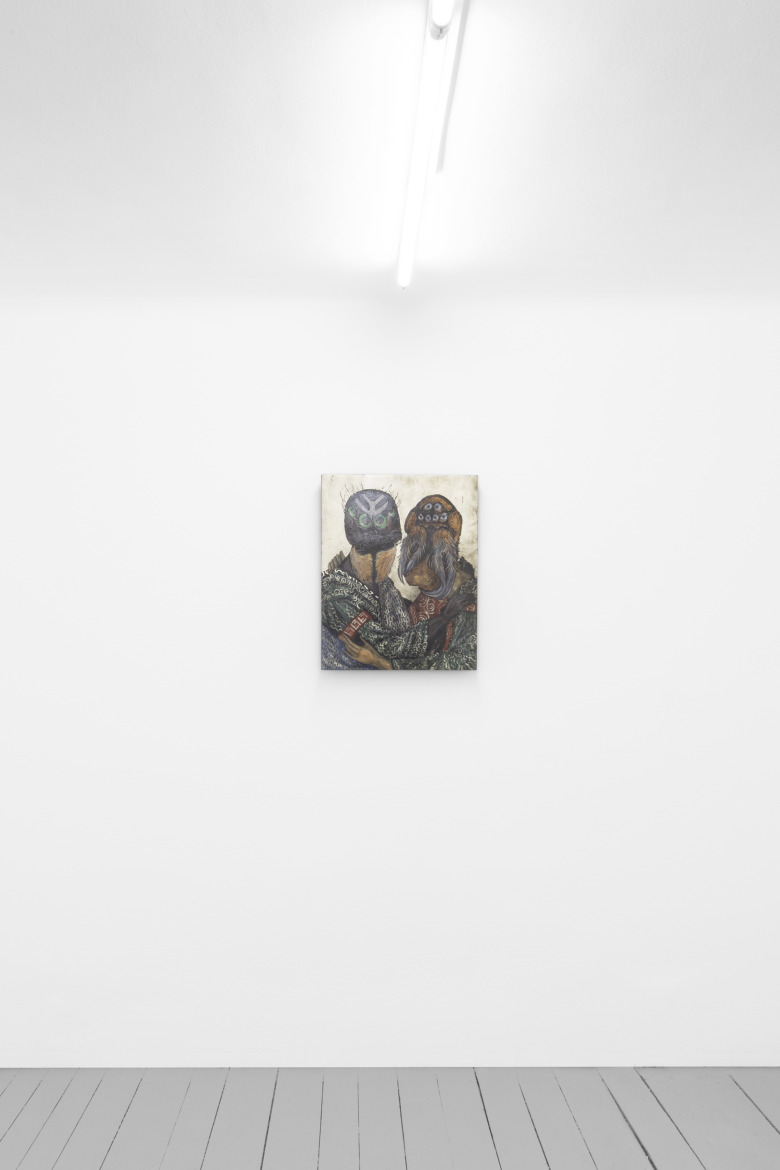
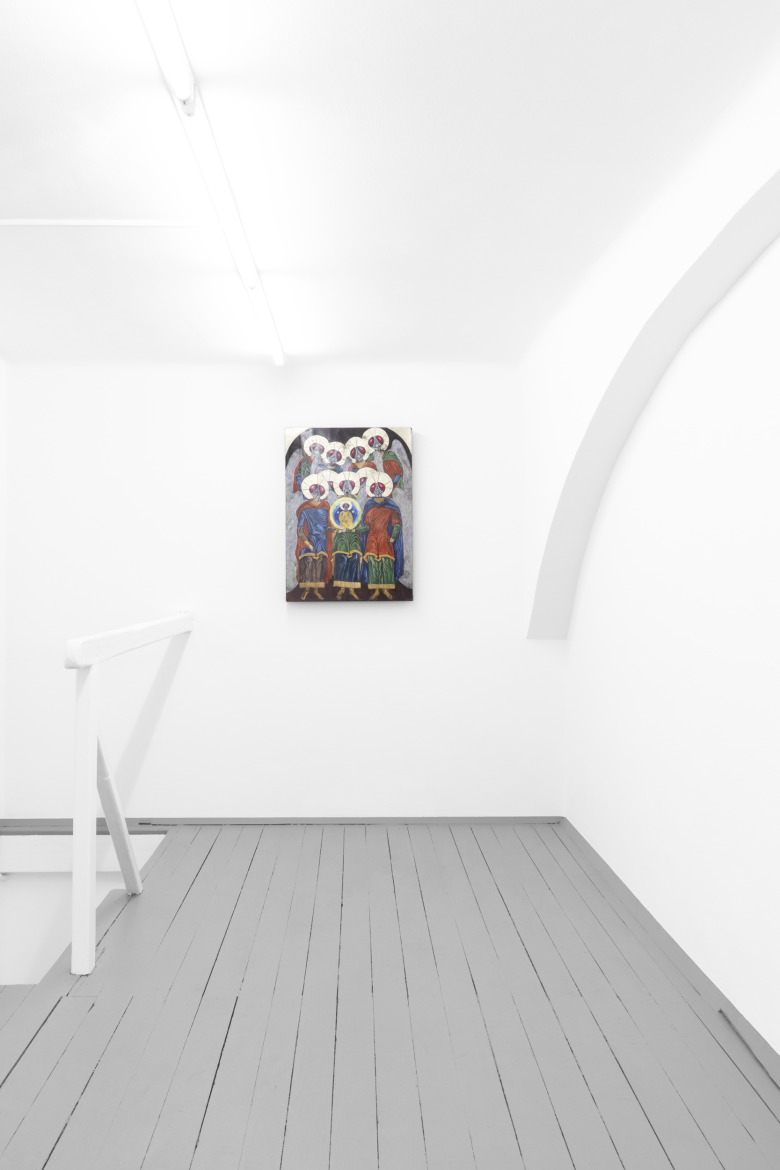
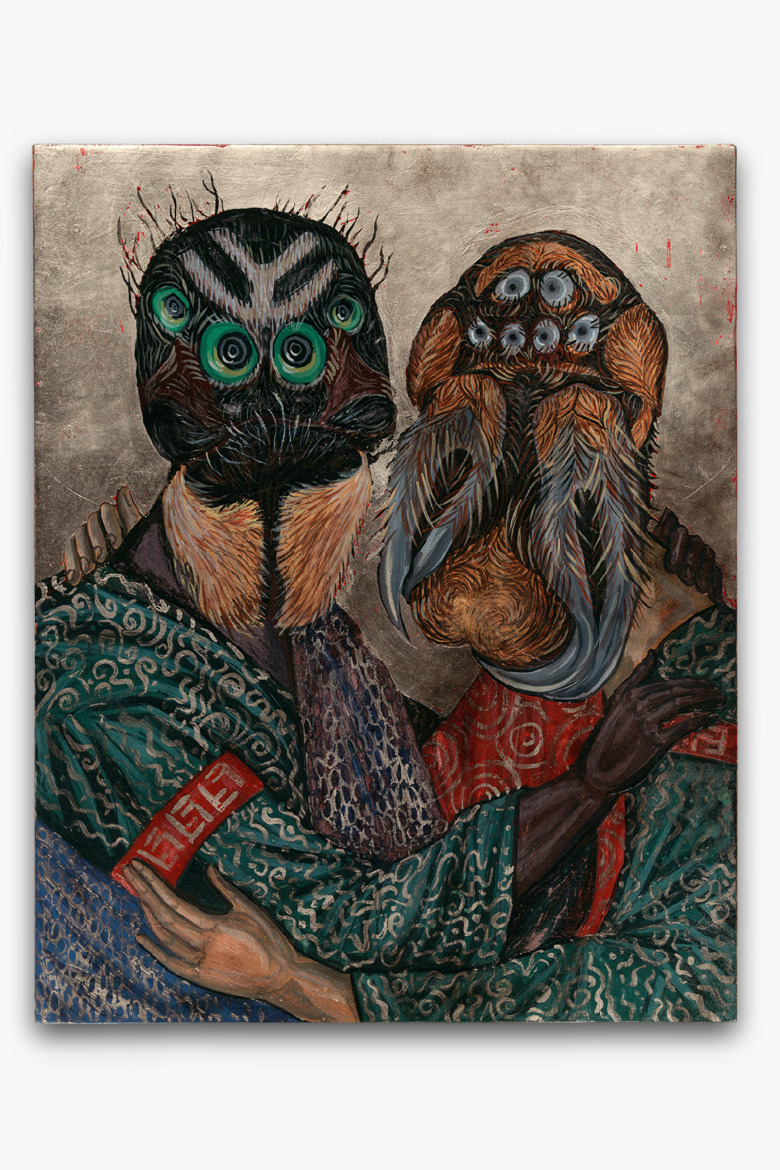
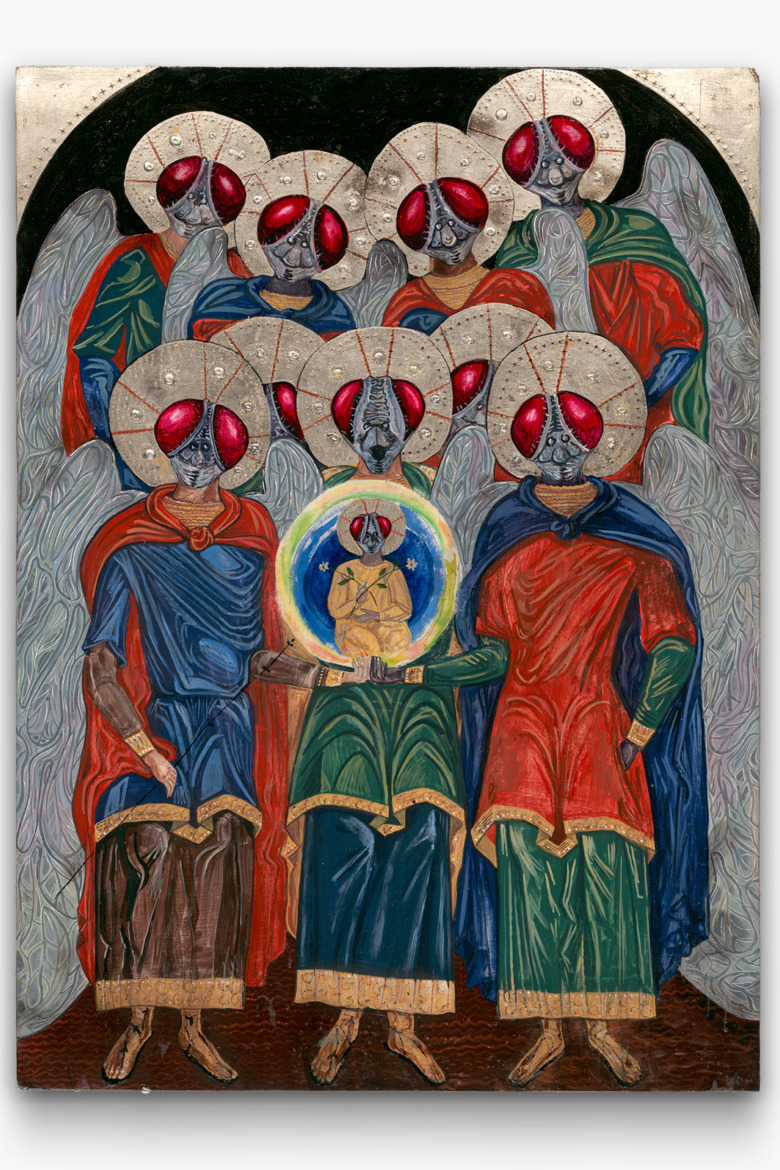
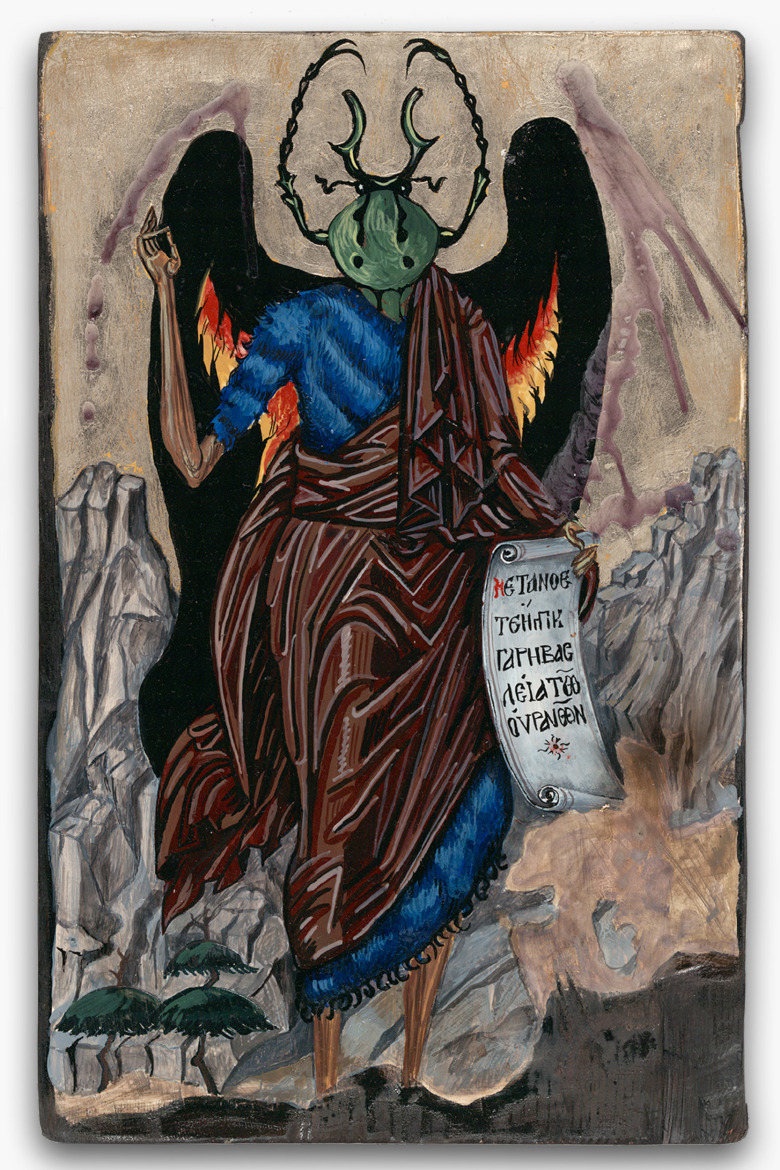
Painted during the calming isolation of the recent pandemic, with the contemporary art world on relieving pause, Anton Stoianov spent endless hours creating what appears reminiscent of orthodox christian artefacts commonly found in ancient churches of far away, mountainous and hard to reach territories. Painted on heavy blocks of wood, Stoianov’s works show priests of an ancient religion, dressed in elaborate and ornate clothing. Painted in a flat, as if pre-perspective spatial setting, the painted deities seem to address the viewer through a long lost, but familiar gestural code. The paintings’ colorful and precious opulence, the priests’ elaborate clothing and auratic body gestures almost make the viewer overlook the core distinction from the historical reference. The deities’ human heads are painted as, or have been replaced by, heads of various insects. While the isolation experienced during the pandemic might have evoked a Gregor Samsa-esque experience, it remains a question what these insect heads actually mean in relation to the otherwise devotional appearance of these works. Do these works address a historical past, critique the anthropocene, or predict the future? A critical analysis in relation to past religious practices seems somewhat dull while a relation to a post-human future seems more fruitful. In such a future, insects, having survived human-caused oblivion, have retouched themselves into human archeological artefacts as replacement goddesses of a trippy insectoid iconography.

The exhibited works oscillate between a wunderkammer-esque notion of magic, mystery and ancient tradition as well as fear, precariousness and outsiderist production. Isolationist artistic strategies becomes metaphors for social hermit-like withdrawal. At the end of another challenging year, we might need to refer back to their protection, to their comforting support to navigate the many melting icebergs ahead. By rephrasing the superstitious, yet colorful bleakness of ancient dark ages, these bodies of work could be seen as praying mantises of wishful thinking or as soothing offerings to prevailing gods of war and destruction. Though likely, we collectively sit way too deep inside a pitch-black artificial cave, too removed from the entrance to turn back.

Curated by Christian Siekmeier

Dead End Galaxies

For the lack of better knowledge galaxies are infinite, endless spaces, which will always offer an ever so imaginary escapist niche, somewhere. Such magical spheres where Siri or Alexa are just poetically named starlets, where a ‘Hello Alexa’ remains unanswered, where there is silence beyond entrenching reason.

The longing to escape to such a non-defined, free space is as ancient as contemporary relevant. In times of seemingly endless reason, it remains the ultimate desire, yet ultimately results in a dead end. No form of contemporary escapism can any longer provide an idealized, naïve notion of a lost paradise. Escapism is at its end as it is en vouge. Parallelism or Internalism can provide relief yet, in the very end, it is the here and now.

Anyone who has thought about parallel universes will know that it is hard to figure out which one of them is ‘real’. The denominators of what we call ‘reality’ have become blurred, a new flexibility of ‘truth’ rules even over the galaxy we currently reside in. The ‘fake-news’ of the day is poking holes in the sensitive skin of our very own filter-bubbles and within the blink of an eye your day can vault you into the ‘upside-down’.

Maybe it is time to travel. Where could we go from here?

‘Introspection’ is the new long distance journey, as we slide through the endless feed of information and images that busy algorithms have chosen for our fingers to scroll through: A gentle touch, a ‘reaction’ of sorts – like staring into the abyss of binary code.

The afterimage of a world seen from outer space, the alienation of the self and ‘the other’ in a dense habitat we share with the digital creatures of our own making. Looking at the remainders of the world we produce and consume, light years filled with the human trace of artificial goods, it is time to enter the void.

The inscription of a seminal painting by the French artist Paul Gauguin reads “Where Do We Come From? What Are We? Where Are We Going?” (P. Gauguin / 1897), a question still unaccounted for as of today. A promise has been made, and for the longest time it remains unfulfilled.

Dead End Galaxies is a single exhibition running parallel across two different cities connected via a time tunnel.

Opening: Sat, Mar 10
Dead End Galaxies at EXILE, Berlin
Artists: Angelika Loderer, Bitsy Knox, Christophe de Rohan Chabot, Core.Pan, Hanny Oldendorf, Nicholas Riis, Phillip Mueller, Real Madrid, and Studio Furthermore.

Opening: Sat, Mar 17
Dead End Galaxies at POLANSKY, Prague
Artists: Bitsy Knox, Christophe de Rohan Chabot, Erik Niedling, Jura Shust, Pakui Hardware, Patrick Panetta, Pauł Sochacki, Sarah Pichlkostner, and Sarah Schönfeld.

Dead End Galaxies is curated by Marlies Wirth, Curator for Digital Culture and Design at MAK Vienna, and Christian Siekmeier, EXILE.

Features
Art Viewer


Richard Jaray

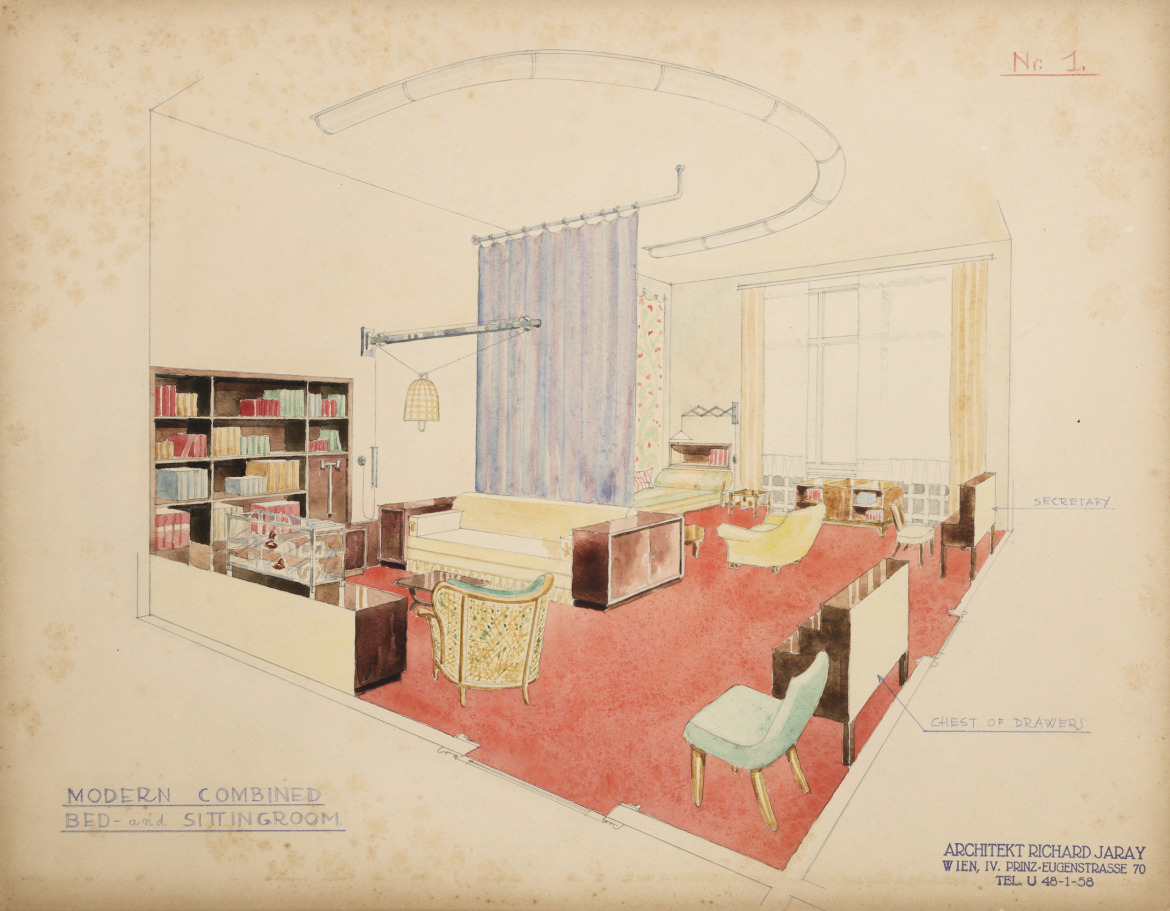
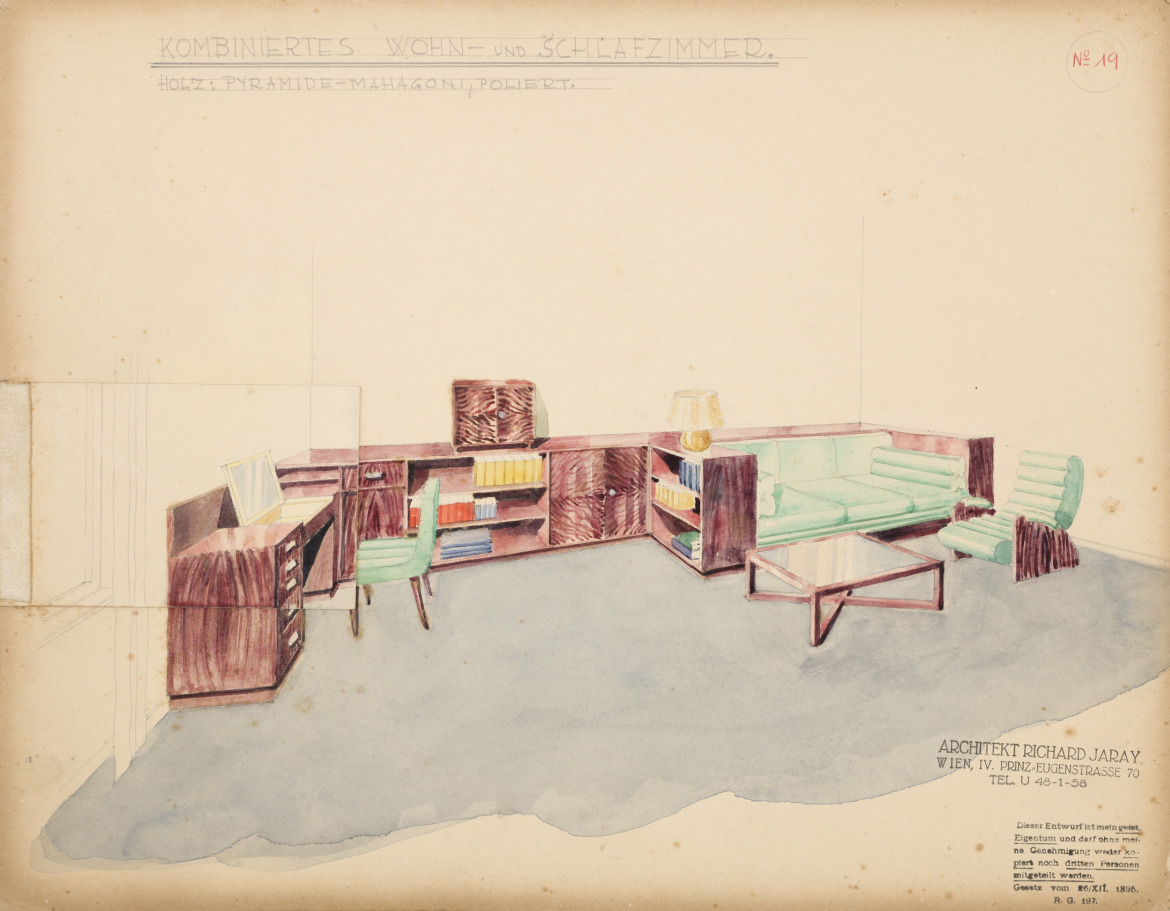
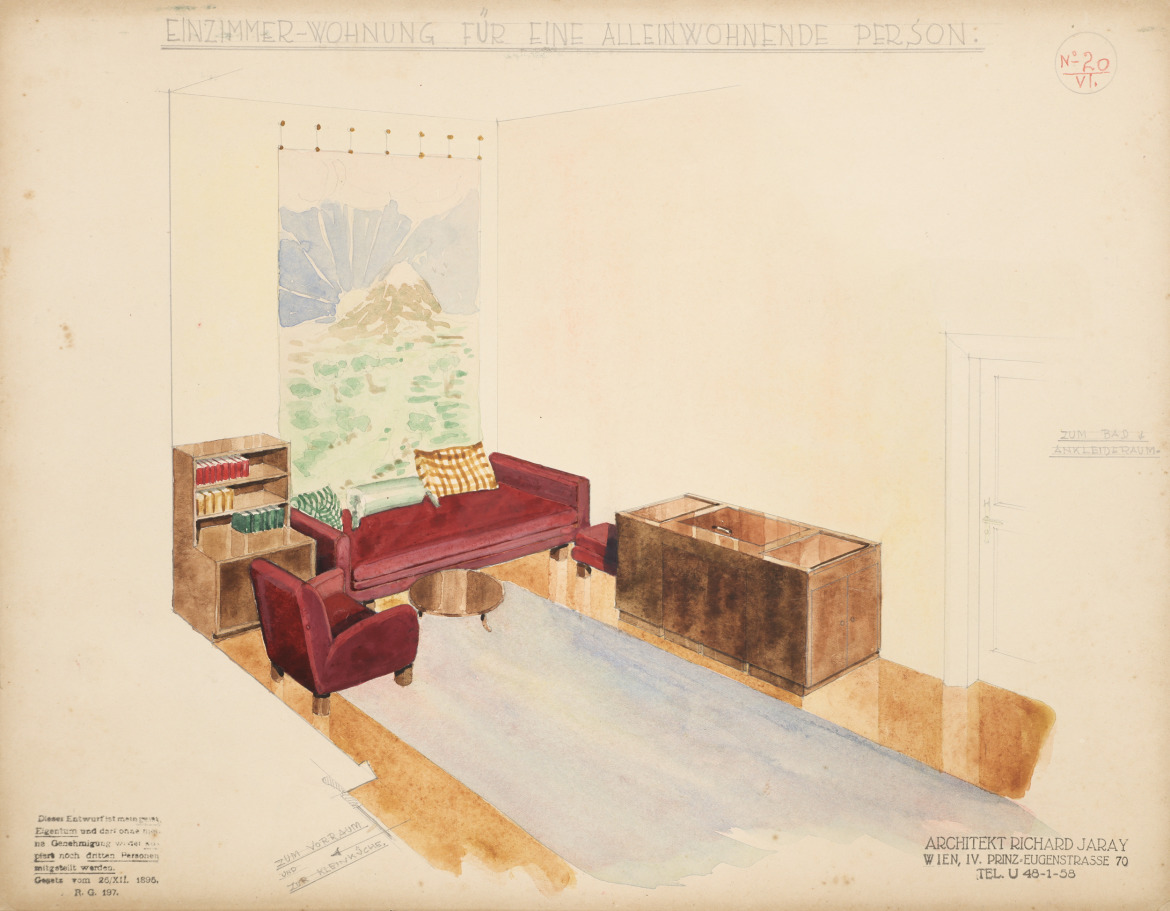
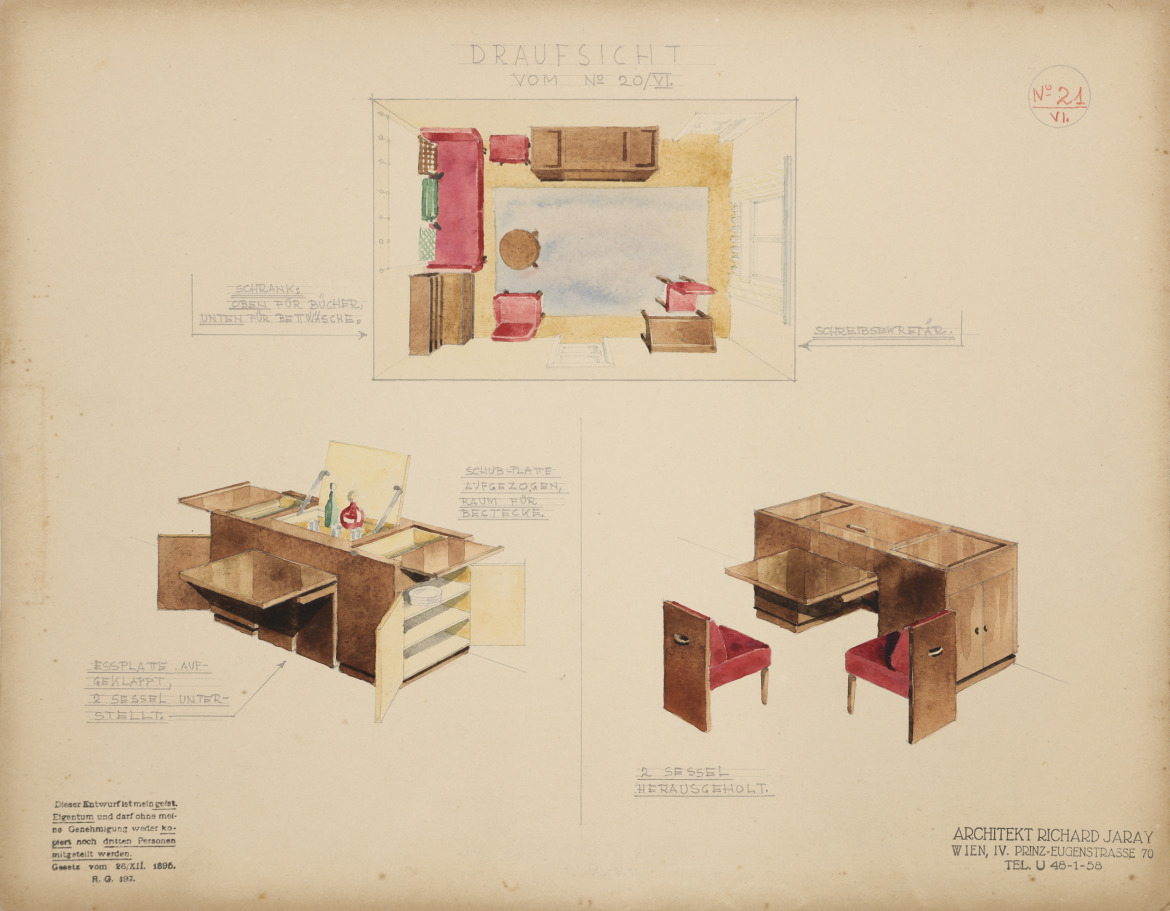
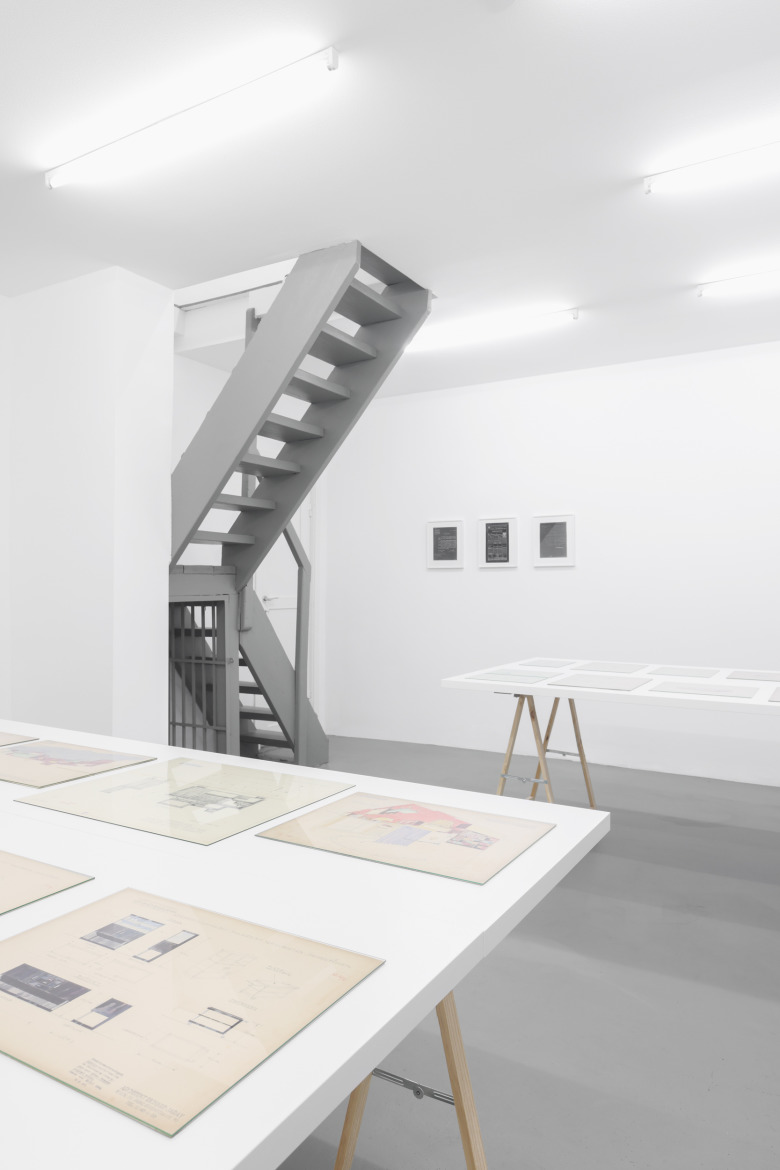
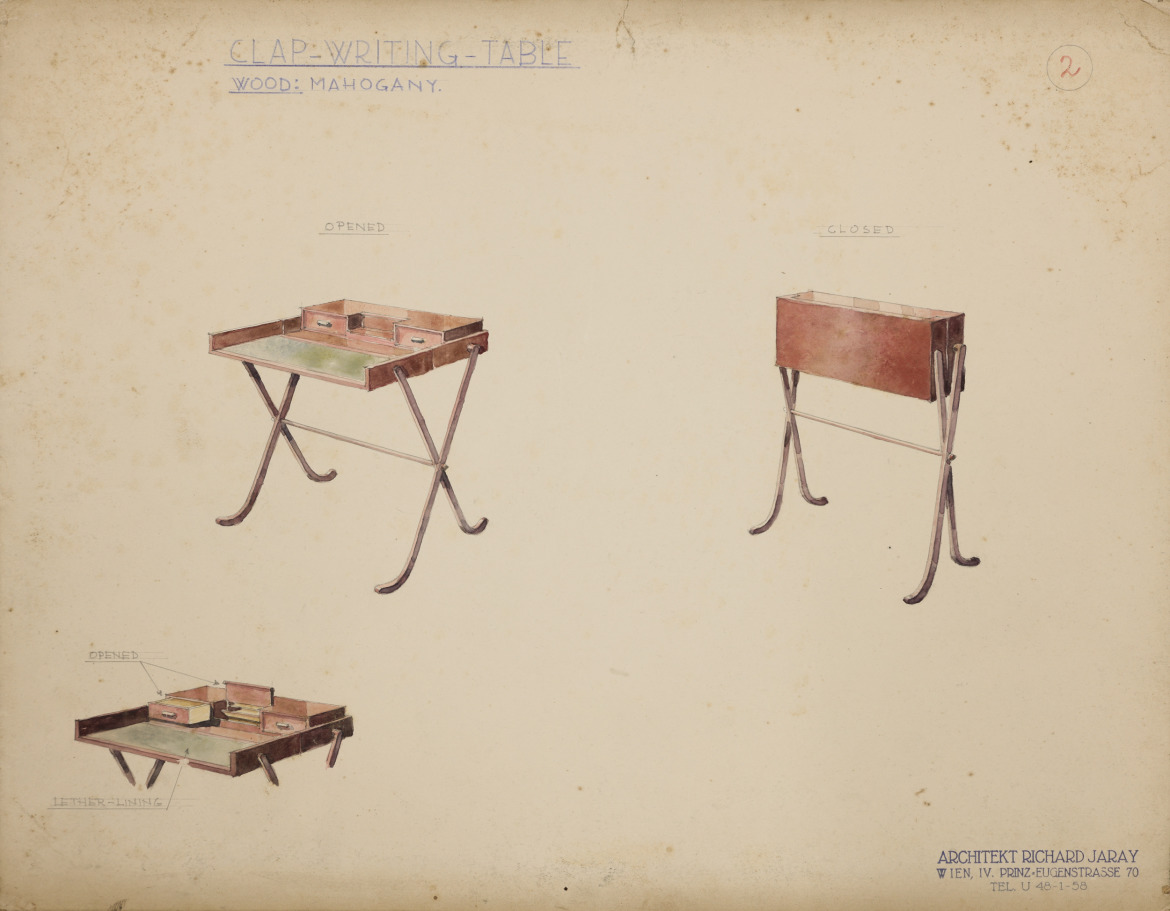
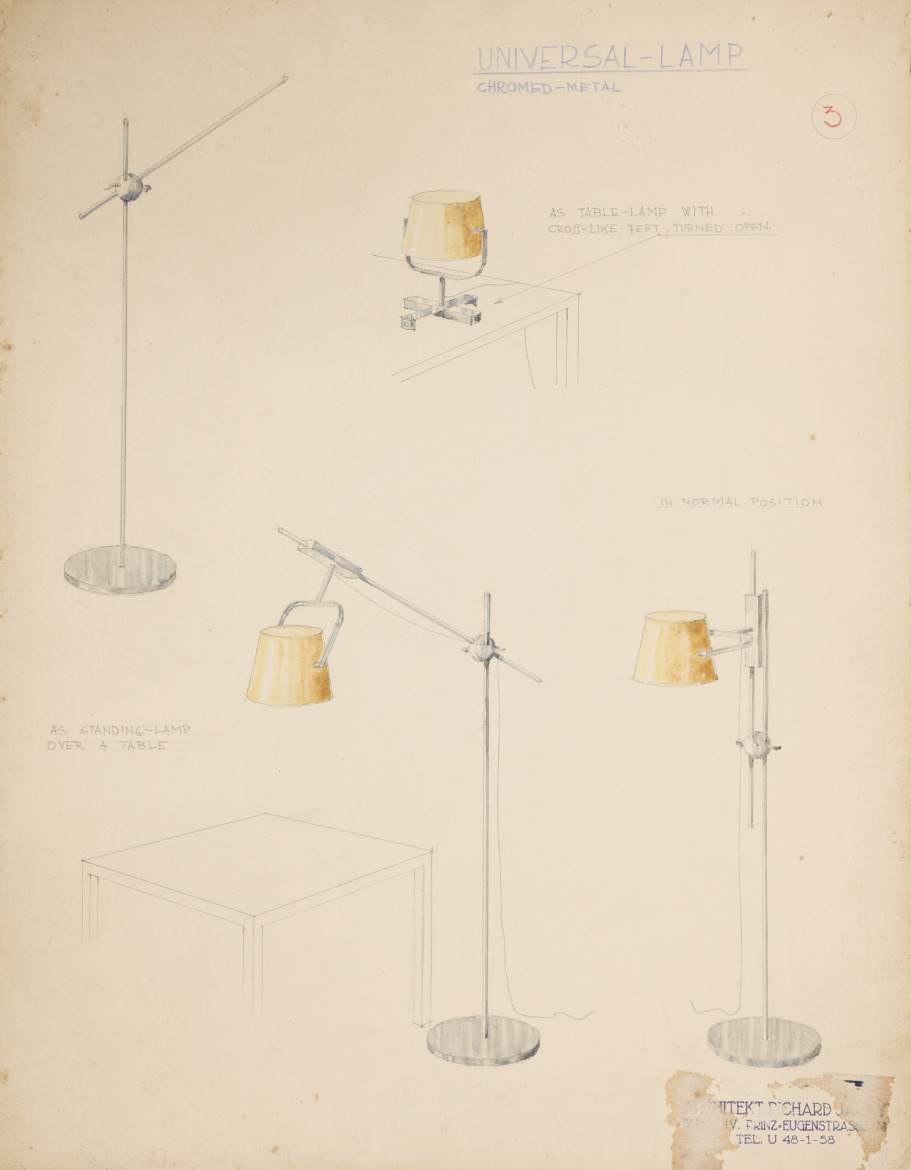
Following many months of renovation closure and various lockdowns we are happy to invite you to the reopening of our physical space with a presentation of the estate of Richard Jaray (1902-1942) conceived by Tess Jaray, artist and niece of Richard Jaray, Sebastian Hackenschmidt, curator for furniture and wood work, Museum of Applied Art, Vienna, and Christian Siekmeier, founder of EXILE.

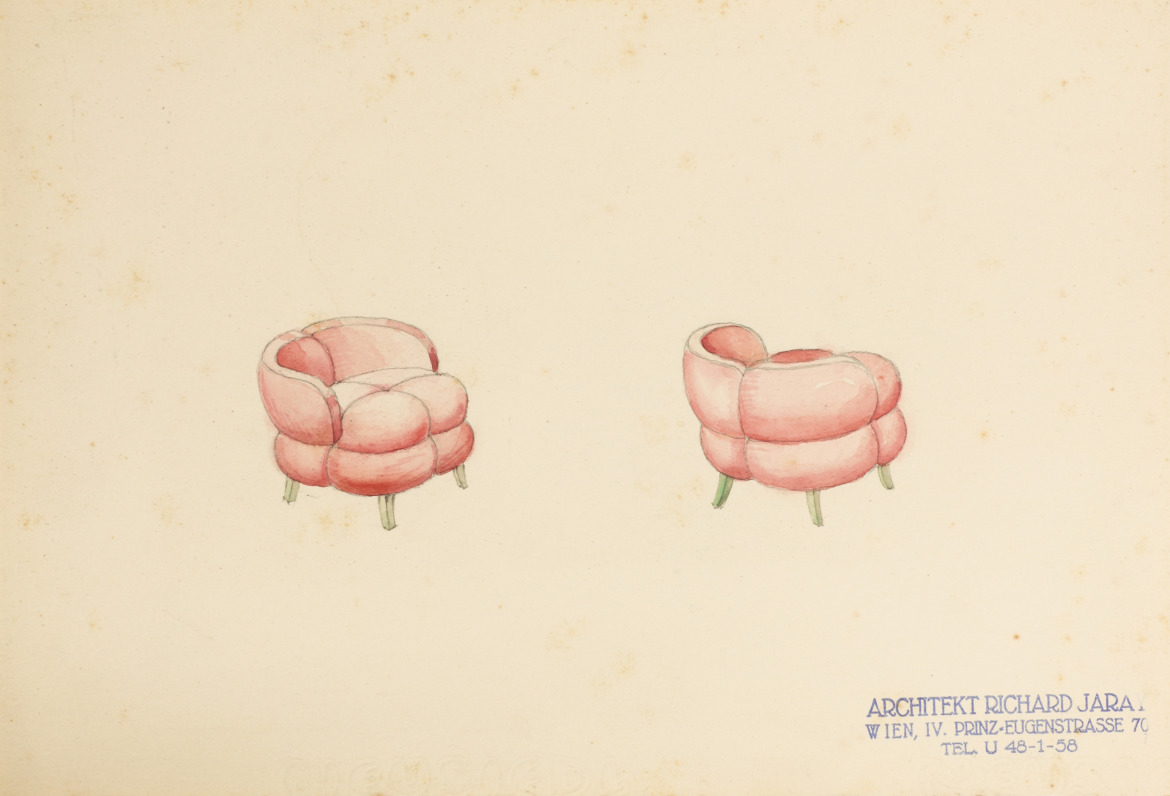
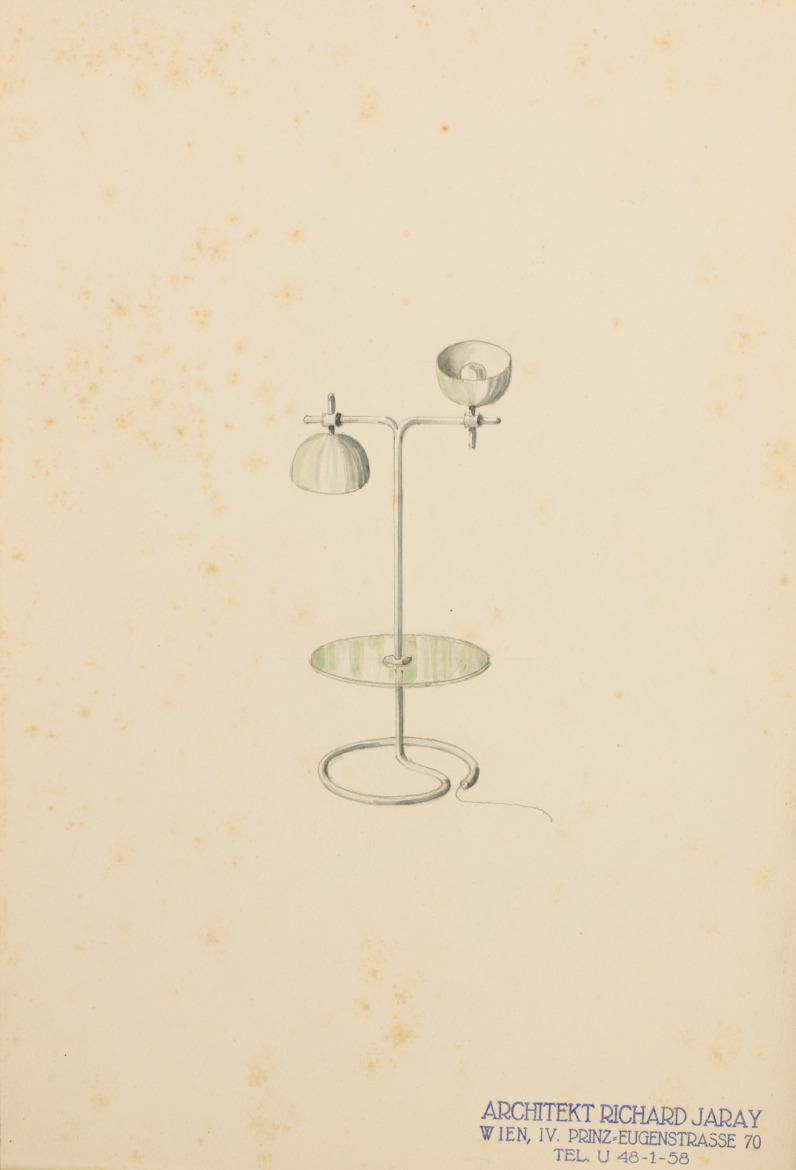
The presentation will give insight into the work and life of the architect Richard Jaray and was originally scheduled to be held parallel to Tess Jaray’s first institutional solo exhibition in Vienna at Secession which closed on April 18, 2021 entitled Return to Vienna. Born into the Jaray family furniture business in Vienna in 1902, Richard himself became a furniture designer and architect but was unable to escape Austria in time. He was deported in 1941 to Łódź and murdered during the Shoah.

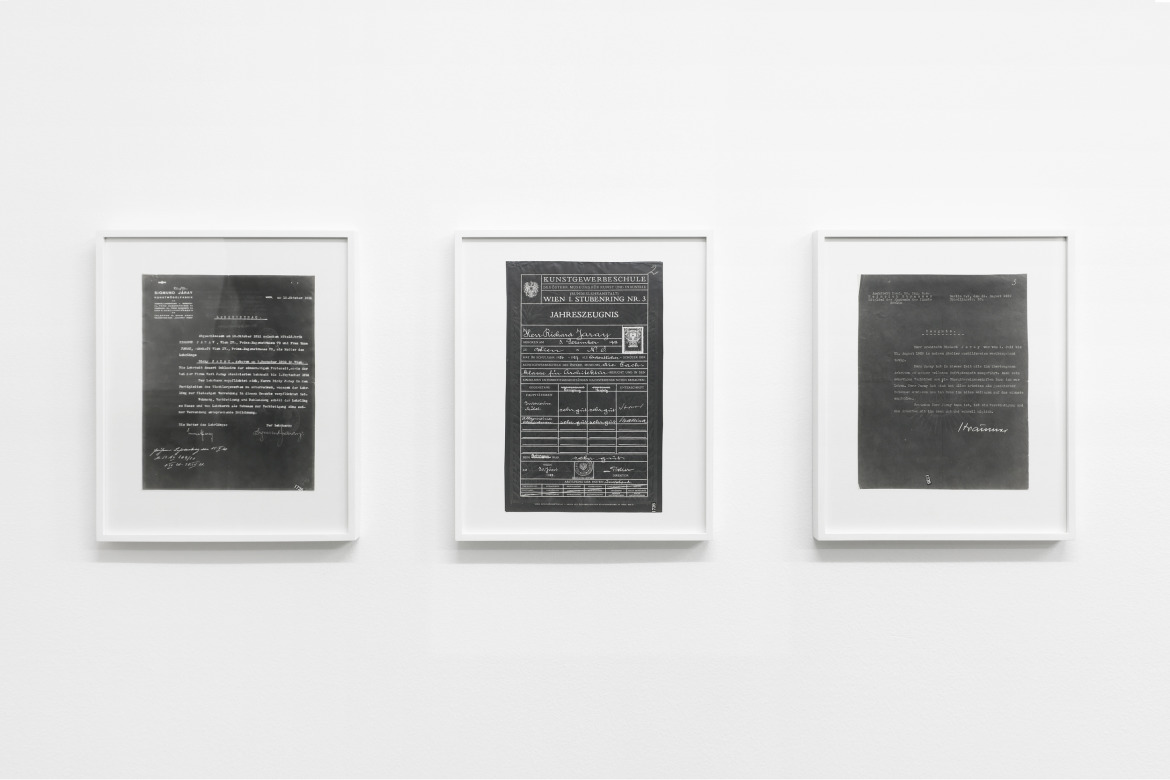
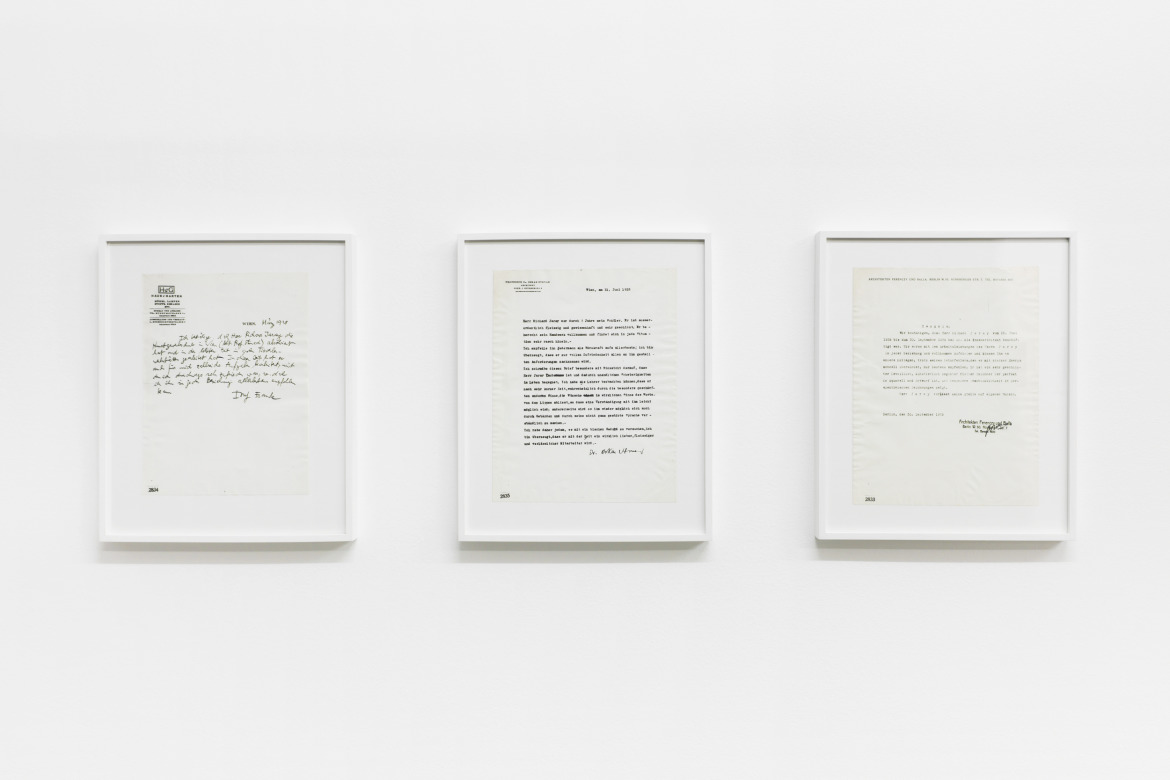
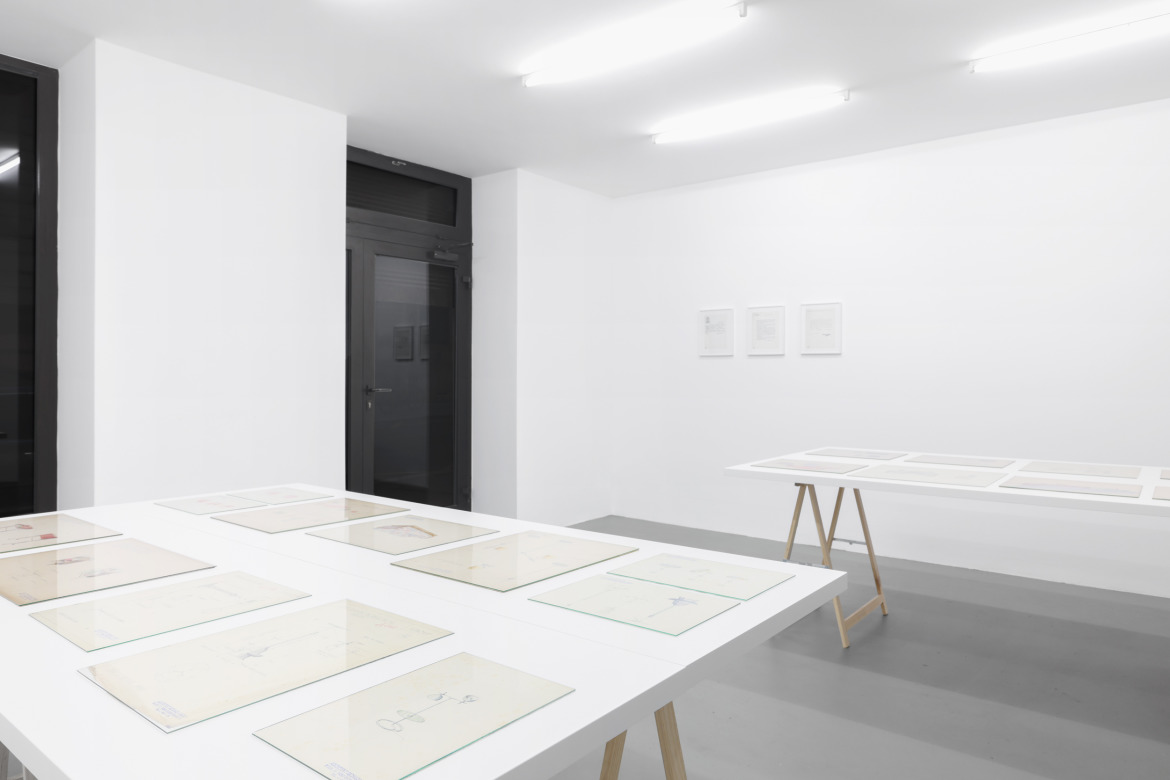
The remaining estate, limited to 70 drawings, few photographs and documents, was given to Tess Jaray by her parents. The majority of the drawings appear to be from a portfolio produced in the mid 1930s and taken to the UK by his younger brother Francis, who escaped, with his wife Pauli and eight months old daughter Tess, in 1938. Deliberately called a presentation and not an exhibition, we hope to stimulate dialogue and encourage academic research into these works as well as their historical context.

A collaborative effort of many, we are very happy to have achieved placement of the estate in the collection of the Museum of Applied Arts, Vienna. The museum collection also holds a complete room furnishing by Richard’s grandfather Sigmund Jaray from the late 1890s making the museum the most suitable place in preparation for future research.

Within the context of Tess Jaray’s exhibition entitled Return to Vienna, EXILE is honored to present these works and return another member of the Jaray family to their city of birth.

Tess Jaray: Uncle Richard

Sebastian Hackenschmidt: Richard Jaray and his furniture designs

David Misteli: Richard Jaray. Artforum Critics’ Pick, May 2021

Secession: Tess Jaray: Return to Vienna

Museum of Applied Arts: Furniture Collection


Following the presentation, we are honored that the estate of Richard Jaray, consisting of 76 drawings and documents has entered to collection of the Museum of Applied Arts in Vienna. For further information please contact Sebastian Hackenschmidt. All drawings and documents are also now available online. We hope this will encourage further search into Richard Jaray. Access via below link.

graphikportal.org

I’ll See You When I See You

In lieu of an exhibition text, the mating call of the last male Kaua’i ‘ō’ō, recorded in 1987 for Cornell Lab of Ornithology played at random within the exhibition. To listen to his sound while browsing through the exhibition images click →here.

The Kaua’i ‘ō’ō or ‘ō’ō’ā’ā (Moho braccatus) was a member of the extinct genus of the ‘ō’ōs (Moho) within the extinct family Mohoidae from the islands of Hawai’i. The last male Kaua’i ‘ō’ō was recorded singing a mating call to his female life-partner presumed to have died in a previous Hurricane. The last of his species, he died in 1987. Subsequently, the species was declared extinct.


Exhibition text published on the final days of the exhibition:

Final Call –  Kerstin von Gabain’s first solo exhibition at EXILE is about to come to a close. Without the opportunity to experience the exhibition spatially we will rely on memory and story-telling. This text aims to put the exhibition, which deliberately offered neither text nor explanation during the run of the exhibition, into perspective, as not to allow for the experience to full fade. 

I’ll see you when I see you, the poignant title of the exhibition is a quote by professional tennis player Naomi Osaka, taken from the press conference following her enforced withdrawal at this year’s French Open tournament. Citing mental health issues, Osaka withdrew not from the sport, but from the press communication that comes as part of the obligations of her chosen profession. In the context of the exhibition, von Gabain pays homage to Osaka speaking out about mental health issues and extends Osaka’s quote to general questions of professional expectancy. 

By comparing art to professional sports, von Gabain hints at the expectancy of the artist to show her work to a visiting public which in response forms opinions that are supposed to ignite constructive discourse. Though this cyclical process all too often defines rank and status over contend. The differences between professional sport and art become marginal and few options remain except  to perform the in professional mantra to advance, to dance you jester, for the never-ending desires of a voyeuristic entertainment industry or to be sashayed away. 

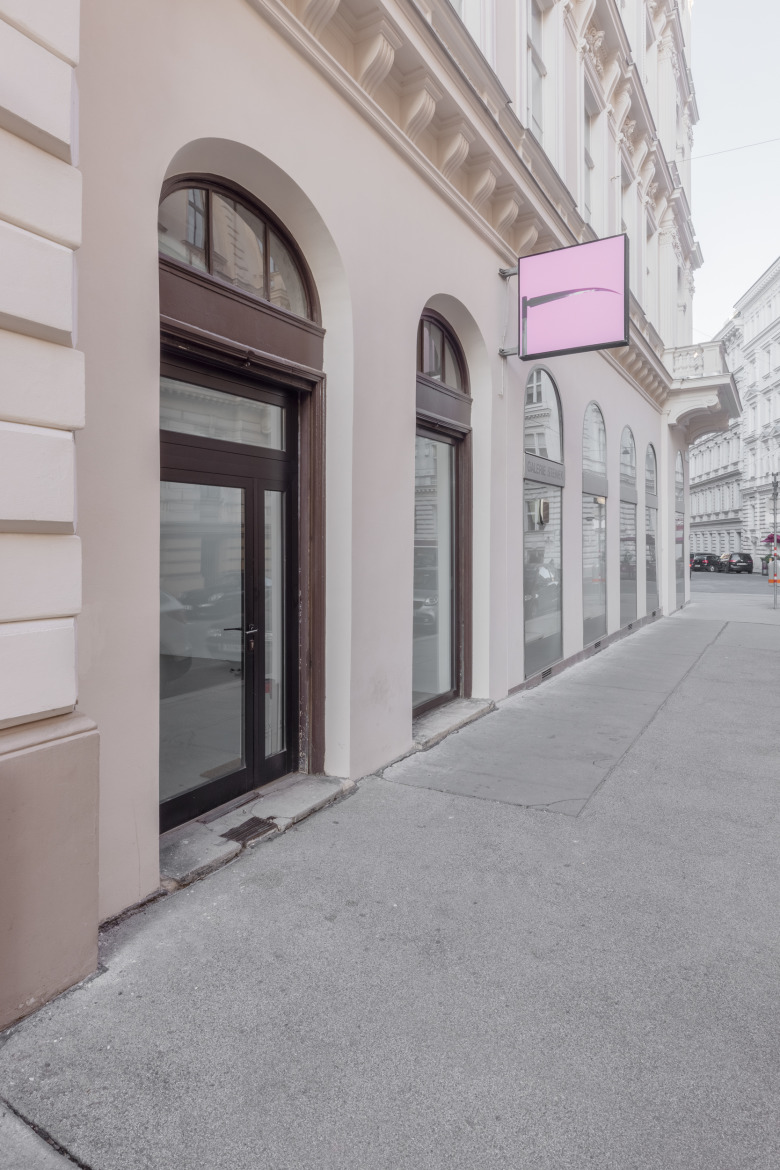
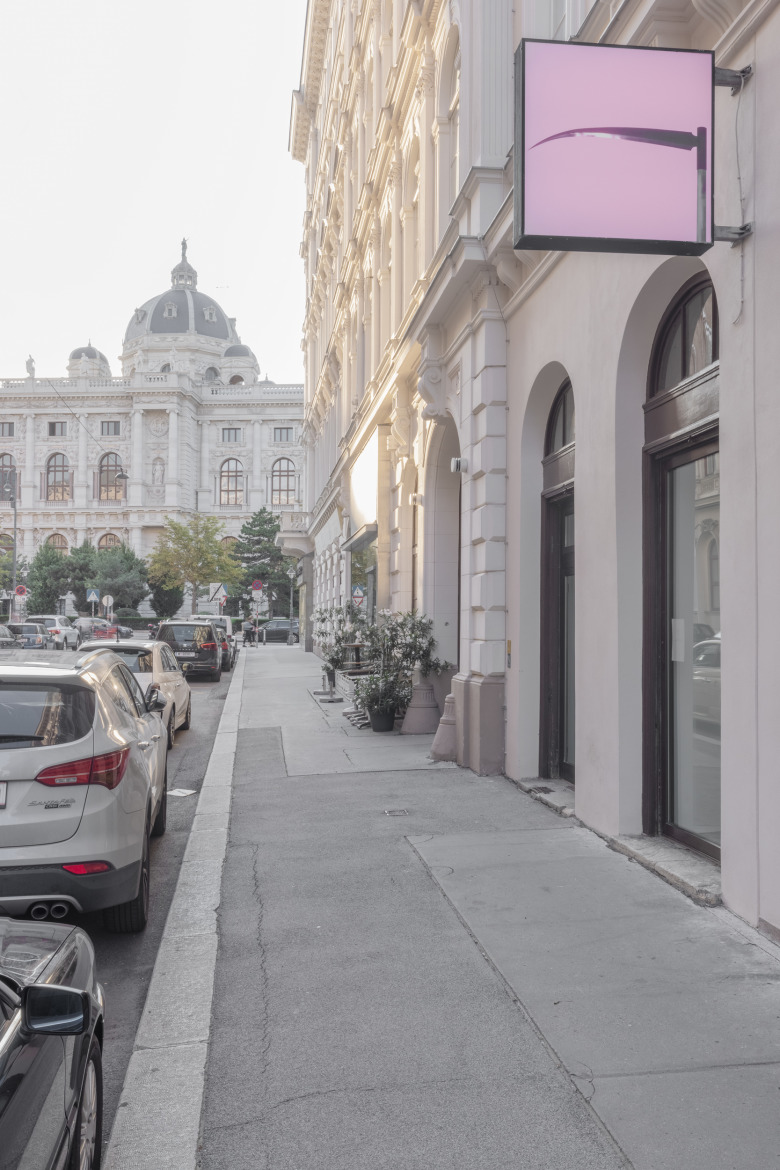
On the outside of the gallery the artist replaced the gallery’s corporate identity display signage with a tumblr image of a sickle on a pretty in pink background. Dragged, dropped and rendered from it’s 35 KB ephemerality to a larger than life 500 GB file, the sickle itself, undefined if harvesting or killing tool, evokes neither harm nor help but describes a mood on which to enter the exhibition. Someone is watching and judging you, always. 

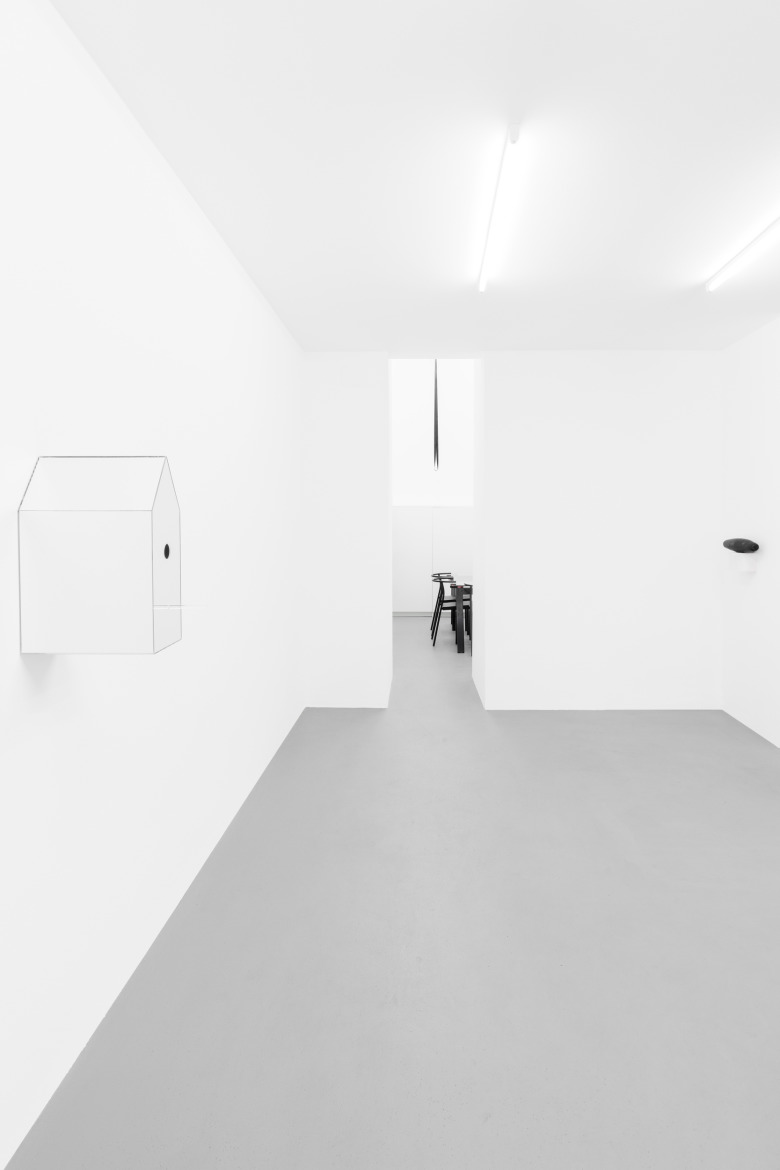
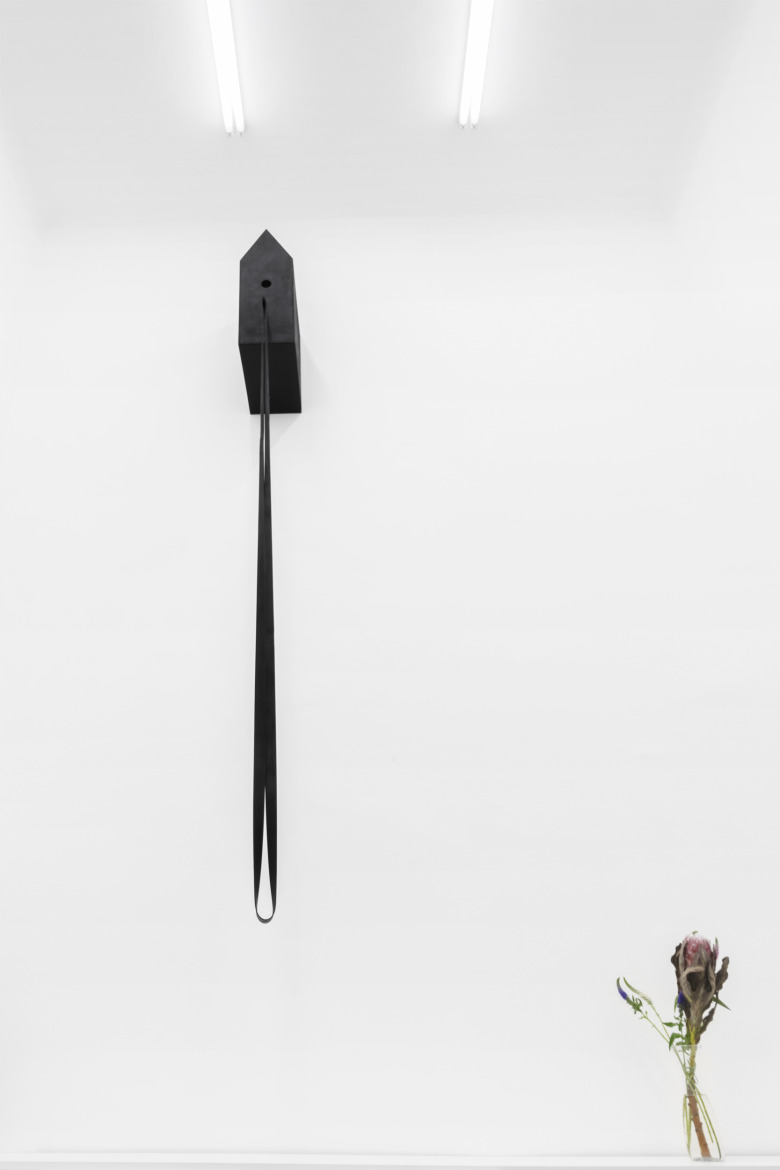
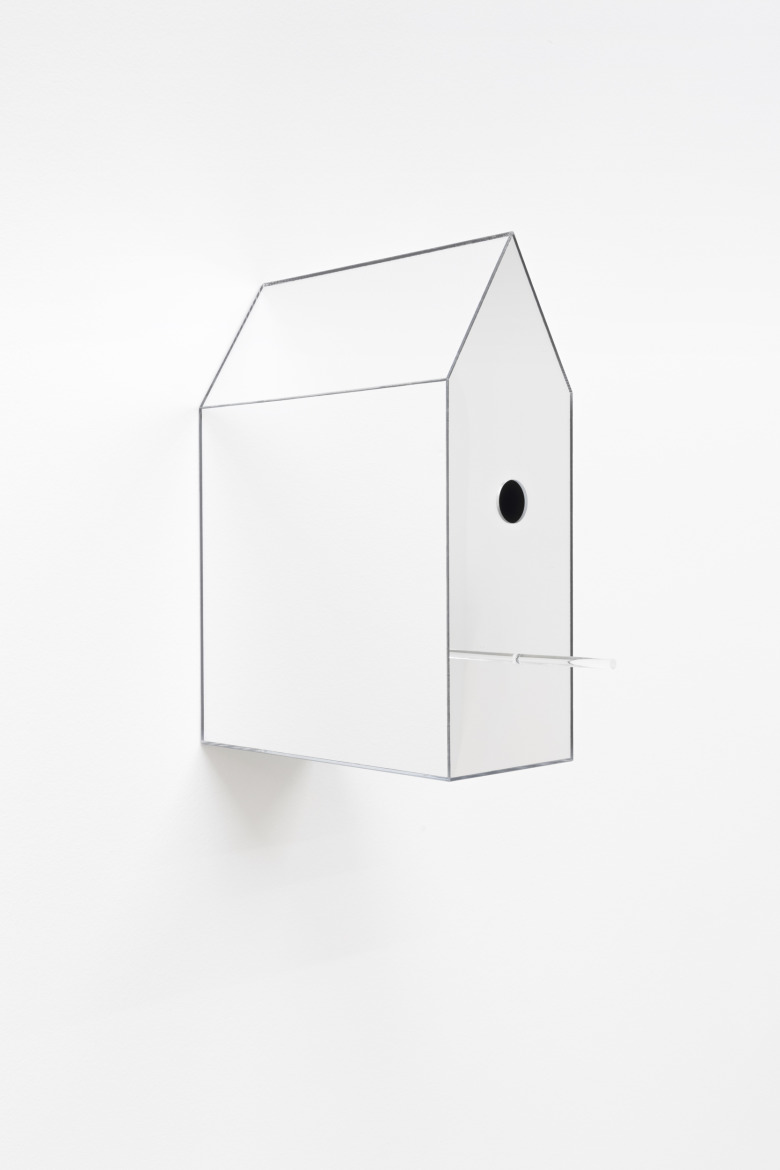
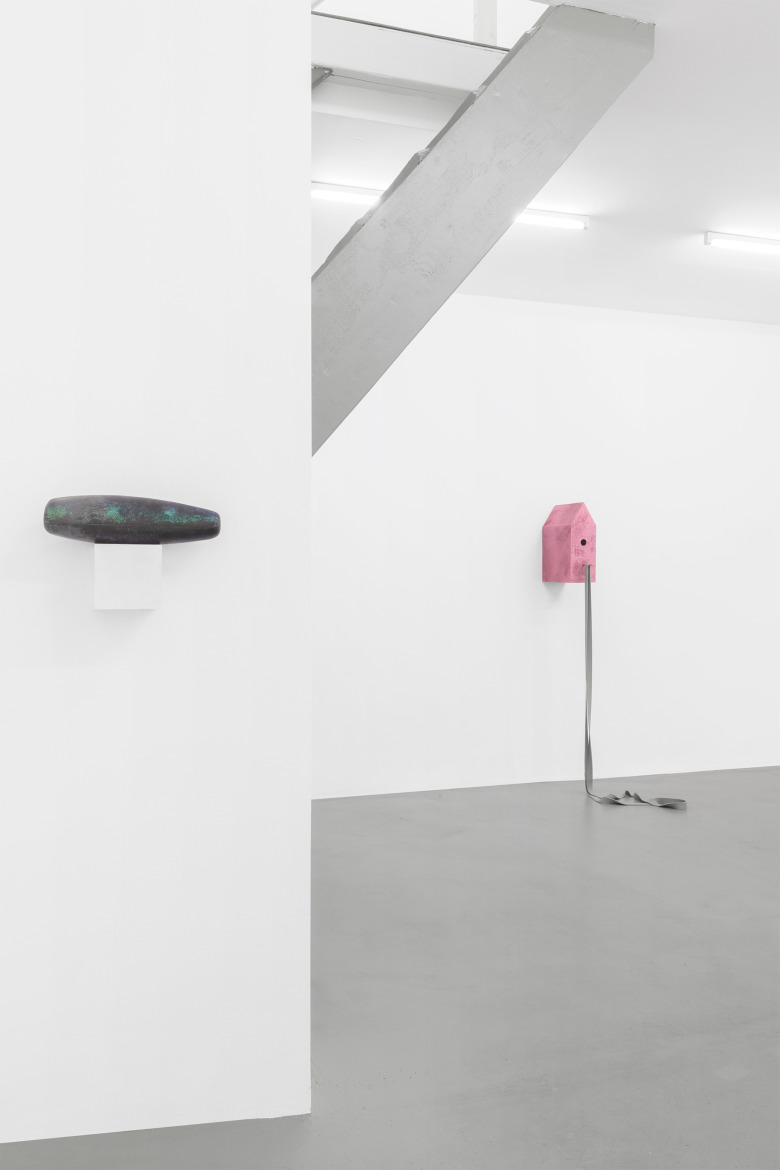
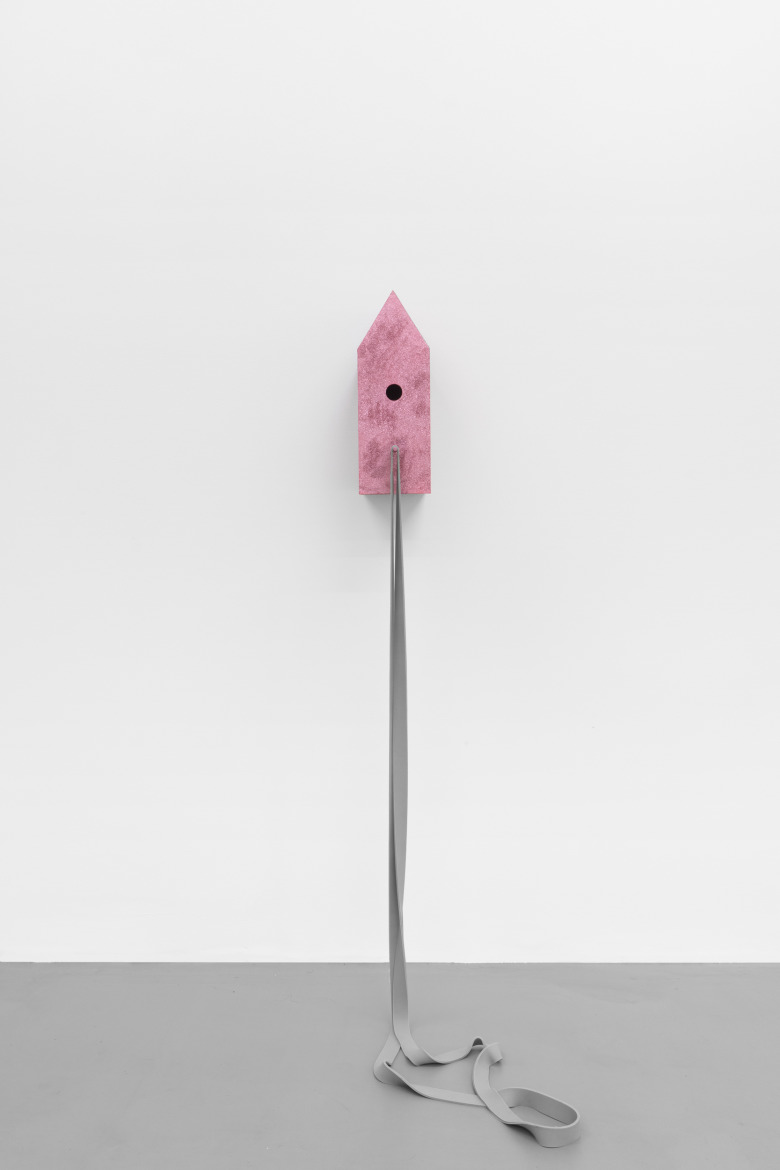
Inside, at first glance, a safe haven: white walls, clean looks, few repetitive works: predominantly birdhouses: first birdhouse, then another, yet another, a stump in-between. Covered in reflective mirror, in pink glitter or matte black, the birdhouses’ shape and scale are identical and so are their titles: Shelter for beasts. A birdhouse surely is a shelter by one species given to another. Yet does one species consider sheltering what is described as a beast? Do beasts deserve shelter? Who defines who and what is a beast? Isn’t the definition of beast left in the eye of the beholder?

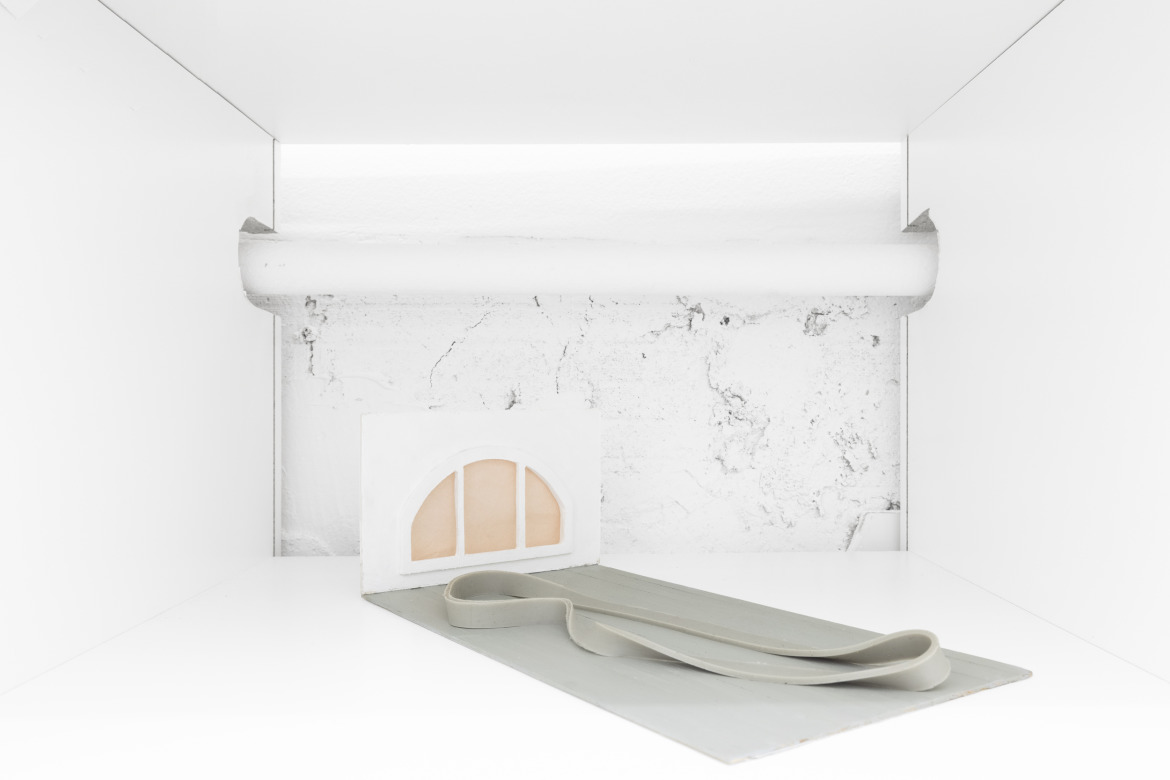
The bird’s landing strip to its shelter, a rounded stick just below the round entrance to each birdhouse, holds in some instances a long rubbery band. Formally almost mundane and more likely industrial, these soft, anti-form, yet precious and incredibly tactile objects hold a somewhat mysterious relationship to the respective shelter. Undefined, if not on a merely formal level, are these (the remains of) the beast reduced to a piece of soft, non-spinal silicone barely held up by the safety and solid geometric construction of the birdhouse alone? Are they the pun in the joke that truly isn’t funny anymore? 

At random intervals, a bird song appears. In lieu of an exhibition text, the bird’s captivating call is the exhibition’s metaphor if not explanation. The bird singing is a Kauaʻi ʻōʻō, recorded in 1983 by Cornell University. The bird’s  song and story is as beautiful as it is heart-breaking. The recording is of the last know Kauaʻi ʻōʻō, he is the inevitable last of his species and kind, he sings for his already deceased partner, his dramatic call predicts extinction. A disturbing aria about loss and violence. 

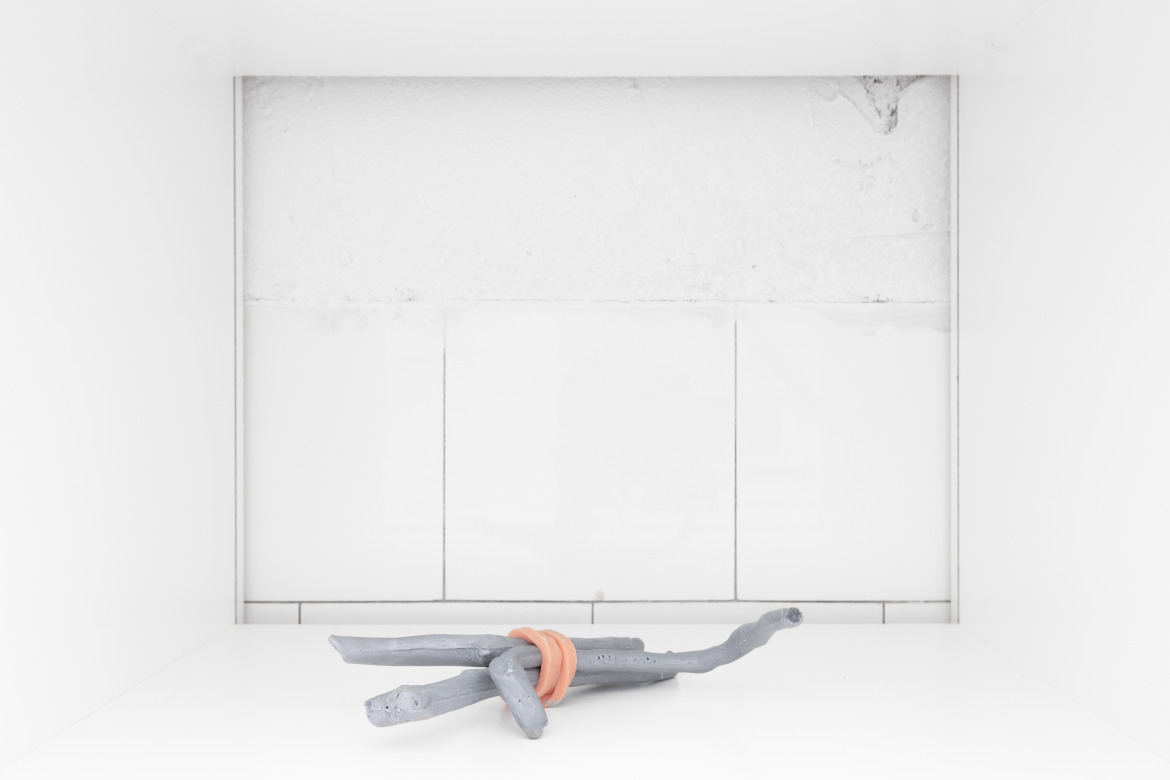
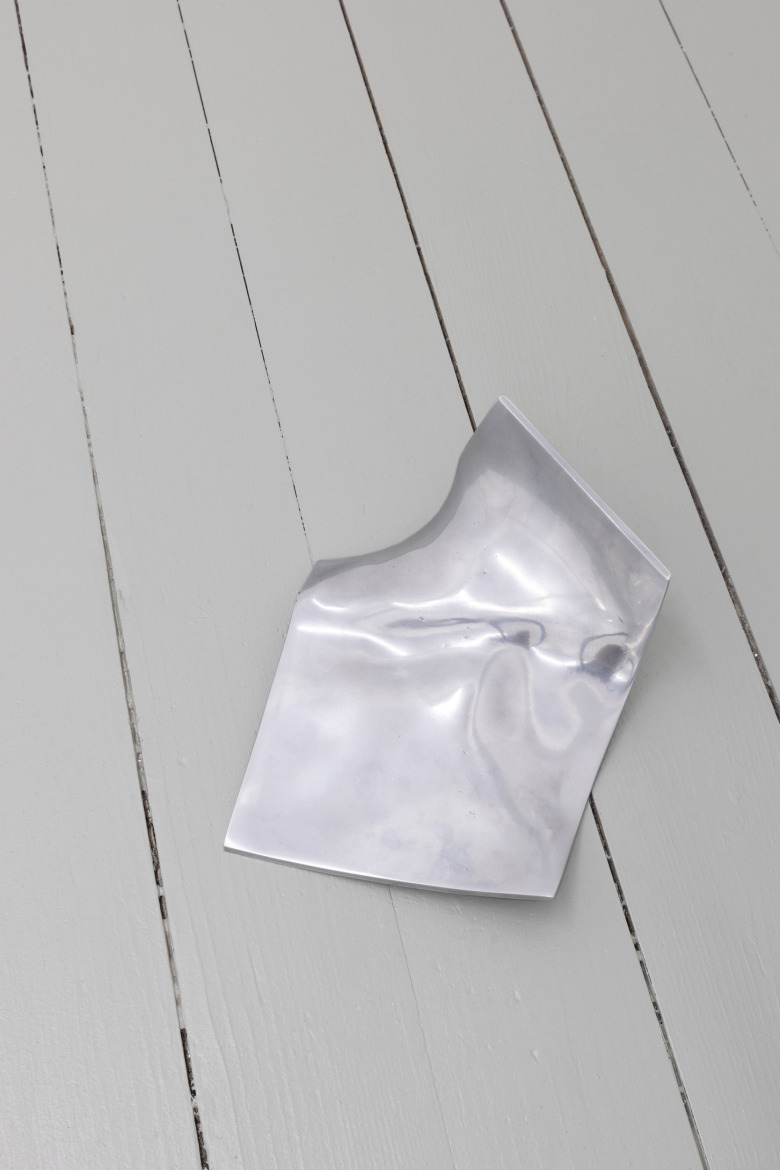
Left exposed to all elements, two works in the first of the two upstairs spaces, decry forms of violence. An aluminum cast of the artist’s collarbone lays on the floor opposite a miniature of a first world war plank bed. Appearing fragile and unfinished, the miniature thrones on a pedestal elevated above the armor placed on the floor. A real-life cast of the artist’s collarbone and the miniatured war utensil. War but no peace? Shelter but broken?

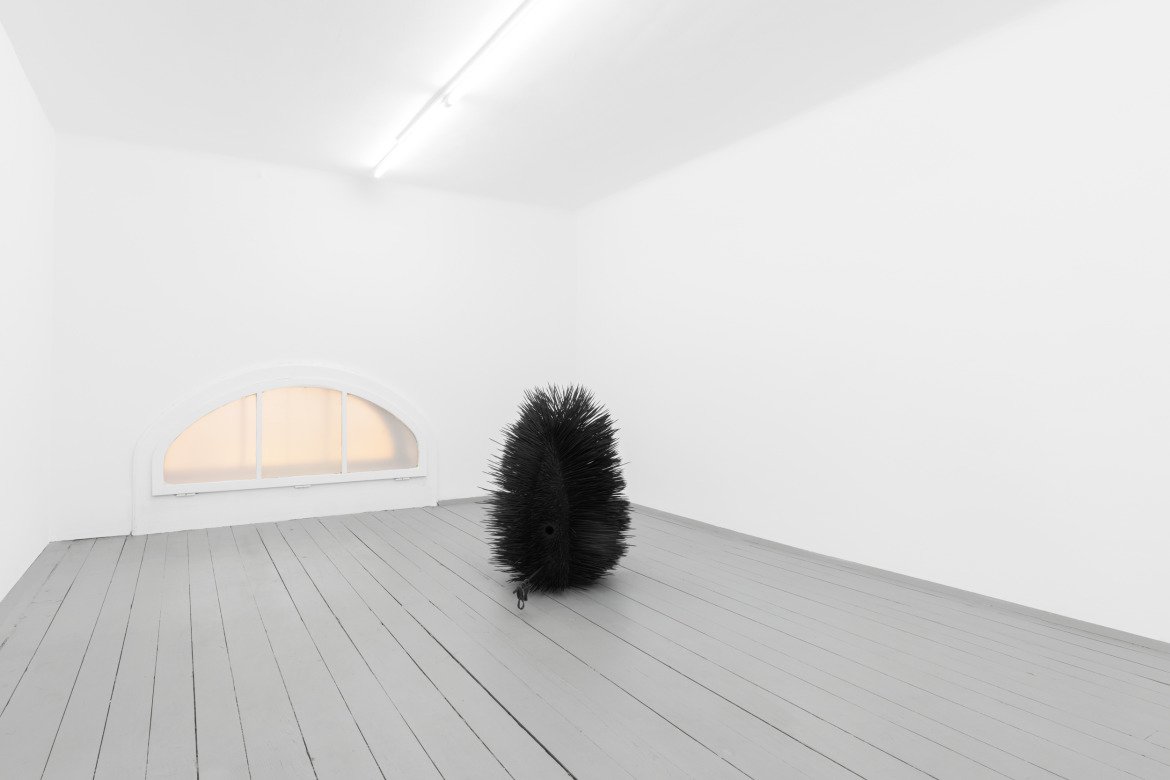
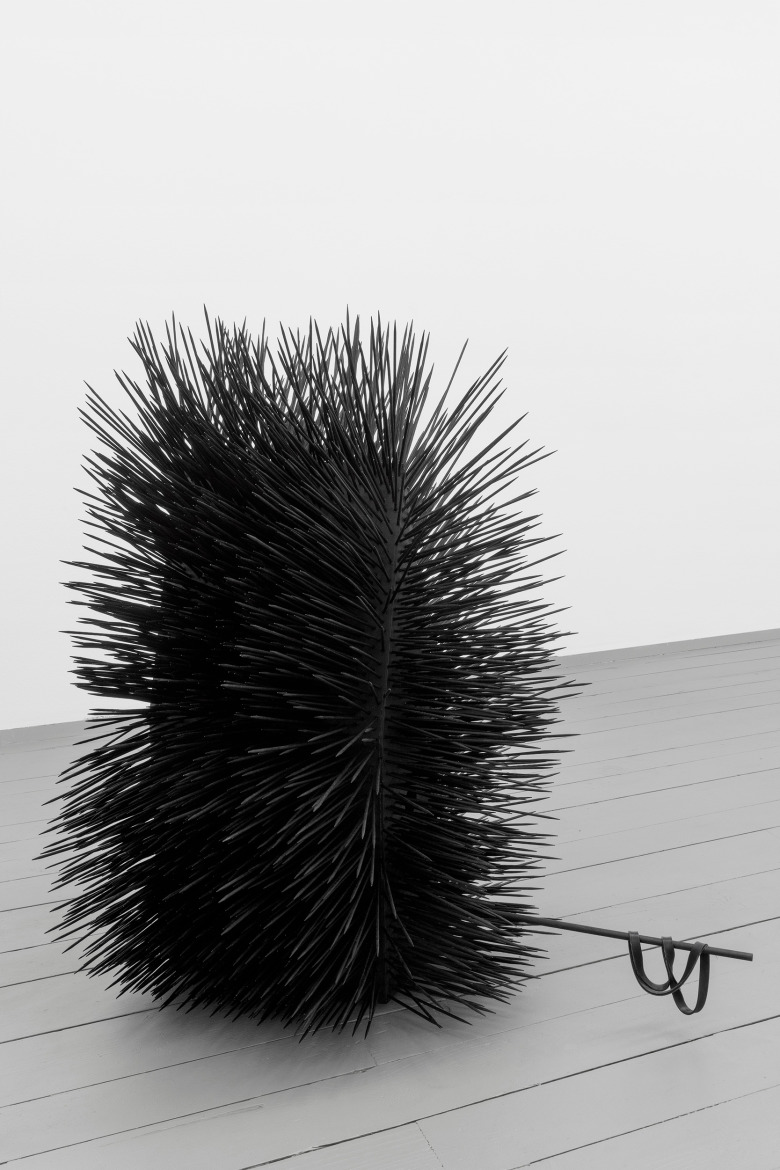
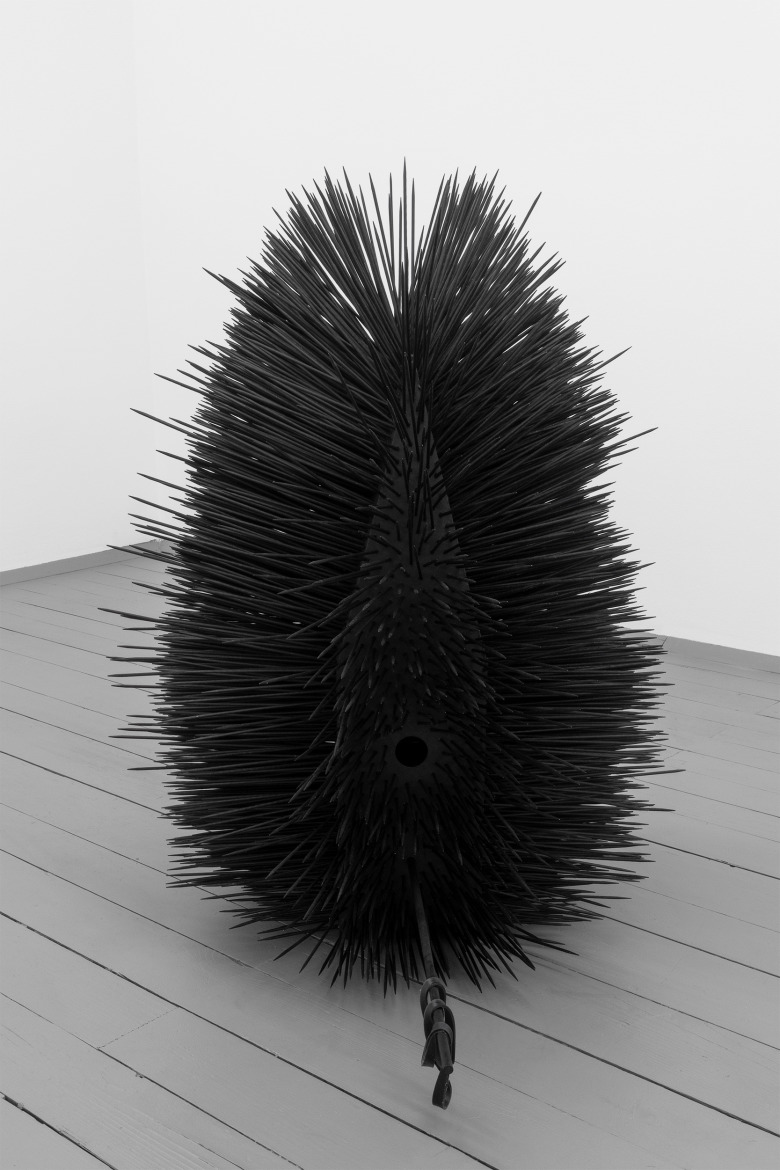
The exhibition’s final act is another, though floor-based, sheltered beasts. A cute hedgehog of a birdhouse or an aggressive medieval fortress impossible to conquer despite for its tiny entrance. Another rubbery band, reduced to miniature, lays aimlessly, yet casually in front of its shelter. 

The exhibition ends as it began. Questions of scale, of shelter, of armor, of loss and relation, of dark phantasy and light glitter. Shelters for beasts. The lonely bird found none. I’ll see you when I see you. 

Further information 

Wikipedia: Kaua’i_’ō’ō

John Green: Anthropocene reviewed. Sept 2019

Songbird: a virtual moment of extinction in Hawaii

Cornell Lab of Ornithology

Kaua’i ‘ō’ō birdsong

Untilted

EXILE is happy to return to ≈5 with the exhibition Untilted featuring recent paintings by London-based artist Tess Jaray (born 1937) together with new ceramics by Berlin-based artist Nschotschi Haslinger (born 1982).

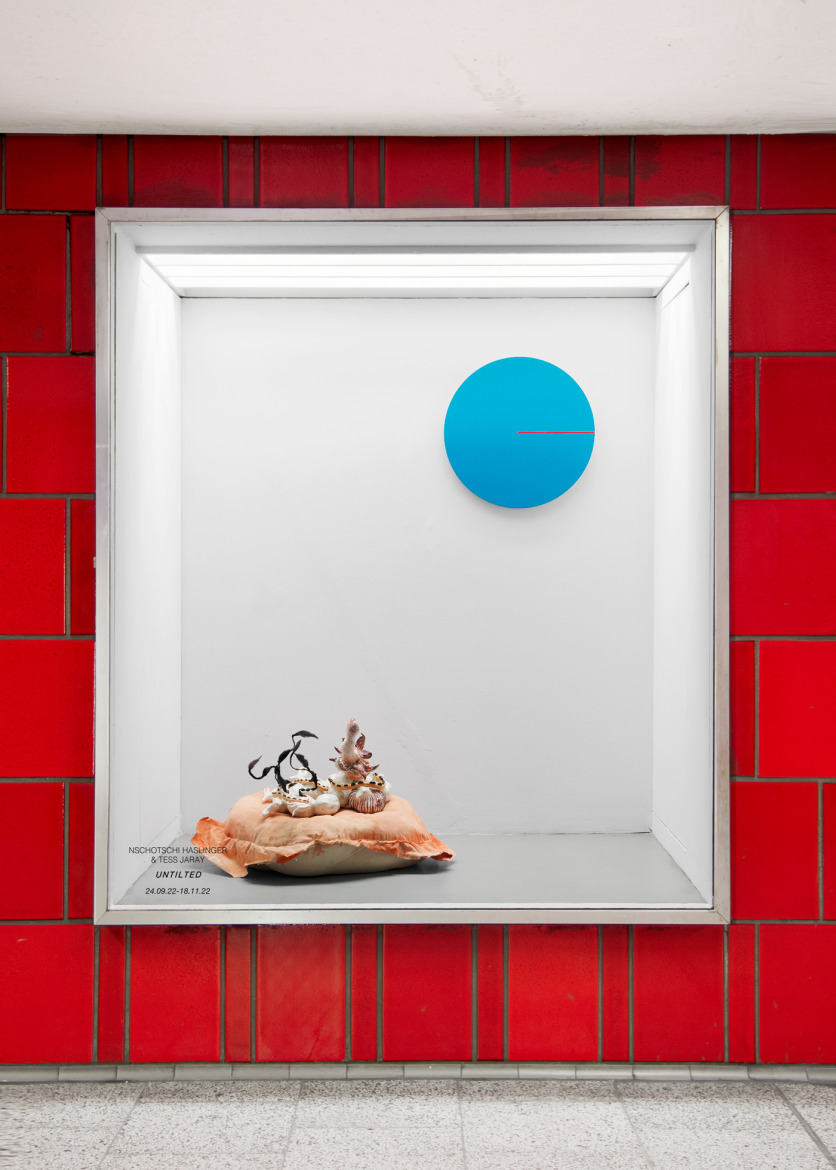
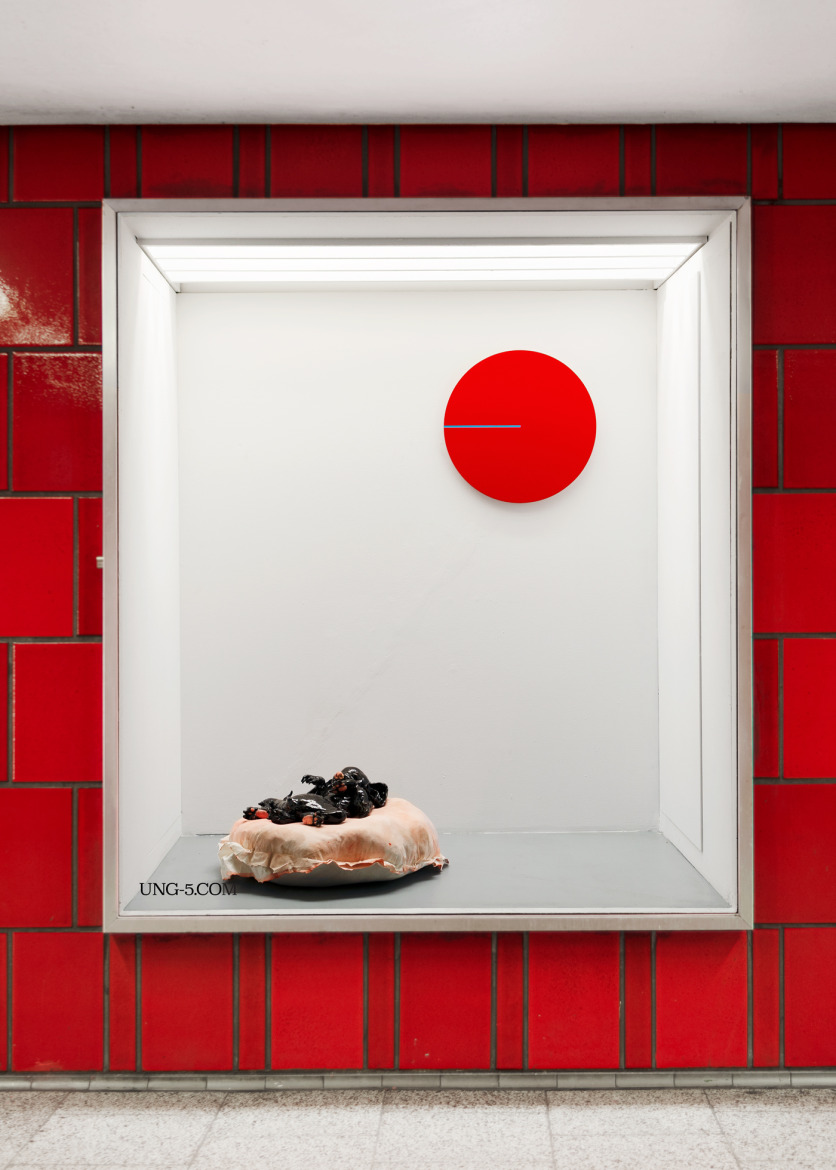
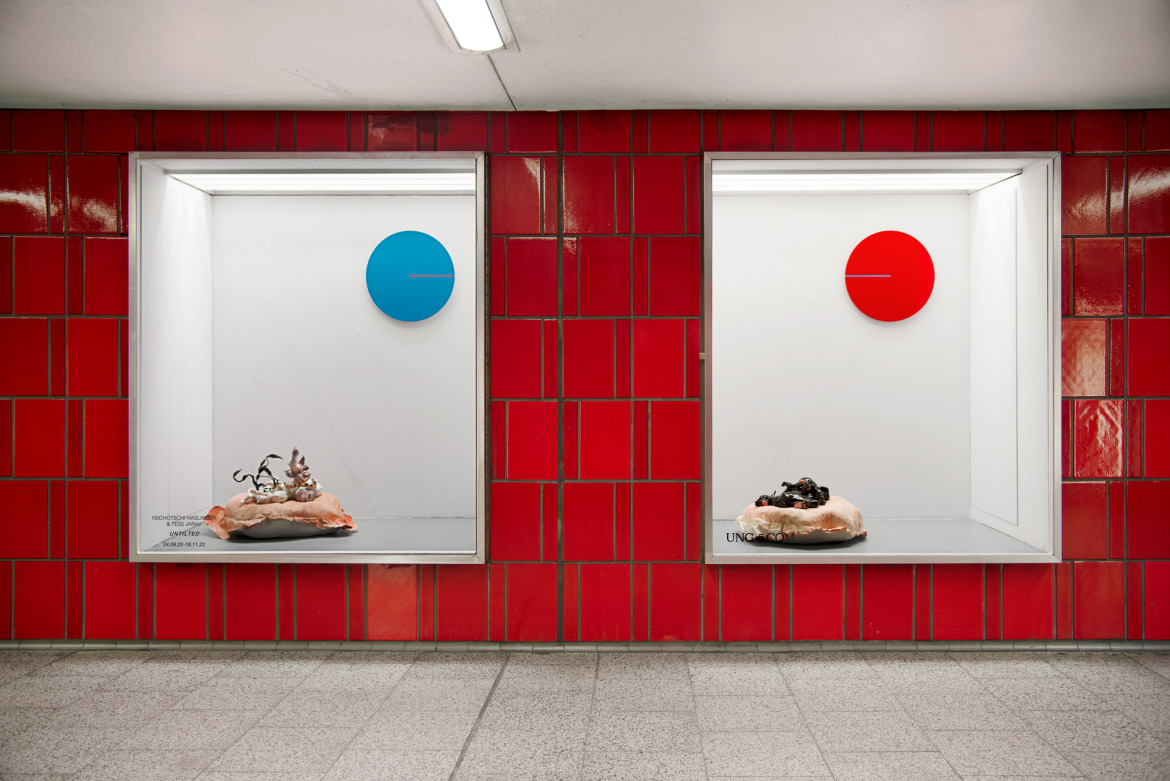
The vitrines of ≈5, situated in Cologne’s Ebertpatz subway station, are defined by their post-war, brutalist architecture. Found within an underground concrete maze of walkways, piazzas and shop windows, the vitrines are fully immersed within the symmetric logic of such rational architecture of the time. The psychedelic hue of the surrounding red tiles evokes an almost aggressive or at least unnerving response. When walking by the vitrines, they recall a filmic take in two shots or, when viewed together from a distance, a kind of dialogue amongst them.

Contrasting the brute architectural rationality, the presentation’s title might be a typing mistakes. If not an error, the first analogy that might spring to one’s mind could be the eponymous 2005 album by the electronic music band Autrechre. Yet what is the difference between untitled and untilted? This dichotomy has most poignantly been explored in the visionary work Untitled (Perfect lovers), 1991 by Félix González-Torres. Two equal clocks are aligned, yet one quickly learns about their incontrollable individuality, their emotional differences, irregularities or imperfection. Any initially perceived synchronized duality will fade with the ticking clocks inevitably ending out of synch. Yet, as perfect lovers, they are defined by their individual identities and not their structural systemic perfection. The untitled perfect symmetric surface falls behind to reveal a complex and humane, an untilted, reading.

The two artists chosen in dialogue to one another work in very diverse practices. At first sight, their link might appear even vague resulting in an unclear, raw or even missing connection. Another programming error? It is not, as both artists address emotional qualities and longings in their works quite similar to the mentioned work by González-Torres. Might Untilted be an (un)intentional homage?

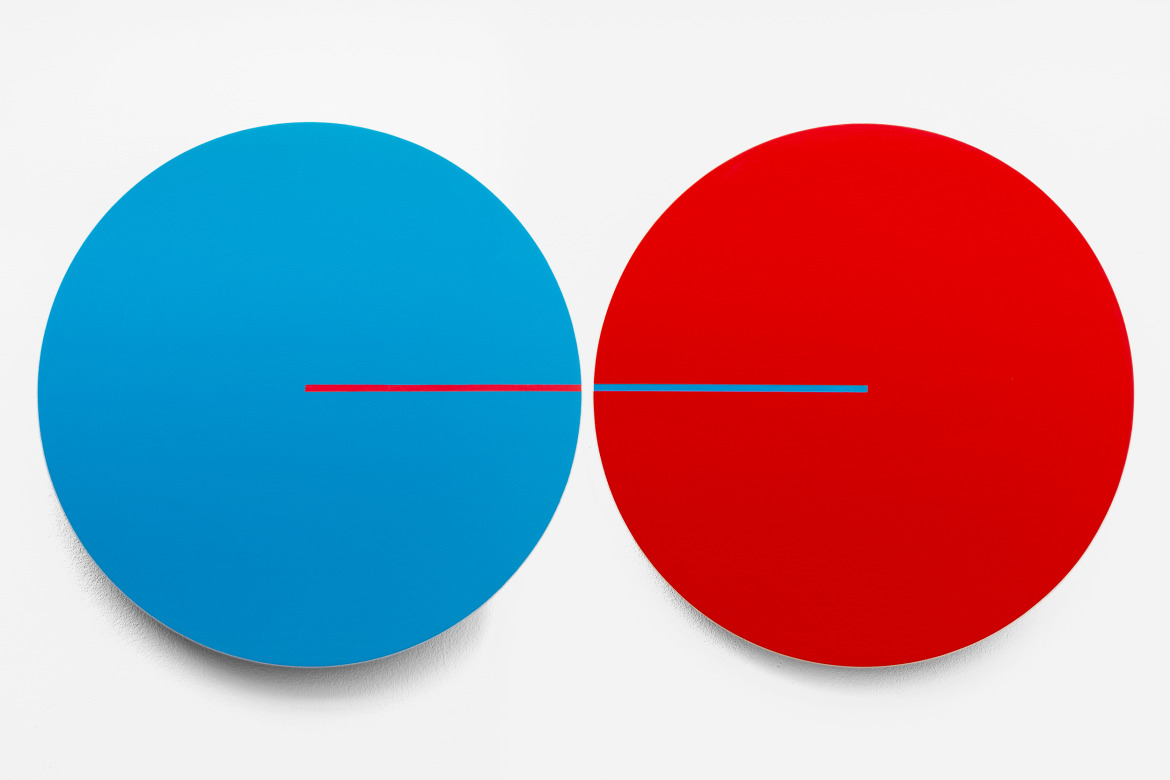
One work per artist per vitrine leaves the featured works isolated and exposed to each other as well as to the passing viewer. Beginning with the diptych by Tess Jaray, that is forcefully split across the two vitrine spaces, each painting consists of an essentially monochrome circular plane that is superimposed by a perfect thin line measuring from the outer edge to each painting’s circular center. Each line is painted in the color of its diptych other. With the lines set in horizontal position and facing one another, the work appears as a strict geometric exercise, yet it mutates through perceptions of color to ask about the interconnectedness between the two parts. One cannot exist without the other, an emotional interdependency expressed through rigid symmetric shapes of circle and line. If indeed an homage, Jaray’s work could refer to a pair of one-handed clocks that tick in mirrored synchronicity but aim to blend into relational belonging through the missing part of each other’s color plane.

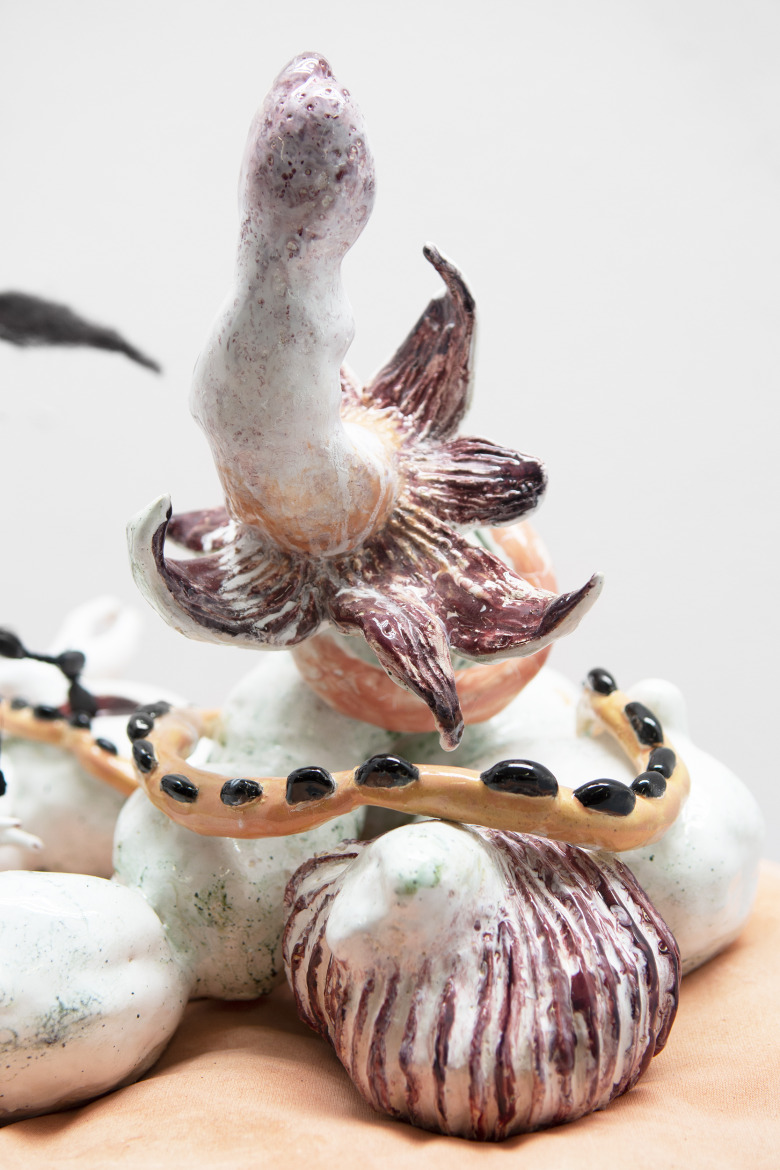
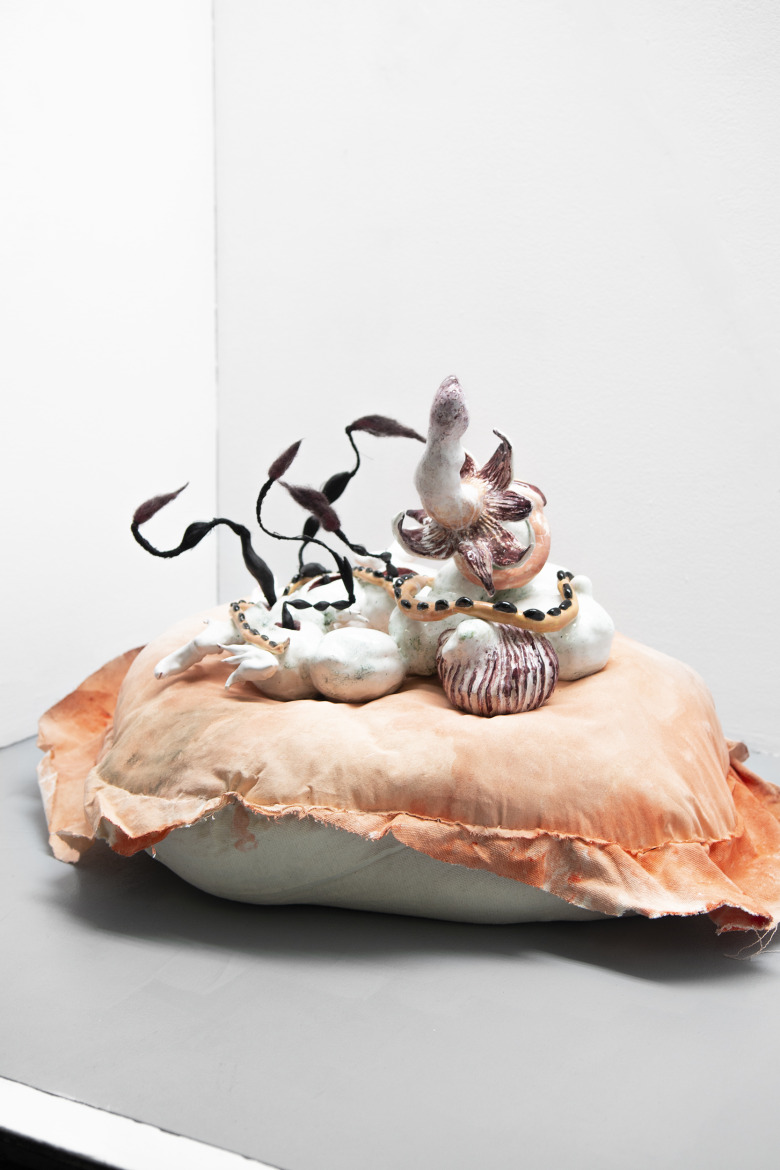
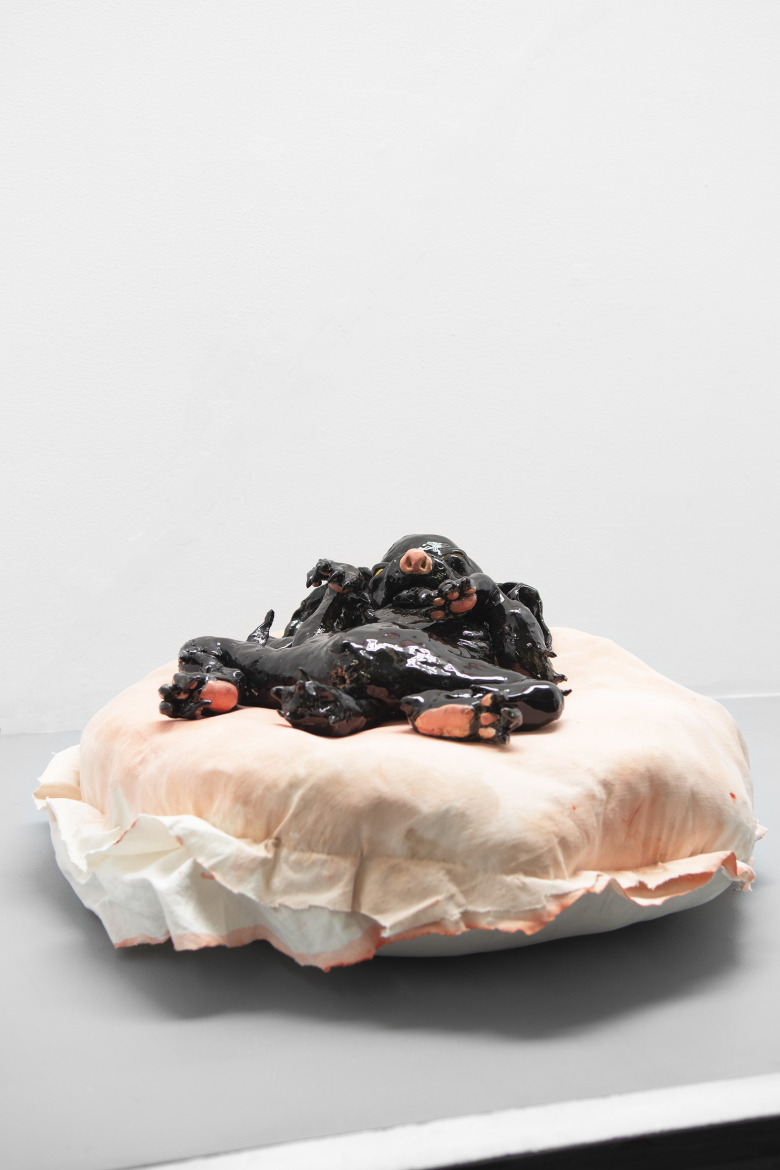
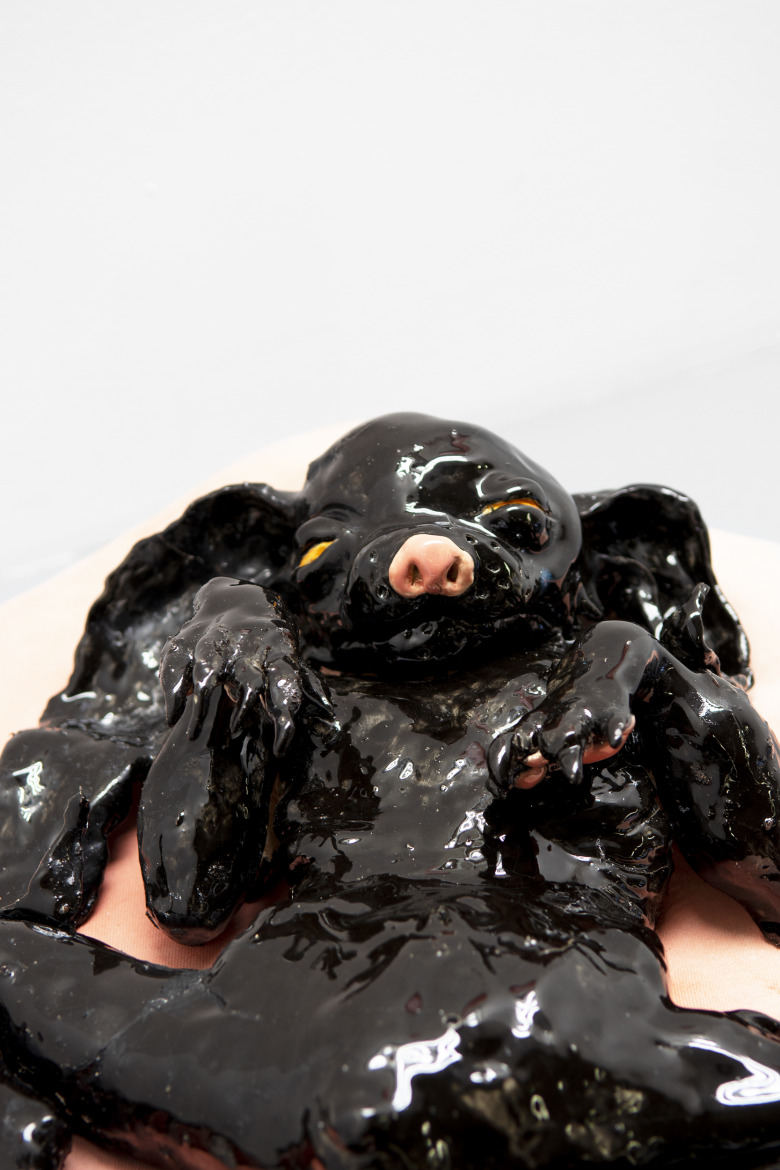
A recent ceramic by Nschotschi Haslinger rests at the bottom of each vitrine. Relaxing on comfortable pillows, these beings continue her exploration into magical, dream-like spheres expressing diverse feelings manifested as physical identities evolved to some stage between gruesome monster, psychedelic tripping and post-human life form. Their relationship to one another, in explicit difference to Jaray’s work, remains unclear. The first being, Schwarzes Bunny (2022) alludes to filmic visions of teenage nightmares and somehow reminds of Donny Darko (2001). The ugly bunny, uncomfortably exposing its genital area, asks for attention, care or even love. Fear, isolation, loneliness and loss are integral parts of human existence. The other being though, entitled Vibrationen V (2022), does not appear in need of much attention but seems to have evolved. It confidentially acknowledges its own negative emotional darkness expressed through external feather-like and exposed organs while appearing as a confident, amorphous, poly-amorous, post-gendered identity. Without a need of a smooth surface Vibrationen V has morphed into a self-certain, self-sufficient self.

Jaray’s and Haslinger’s works are left to communicate in their isolated display cases to the passer-by through their self-reflexive, crisscrossing emotional interferences. The paintings by Jaray as much as the ceramics by Haslinger don’t guide us into linear belief, instead they point to fragility, emotionality and dependency as a basic human need and positive instinct. It is each viewer’s choice to sense relations between the works as much as – through the glass – to themselves. 

Curated by Christian Siekmeier

Gwenn Thomas: Jack Smith in Cologne, 1974 & 2018 at ≈5


ARS ELECTRONICA

(more…)

Document Performance

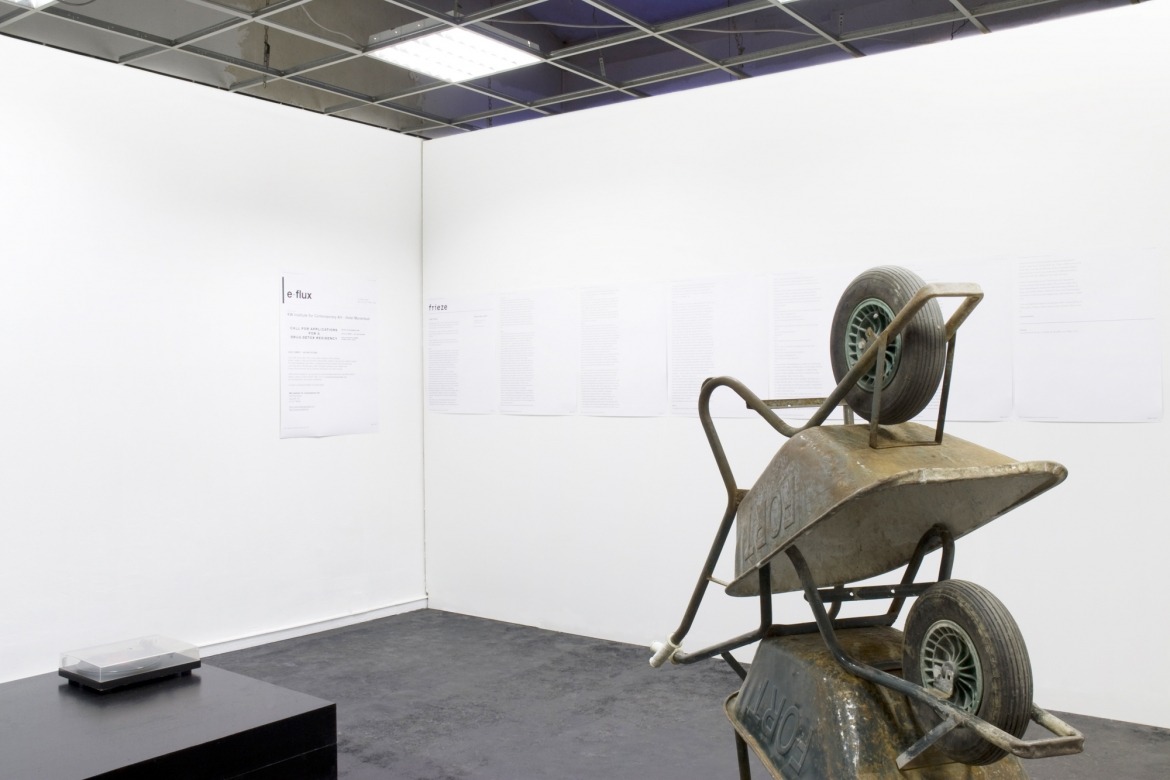
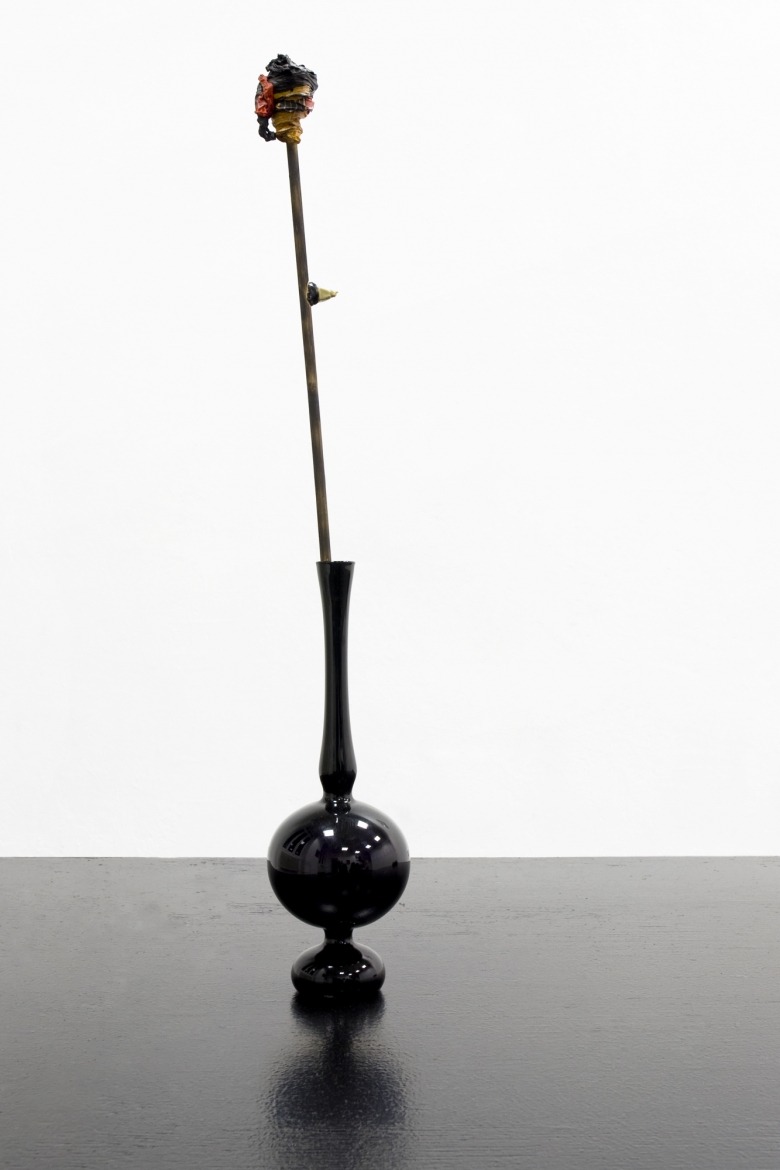
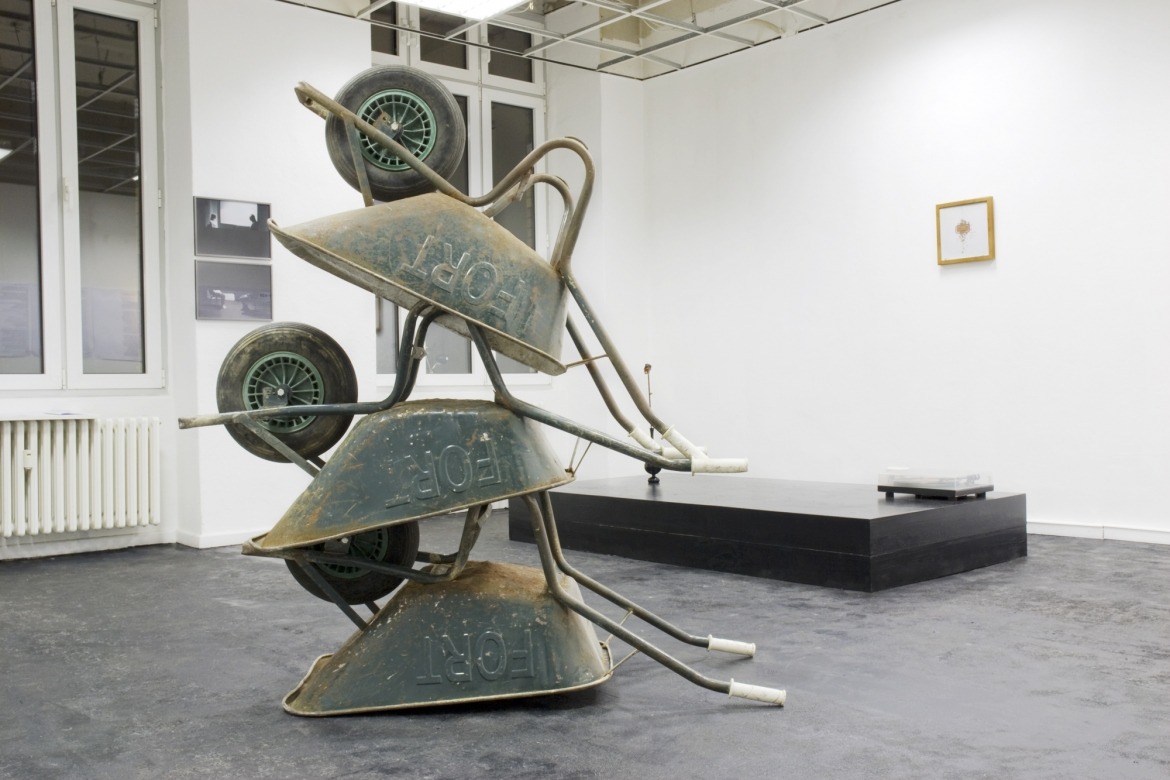
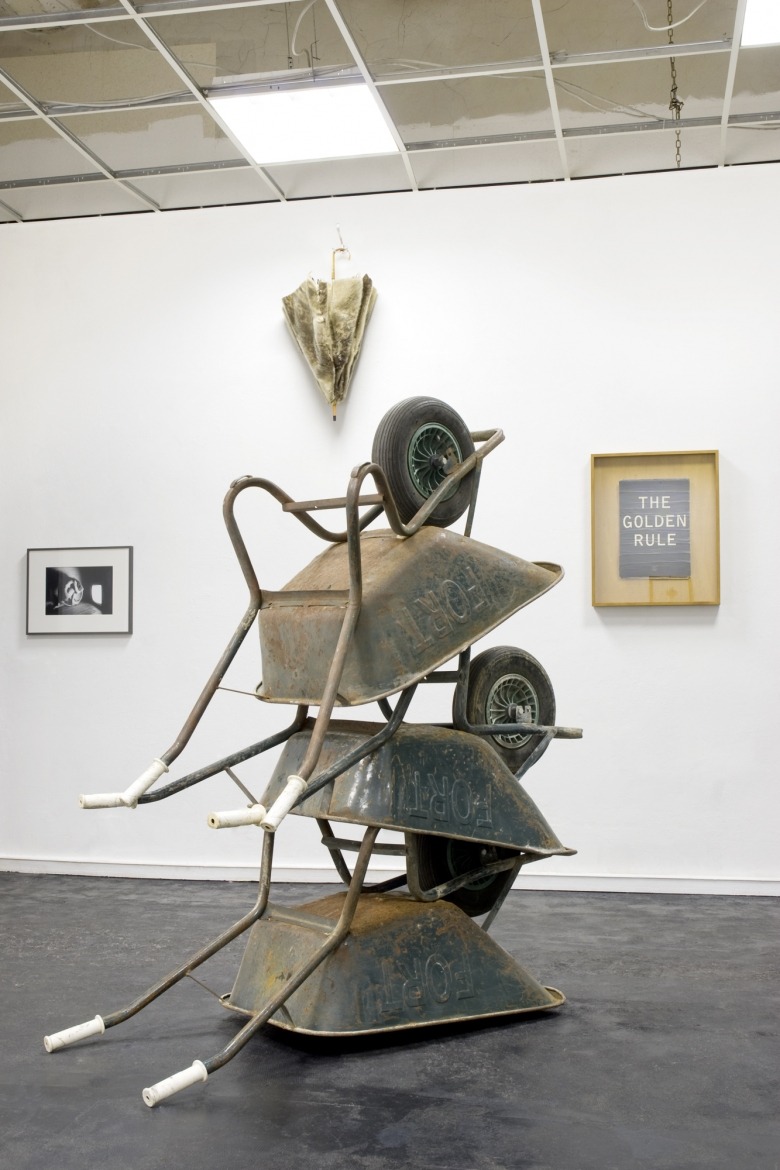
The exhibition Document Performance presents objects by artists Awst & Walther, Claudia Kapp and Benjamin Blanke, FORT, Gwenn Thomas / Joan Jonas, Hermann Nitsch, Johannes Paul Raether, Kazuko Miyamoto, Martins Kohout and Stuart Brisley.

A performance is an action in time. A document of said performance is a physical manifestation of a previous action encapsulated in various material forms.

However, such objects are never merely just documenting their source performance, but are rather autonomous in and of themselves. While they refer back to the source they are neither the past performance itself nor its direct representation. Their temporal source is embedded in the permanent. This doubled relationship to time results in a contextual shift: From questions of What-has-been? and What-has-happened-since? to What-is-now? and, in some cases, to What-will-be?.

Document Performance investigates the autonomous life of the documents as they exist in the here and now. Their fragmented, though transitional relationship with the past, present and future fuels the viewer’s imagination: What does each document mean? How is the source performance embedded in the object? How did the document come into existence? Who is the author? How has the object’s context shifted? How has time transformed the document itself? What does the object mean to the viewer?

The objects featured in the exhibition follow no historical or contextual narrative. Each of them has been produced as a result, a consequence or a mindset of a performative action. Some documents on display are:

– The photograph by Gwenn Thomas of Joan Jonas during her performance Twilight in 1975. This photograph is identified by both artists as a collaborative work and asks about their individual identities, the nature of their collaboration and the photograph’s authorship and existence in relation to the performance.

– The film Being and Doing by Stuart Brisley (with Ken McMullen) features Brisley’s performances in the context of a 50-minute documentation that investigates the origins of performance art, connecting it not to modernism but to ancient folk rituals in England and Europe.

– The object from Johannes Paul Raether’s performance Nationalfahnen zu Schwefelrosen shows a small, burnt German flag. When burning such flags, Raether transformed each into a rose with a thorn. He combines one of the highest visually charged expressions of protest with the creation of a vernacular kitsch object.

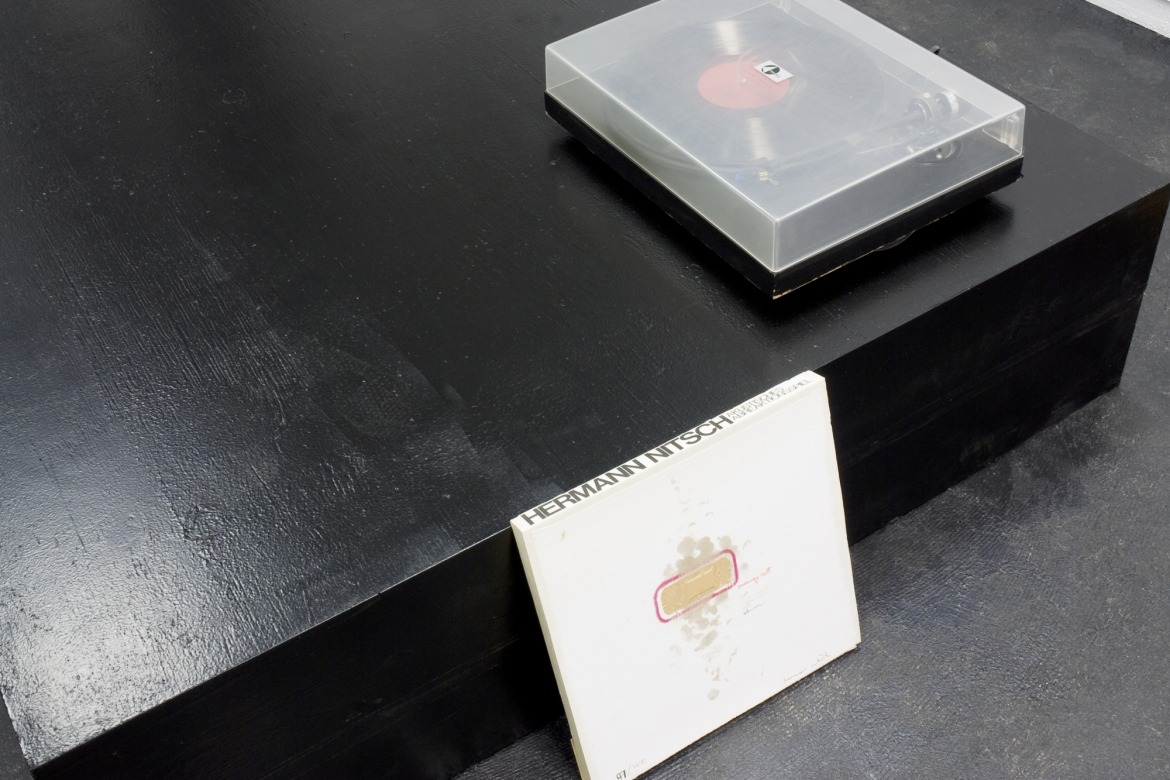
– The first vinyl recording of Hermann Nitsch from his 1972 performance Akustisches Abreaktionsspiel is displayed on a record player, although it is so rare and precious that it can no longer be played. The viewer is forced to imagine the performance solely by looking at the vinyl record and employing his/her knowledge of Nitsch’s body of work.

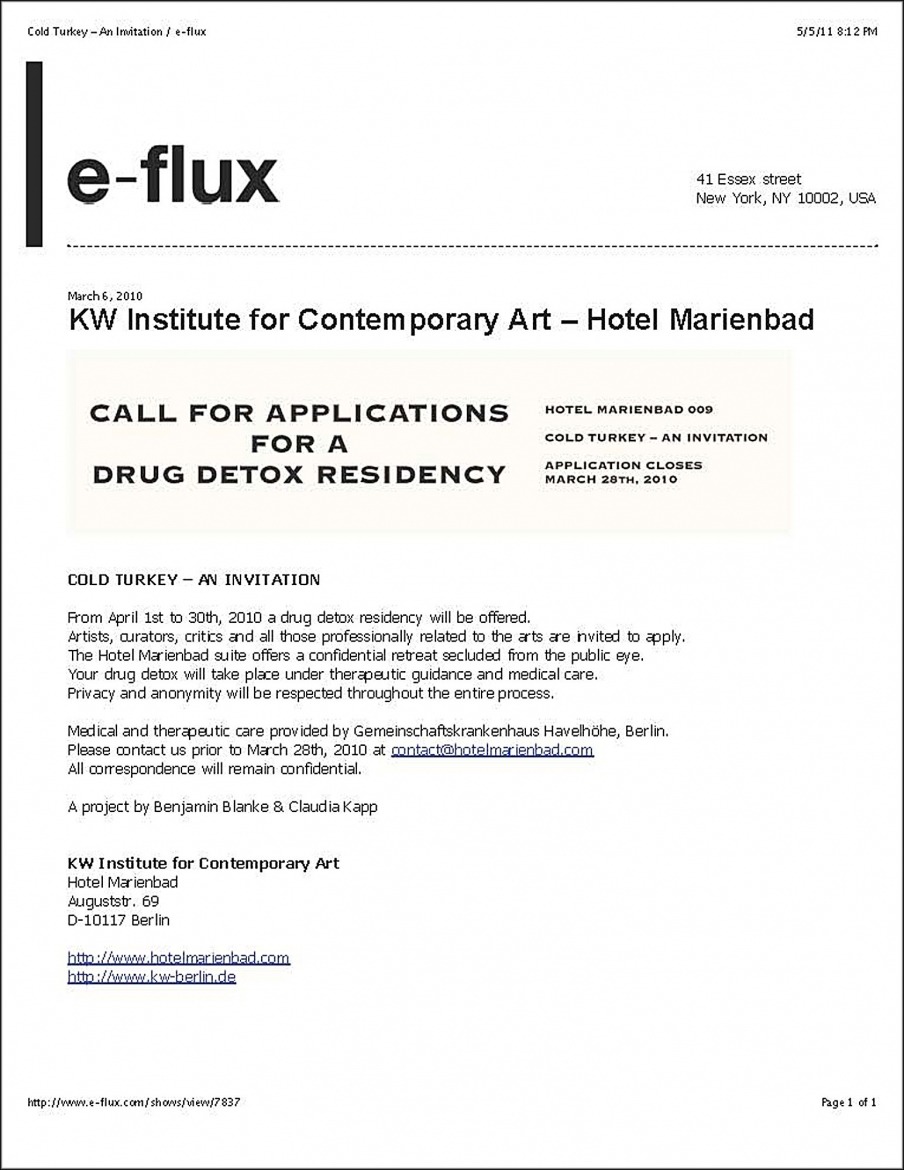
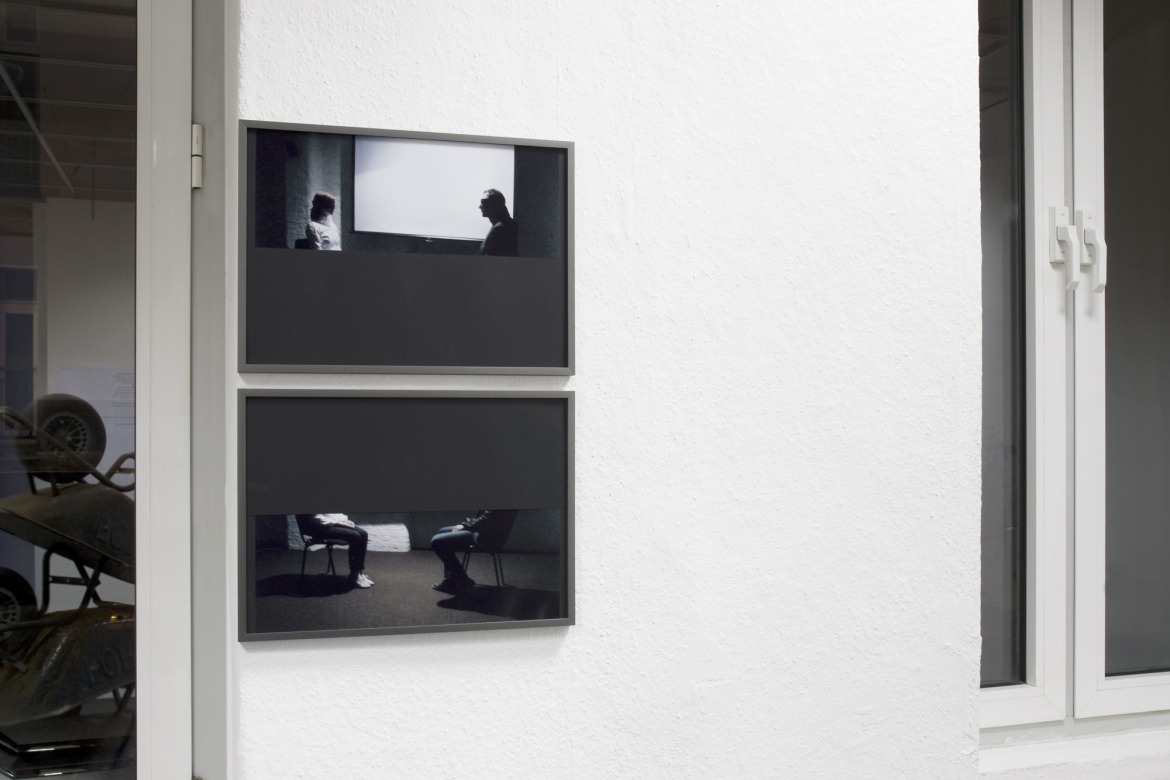
– The printout of a diary of an anonymous participant in Claudia Kapp’s and Benjamin Blanke’s drug-withdrawal project Cold Turkey, presented at Kunstwerke in 2010, undermines almost all expectations of artistic practice, performance and document with one single piece of text.

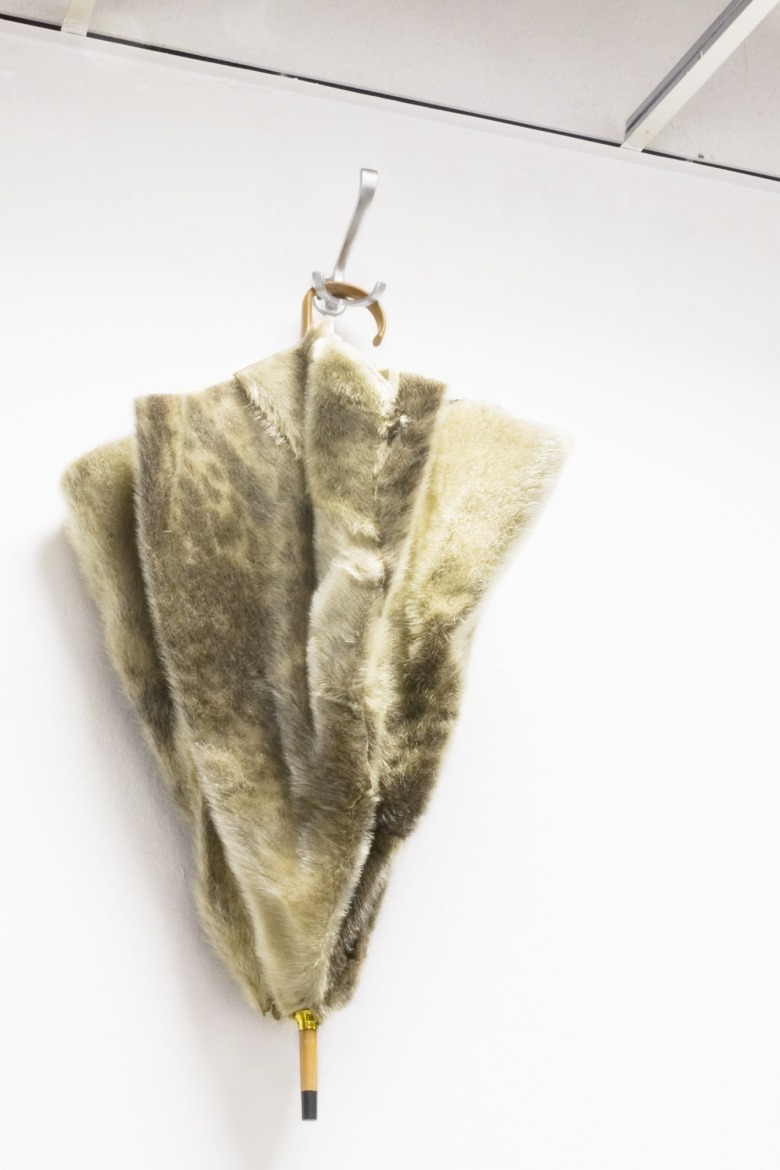
– The fur umbrella by Kazuko Miyamoto has not been used as part of a performance yet. It has been produced by Miyamoto for an upcoming performance as part of her exhibition at EXILE in the late spring of 2012.

Curated by Christian Siekmeier

Read Review: Artinfo

Berlin Off/On Wall & Former East/Former West

In commemoration of the 20th anniversary of the fall of the Berlin Wall EXILE presents two projects focusing on the ramifications of the physical and emotional divisions between East and West created by the Berlin Wall.

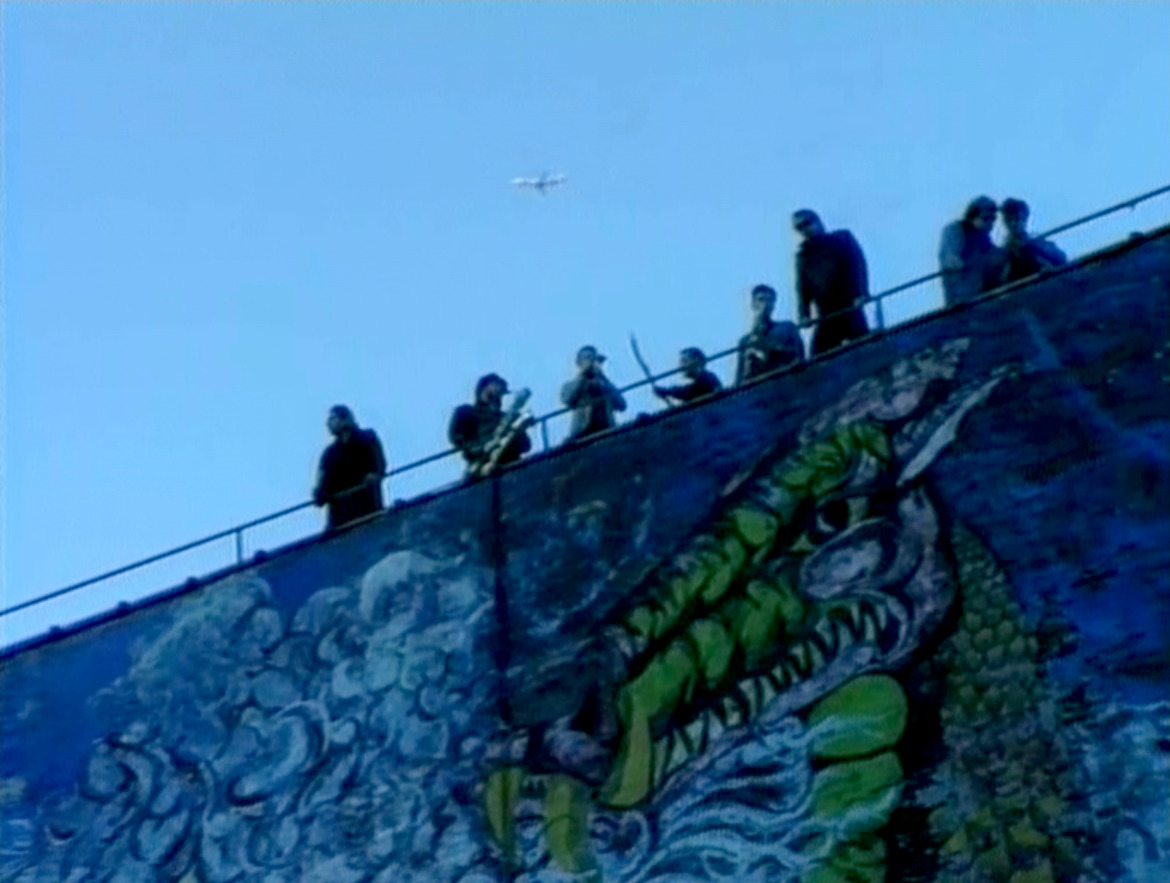
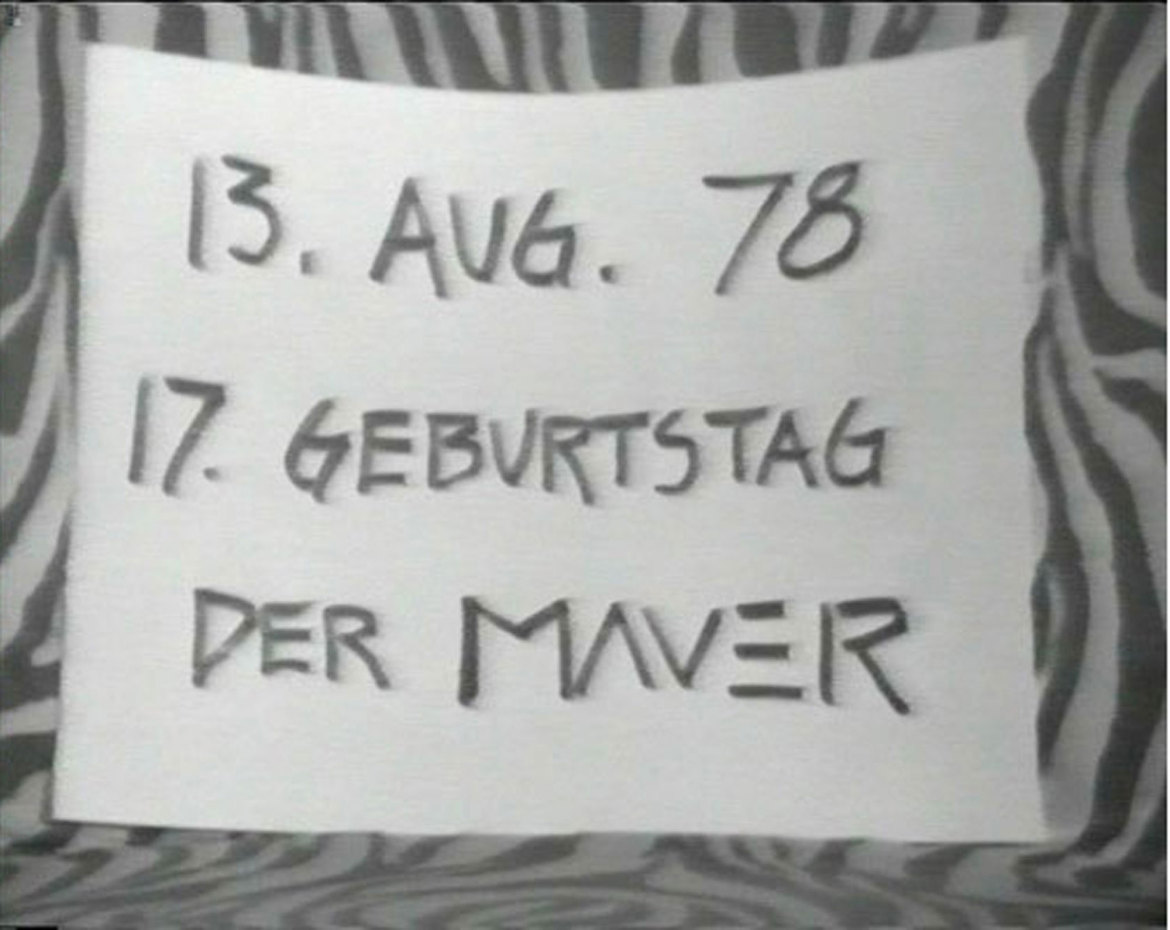
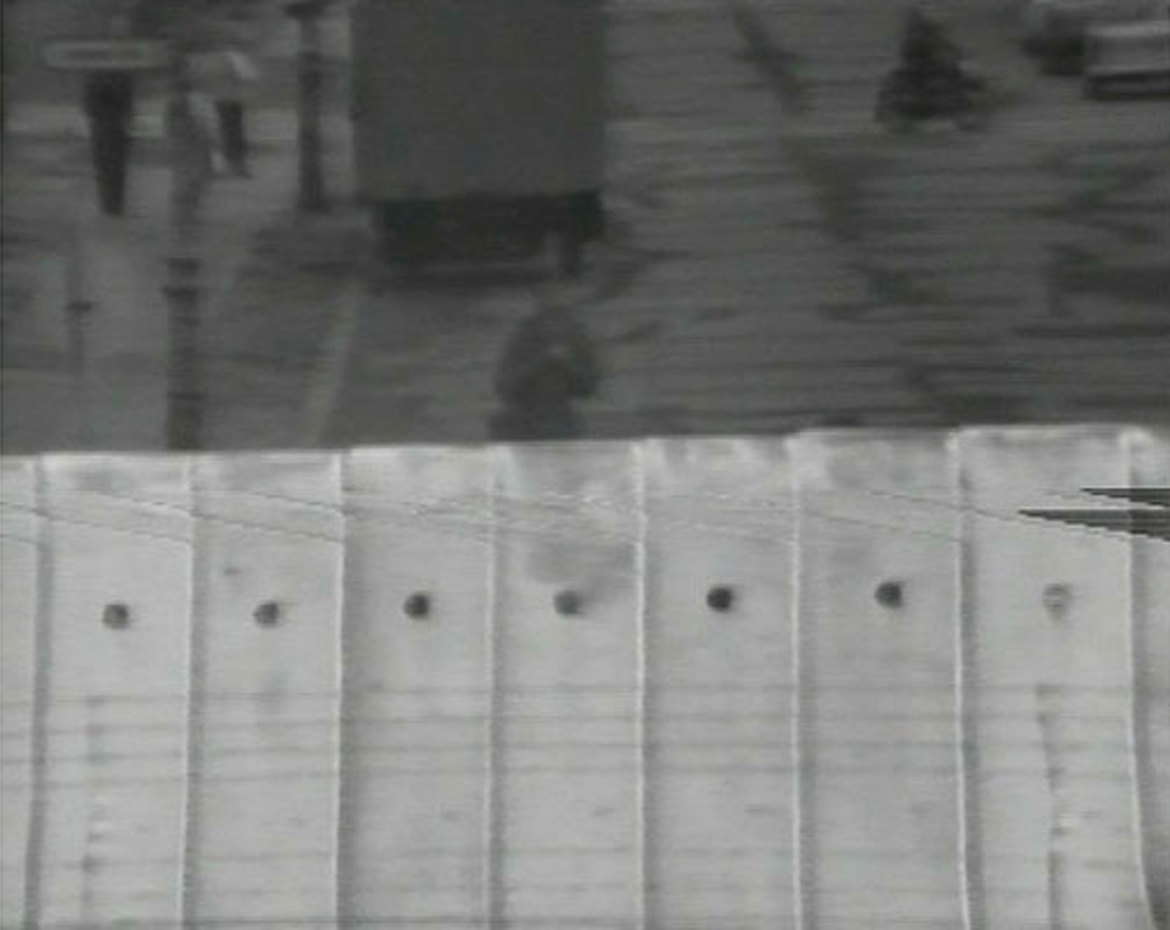
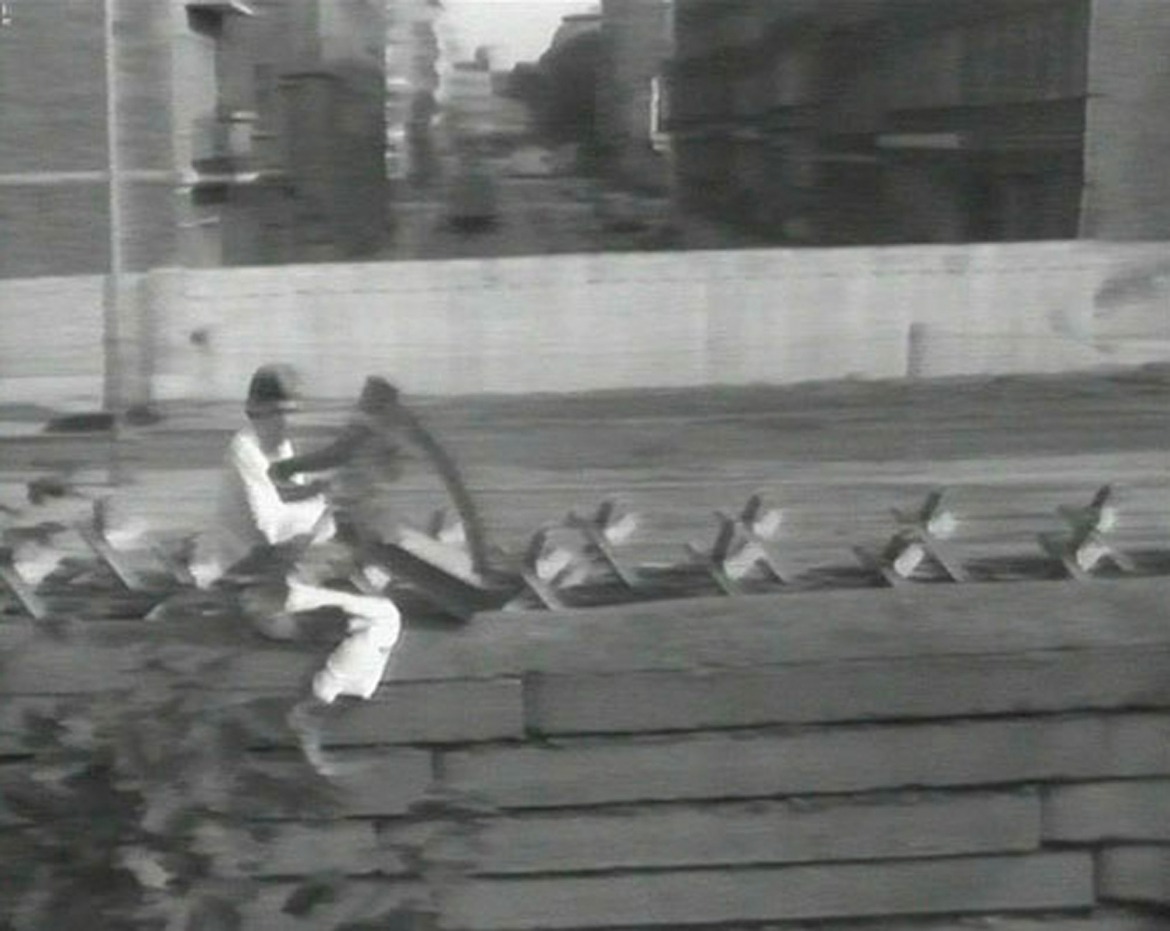
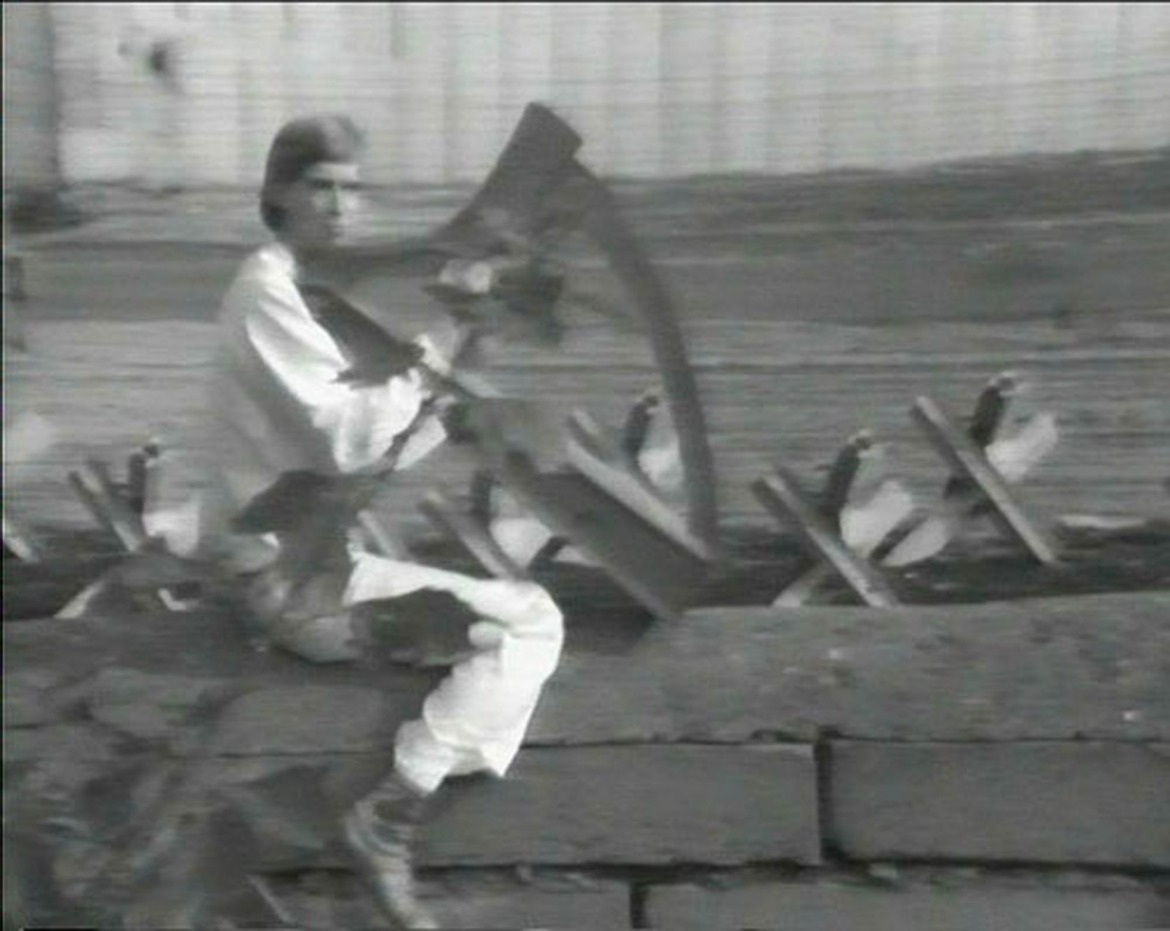
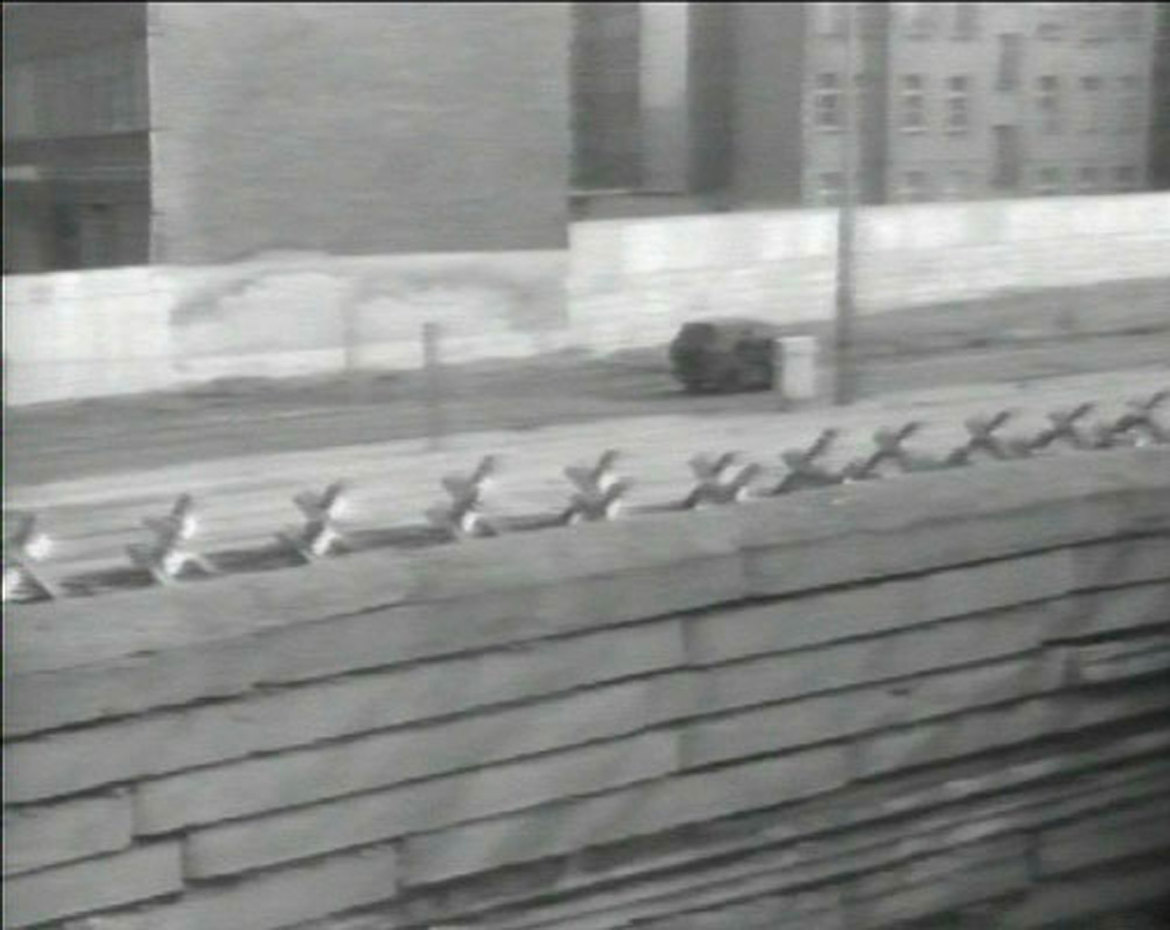
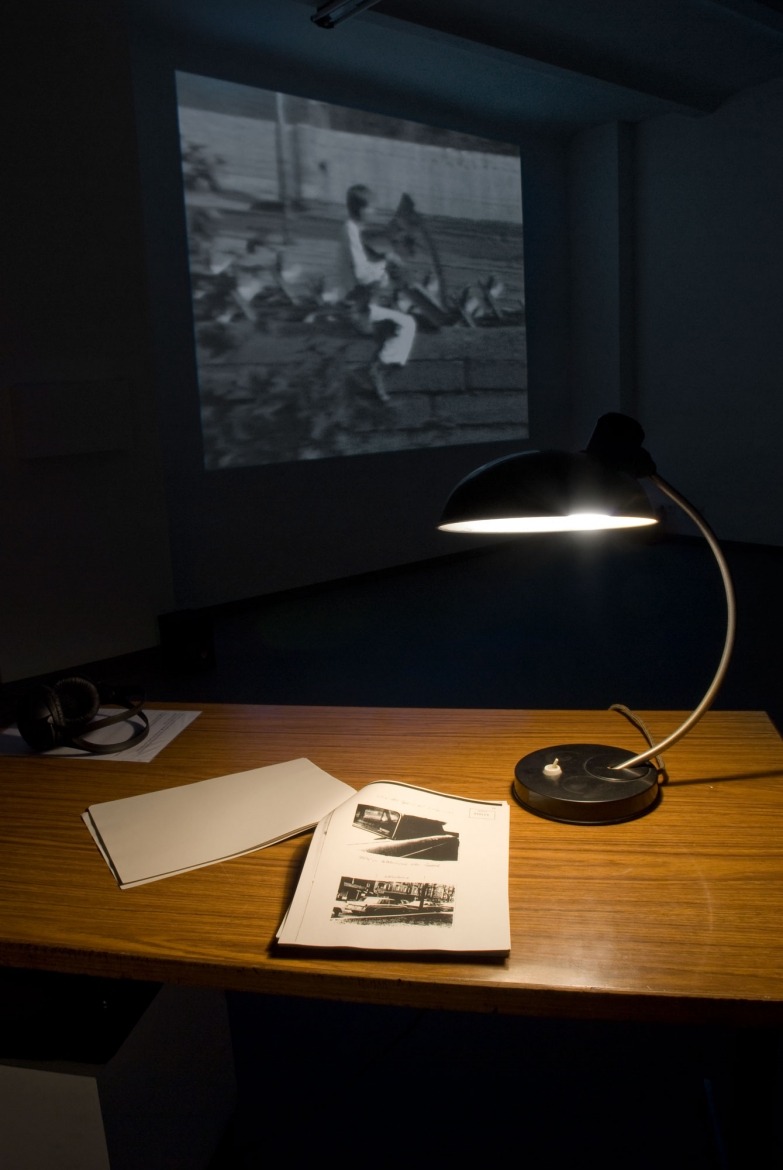
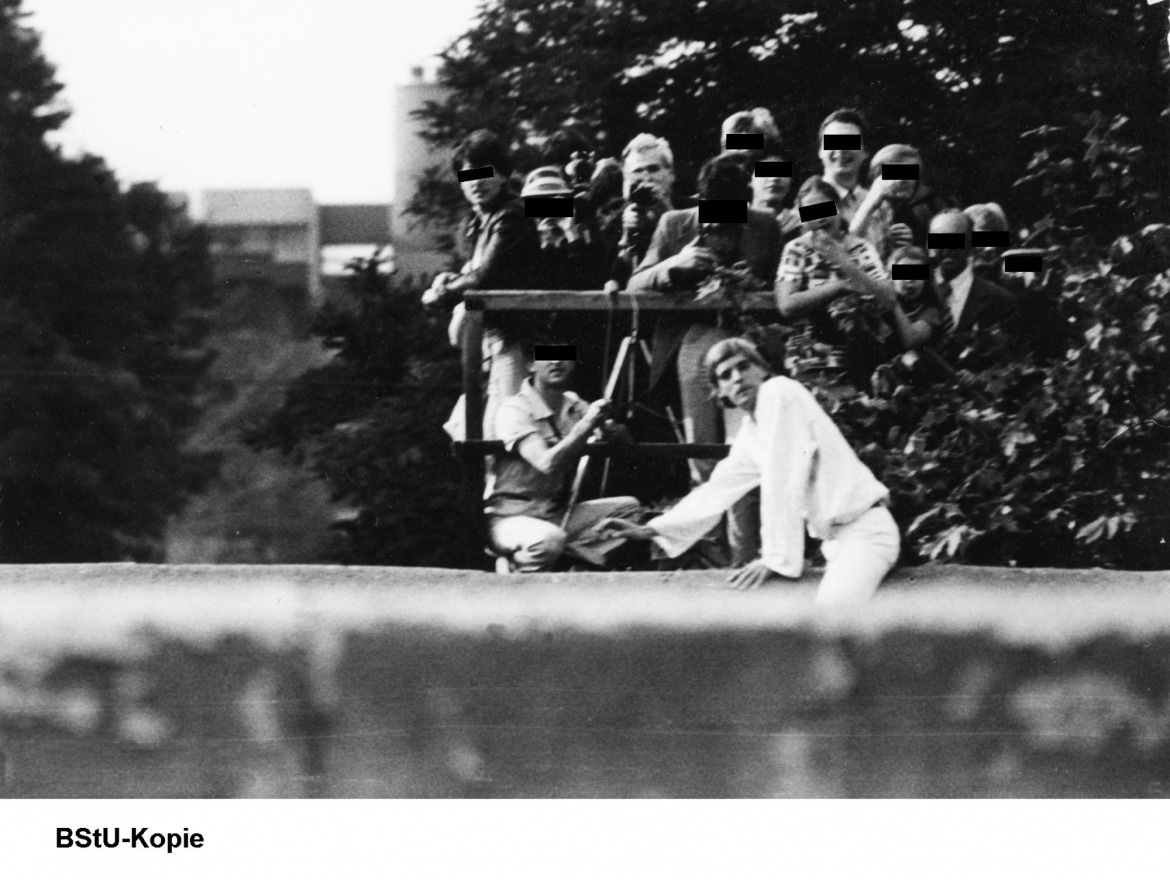
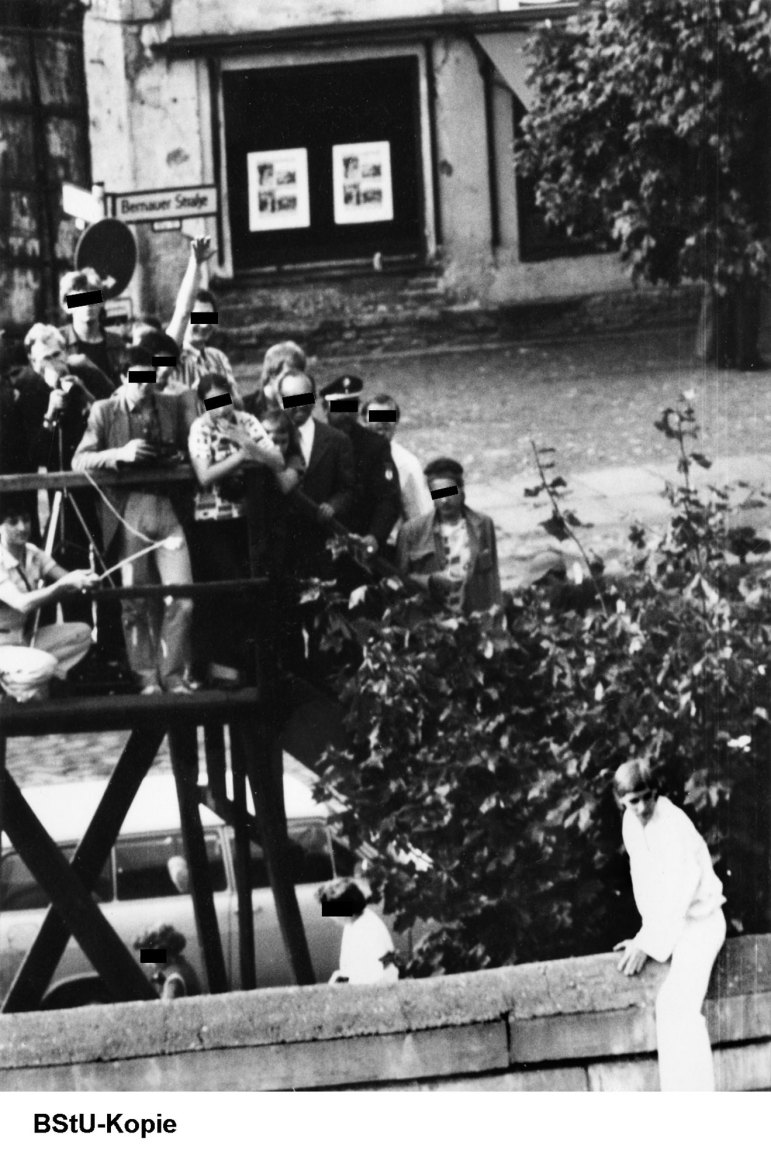
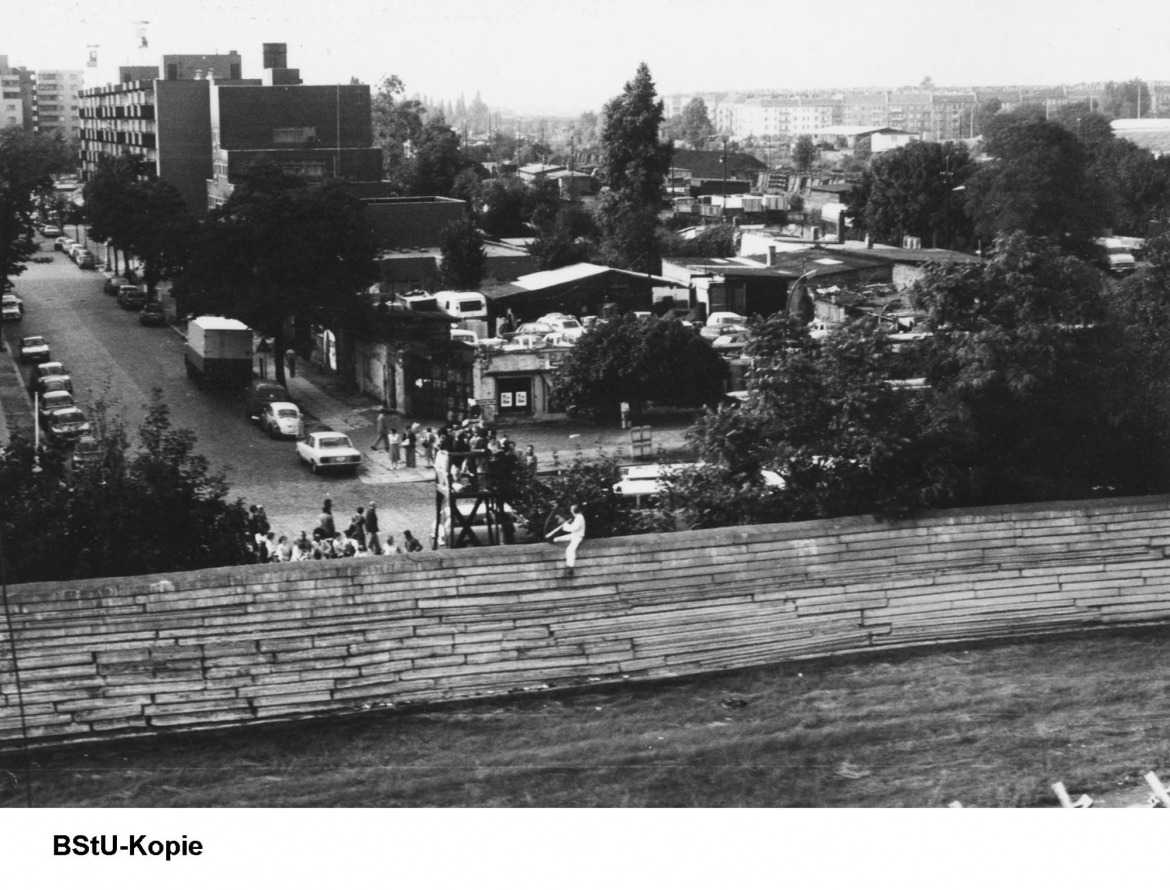
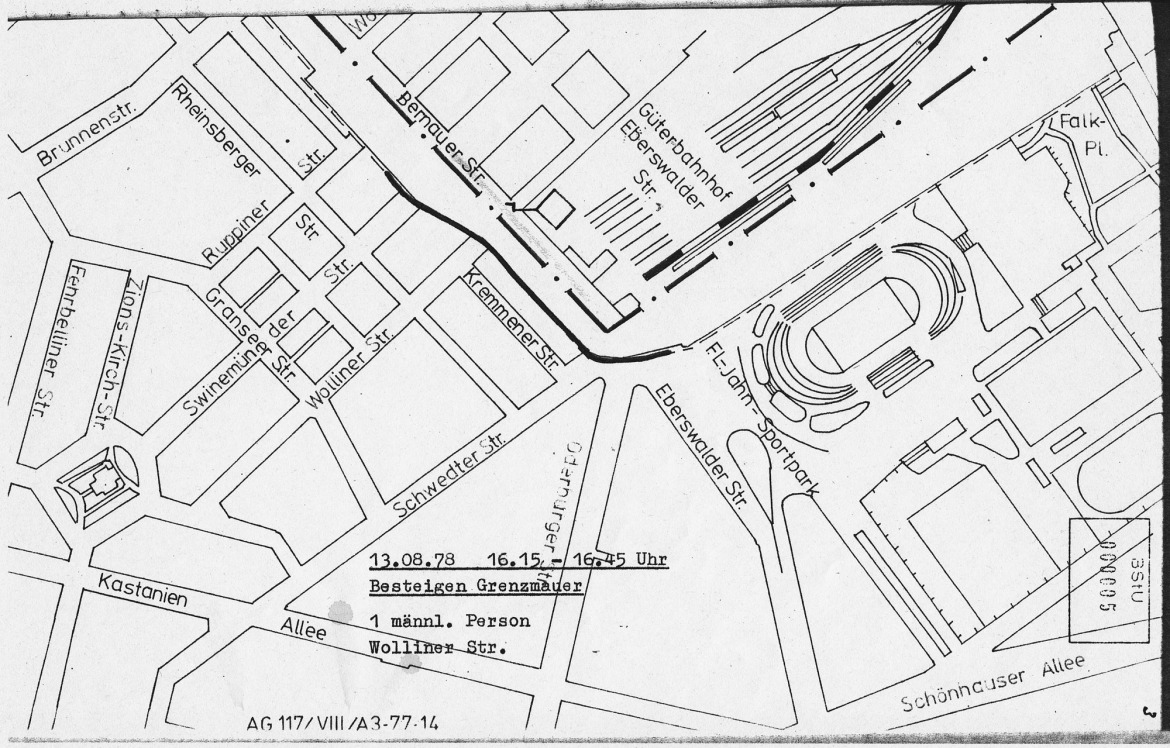
Speck’s installation project Berlin Off/On Wall consists of a video, photographs and documents spanning more than 30 years. The video, filmed in 1978, shows a protest/performance by Berlin Painter Per Lüke in collaboration with video artist Wieland Speck. In the video we see a man climbing onto the Wall and play the harp while being watched by security forces and spectators from both sides of the concrete divide. Decades later, Speck discovered photographs of said performance taken by Eastern border security forces in the archives of the former East German Staatssicherheit (Stasi). An extensive Stasi file, poetically entitled The Harp Player, was created in the aftermath of the protest/performance.

The exhibition now presents the video, photos and documents together for the very first time. In this seemingly distant past everyone seemed obsessed with watching one another. Today, Berlin Off/On Wall acts as an absurd testament to a scary, alienated past. The physicality of the Wall as an epitome of Cold War politics makes the conflict overt; both sides have no other choice than to watch one another through their circumscribed lens.

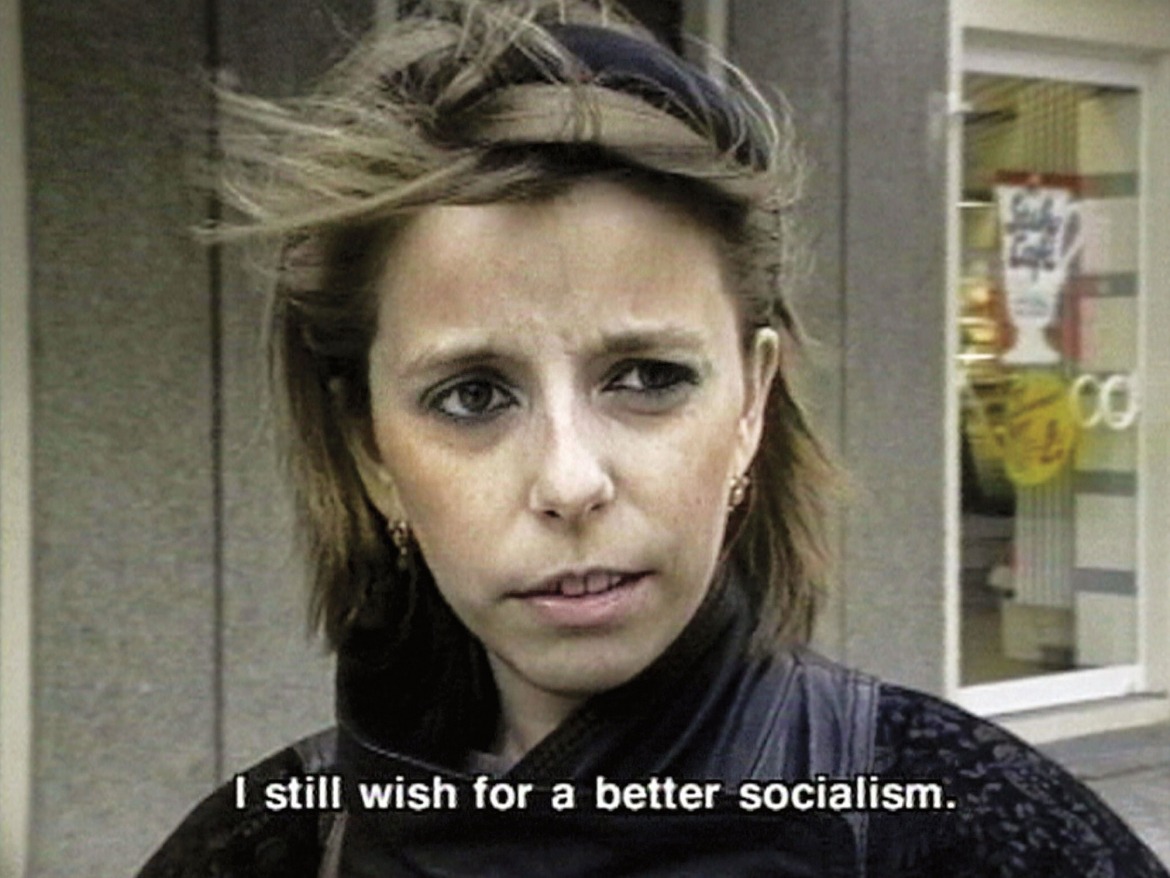
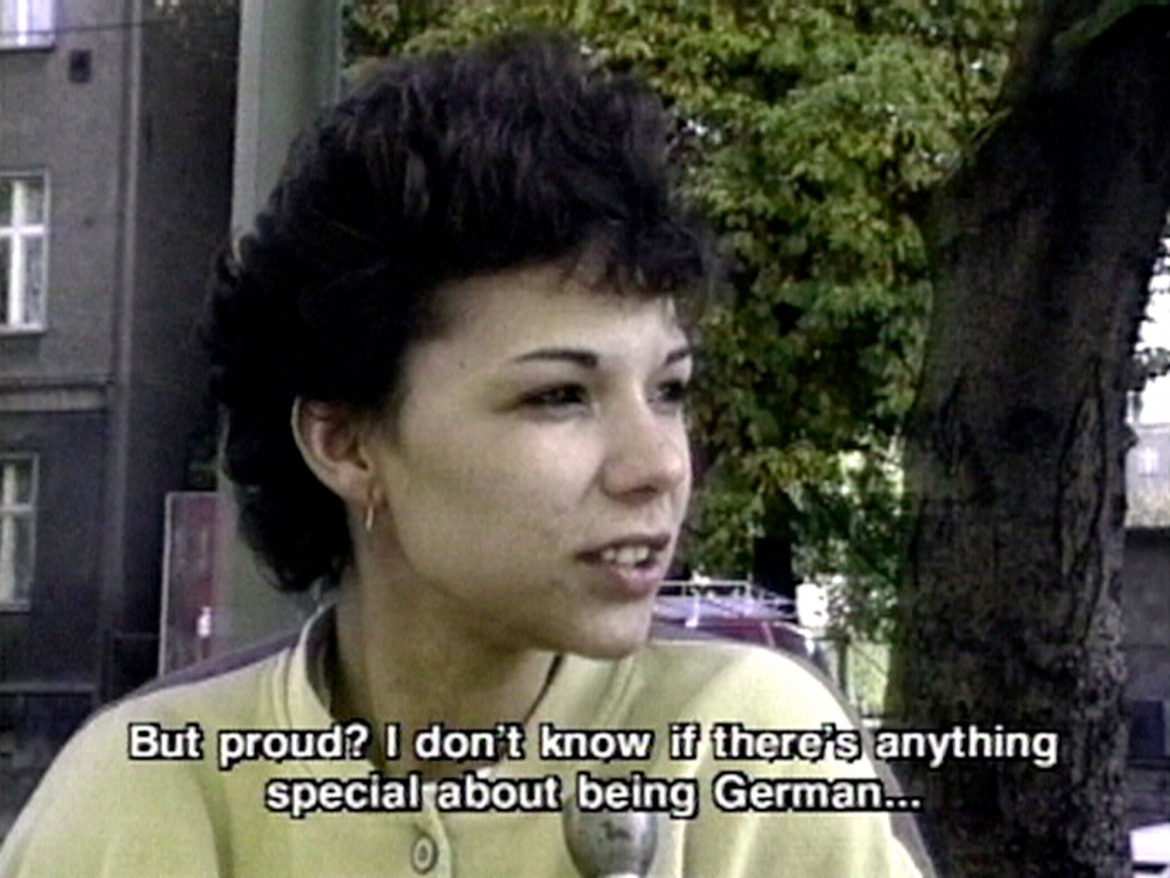
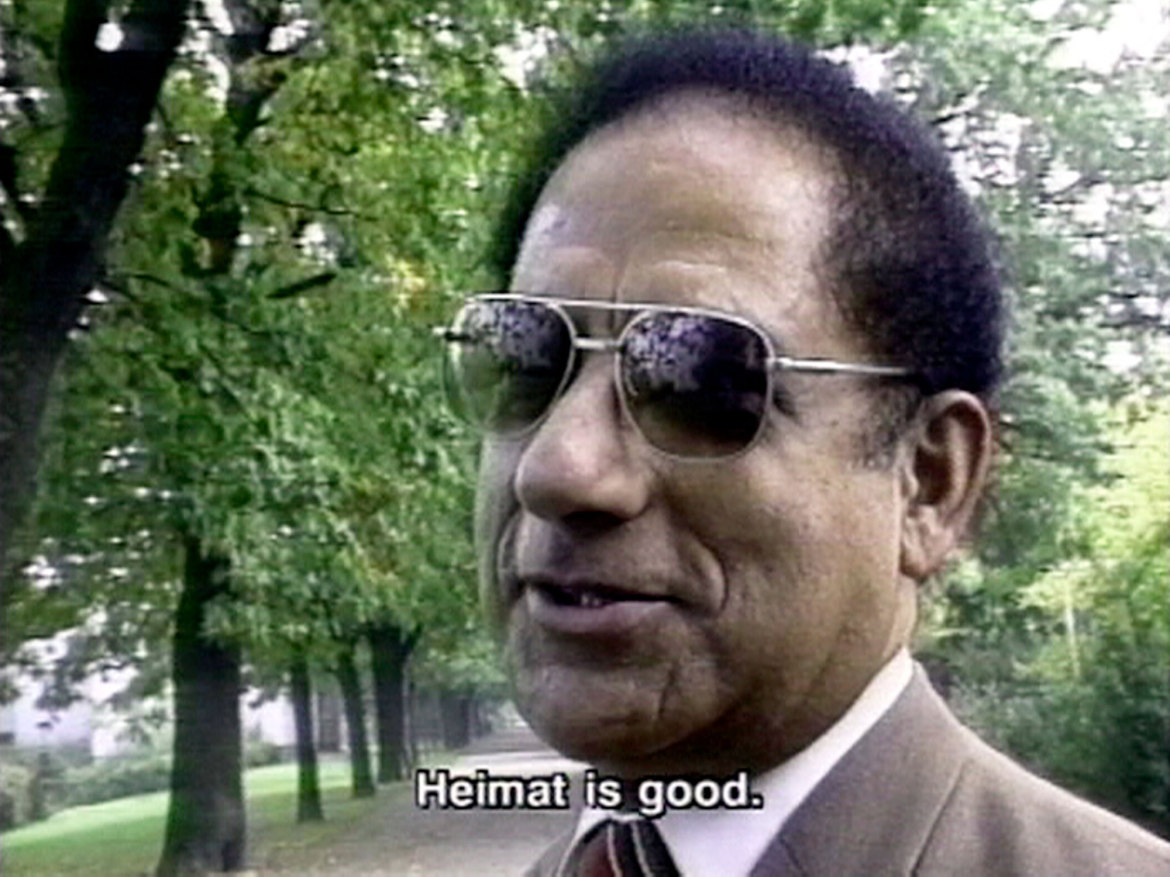
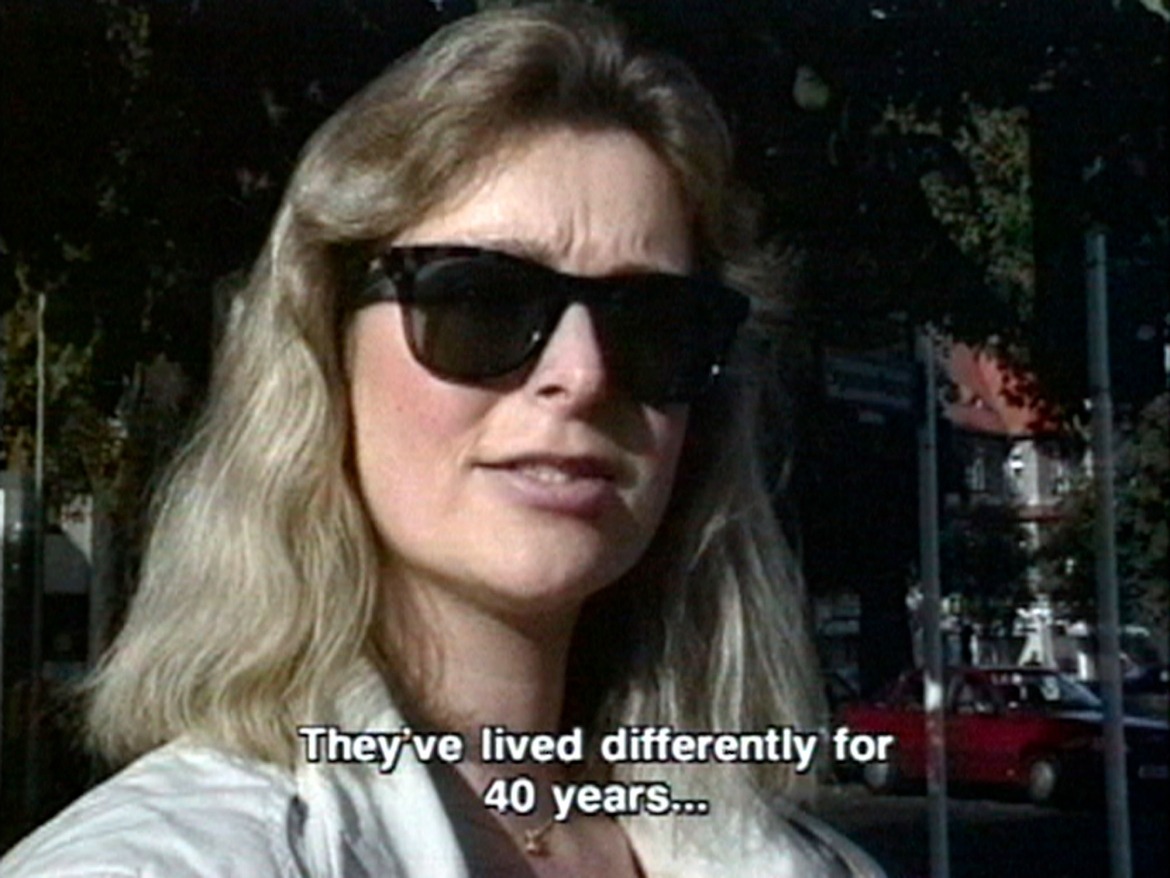
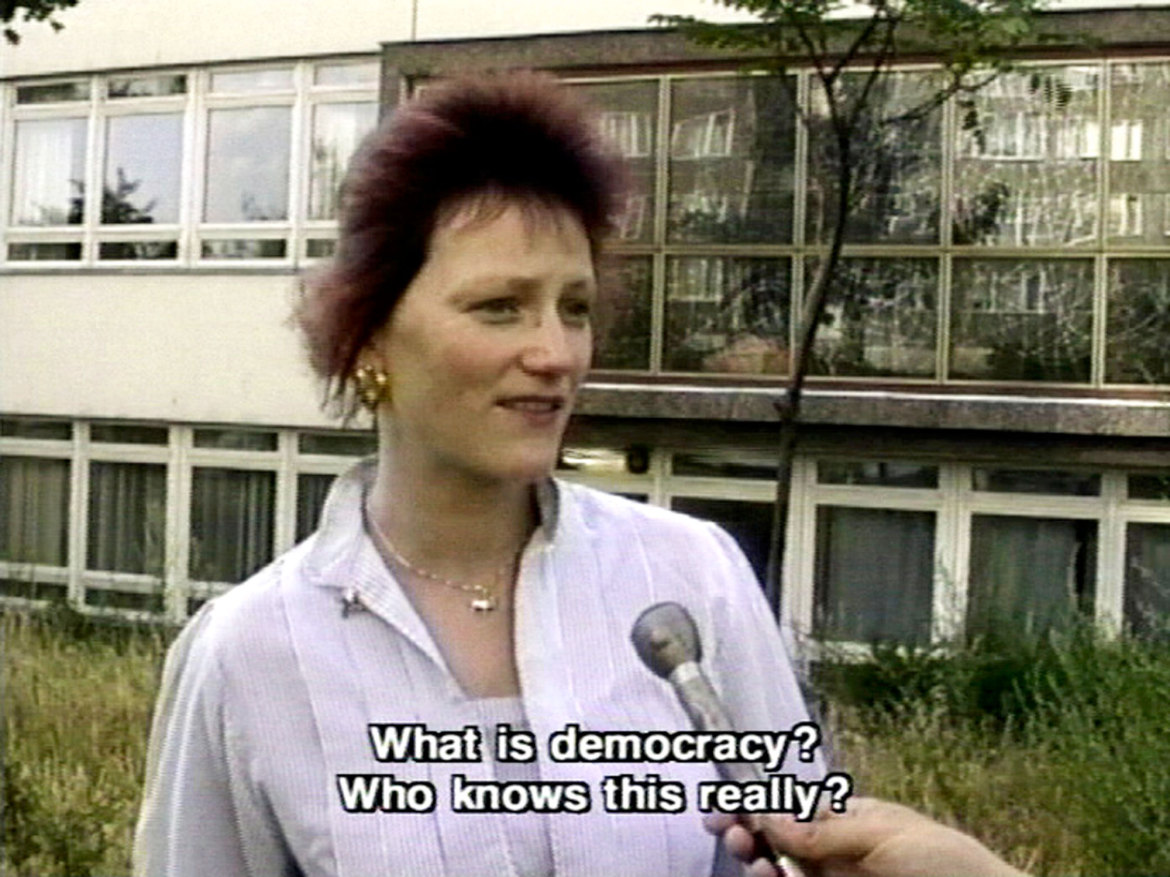
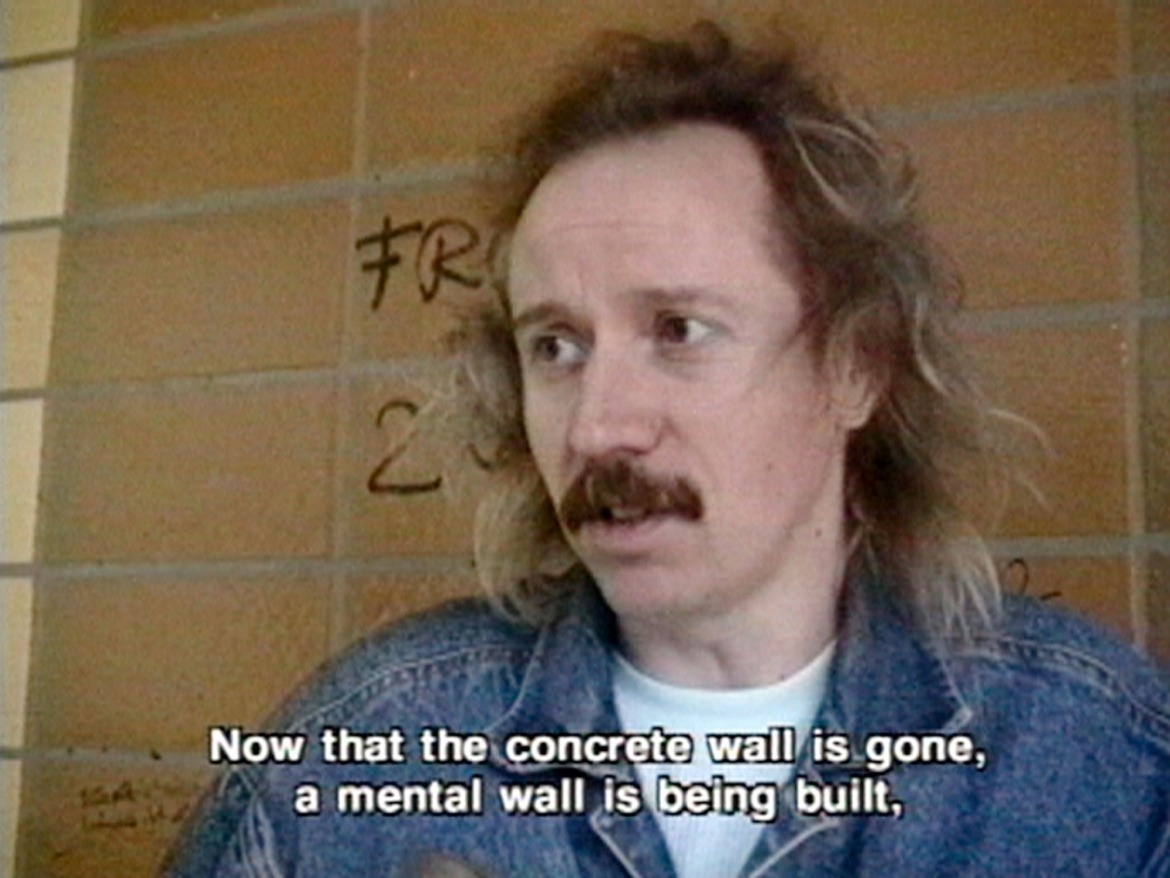
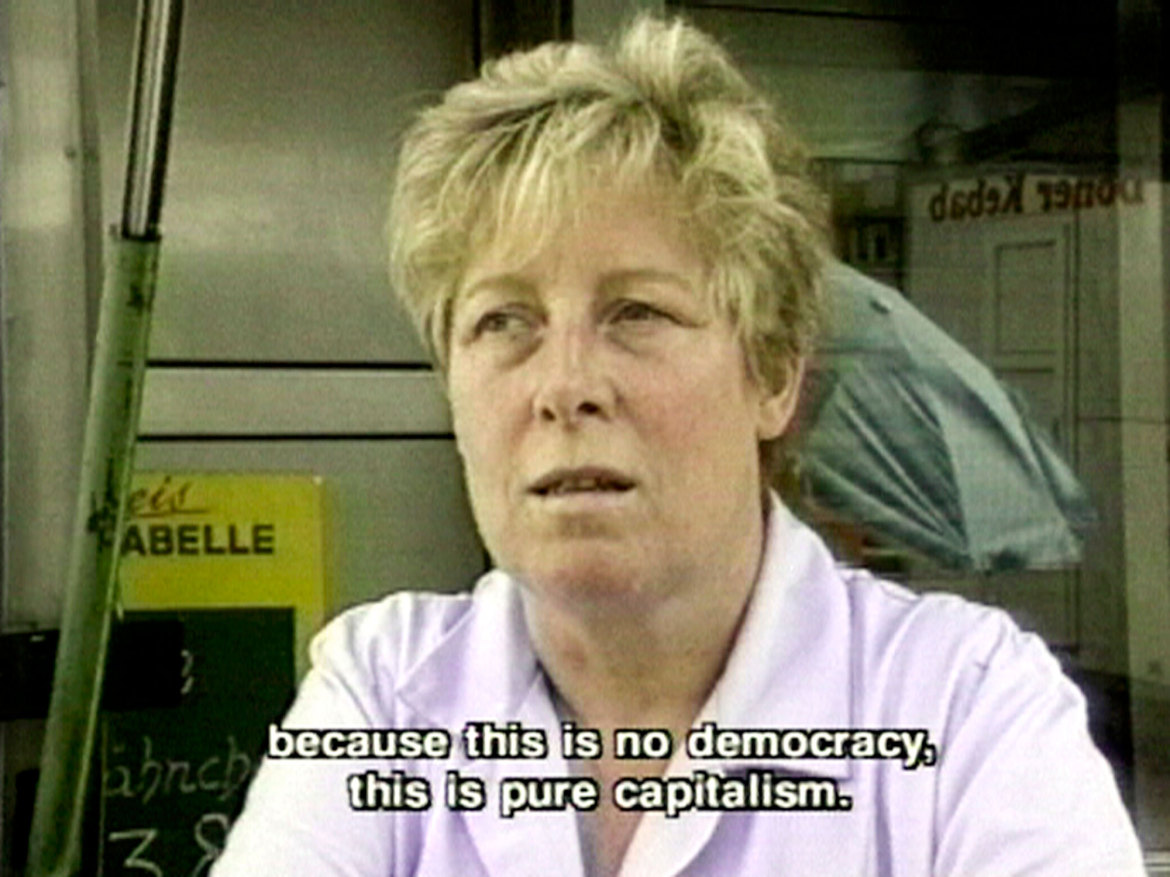
Consisting of hundreds of street interviews done in Berlin two years after the Reunification, Former East/Former West is a vital, surprisingly open, and at times disturbing documentary about what it meant to be German at that particular moment in history. For forty-five years, residents of the divided city lived radically different lives, both in terms of ideology and everyday experience. Silver questions the very notion of a shared language, focusing on changing definitions of words for political and economic systems – democracy, freedom, capitalism, socialism – as well as words used to describe nations and identity – nationality, Germany, history, foreigners, home.

In Silver’s 1994 project, Former East/Former West, the Berlin Wall has become an internalized psychological divide between the residents of the former East and West based on fundamental misconceptions, stereotypes, hopes and fears.
The juxtaposition of both projects commemorates the fundamental complexity of the transformation of a concrete external reality to an internalized mindset that is still relevant today.

Curated by Christian Siekmeier

Artforum Review by Travis Jeppesen

Flash Art Review by Laura Schleussner

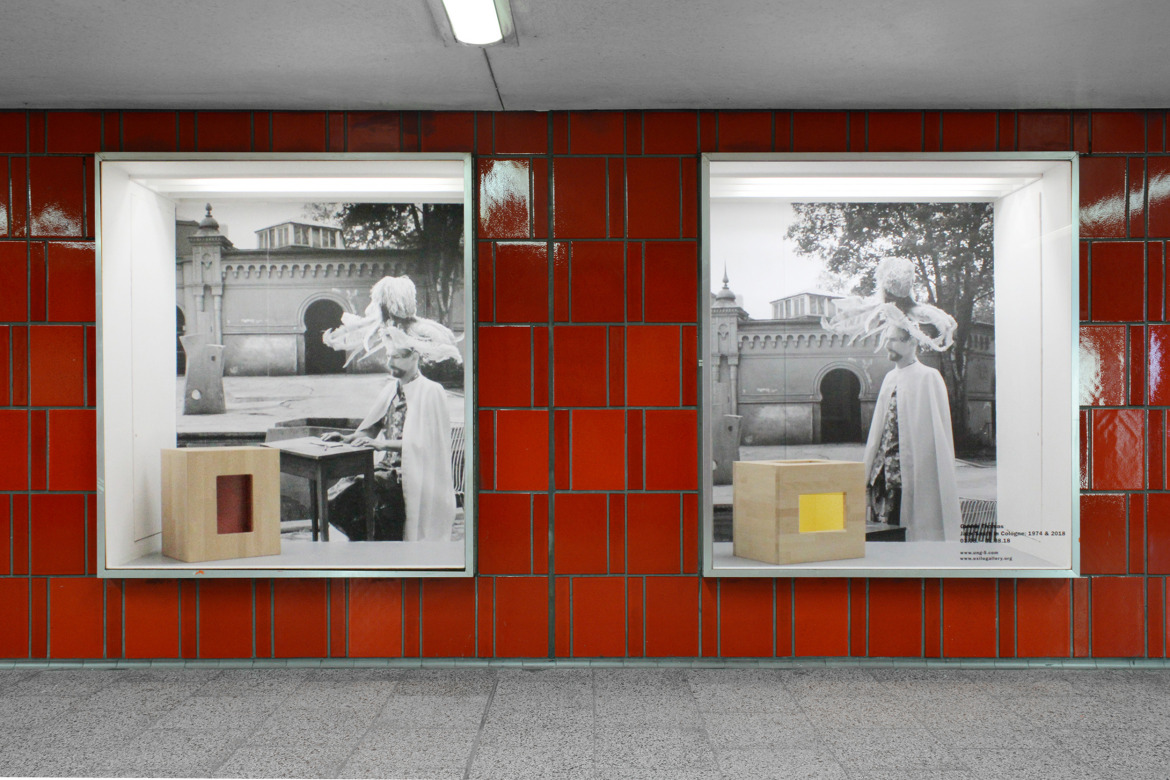
Jack Smith in Cologne, 1974 & 2018

At ≈5 in Cologne, EXILE is proud to present works by New York-based artist Gwenn Thomas. The exhibition, entitled Jack Smith in Cologne, 1974 & 2018, is located inside two publicly accessible vitrines within the underground station of Ebertplatz.

The exhibition combines two distinctly different times and modes of artistic production for the artist. Two recent sculptural objects refer to the artist’s ongoing interest in modernist shapes and legacies was well as material membranes and optical transparencies. These works do not directly refer, but associate to the photographic process of light passing through a particular defined space and object to create impact.

With photography being a core medium and interest for the artist, Thomas became a regular contributor in the 1970s to the legendary NY-based art publication Avalanche. The two exhibited photos show the artist Jack Smith during his performance in Cologne Zoo in 1974. The extended series of over 50 photographs was photographed by Thomas for a feature in issue 10, Dec 1974 of Avalanche where they appeared collaged into a story-board entitled A Thousand and One Irrational Jingoleanisms of Lucky Landlord Paradise. Cologne Museum Festival of Fear, 1974.

It is the first time that these photographs are shown in Cologne. The complete set of photographs is now also in the collection of the Museum Ludwig, Cologne.

≈5

Avalanche Index