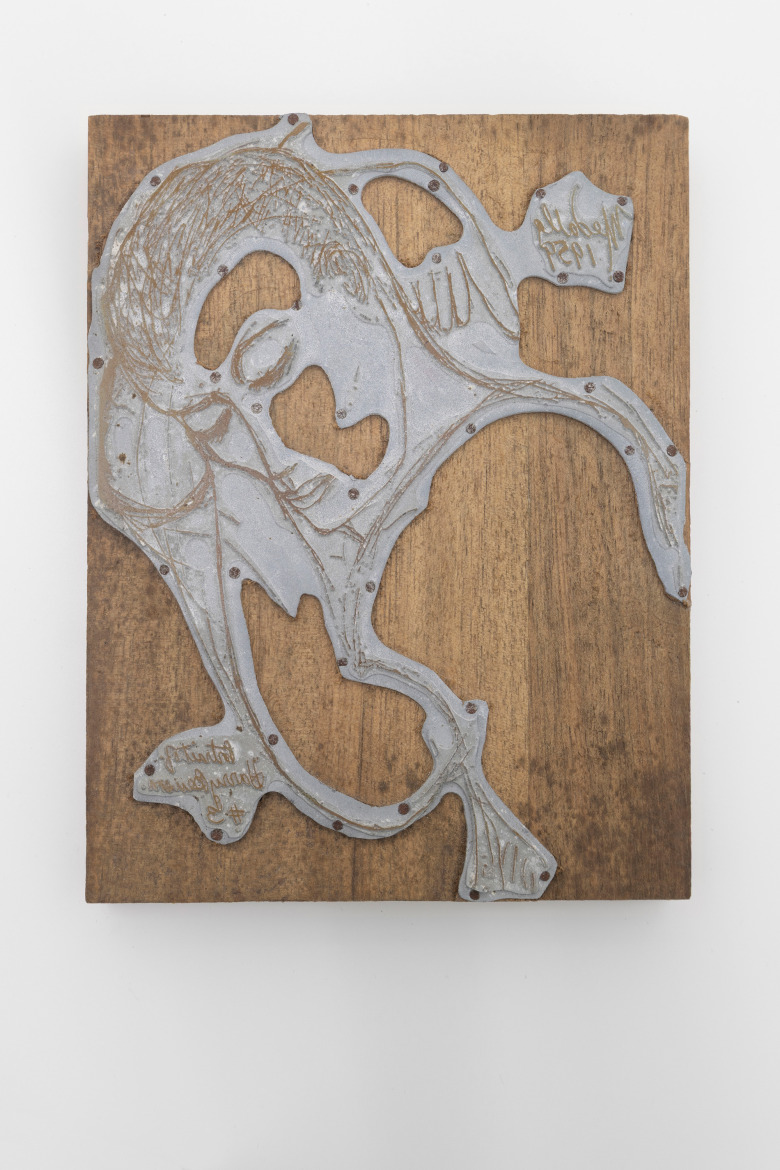
David Medalla, Untitled, 1959, zinc printing plate based on drawing mounted to wood, 17,7 x 13,9 x 2 cm
EXILE is looking forward to presenting a solo exhibition of a previously unseen body of work by artist David Medalla (1938-2020). The exhibition will be curated by Francesca Gavin and Adam Nankervis as part of this year’s edition of curated by – the gallery festival with international curators in Vienna.
Matelot, Matelot: the unseen work of David Medalla
‘Matelot’ was a song written and released by Noël Coward, ten days after the end of war in 1945. It is a bittersweet ode to a sailor, the vocalist mourning his departure and calling him over the sea. From a contemporary point of view, it is impossible not to feel the song is filled with queer longing for the male figure travelling “the wide world over/ Lips that he kissed Could not resist/ This loving, roving rover.”
David Medalla was born three years prior to the release of the song in the Philippines. Lauded as a boy genius, he was lecturing at university aged 12. He experimented with multimedia painting and even participatory land art as a teenager. He was inspired deeply by the openly gay Arthur Rimbaud, later noting “All of us are his children. His life became an allegory of freedom.” In 1954, Medalla was invited to a summer camp for gifted boys in upstate New York, quickly escaping to Greenwich Village and meeting everyone from James Dean to Jackson Pollock. Here he developed the painting practice that underpinned his work. Over the coming decades, Medalla moved across Europe, establishing himself as a unique artist that resisted the confinement of media. Medalla worked with painting, collage, action, sculpture, text, publishing and textiles.
Medalla was deeply engaged with the conceptual and material possibilities of art. He notably exhibited as part of iconic curator Harald Szeemann’s exhibitions, ‘When Attitudes Become Form’ and documenta 5 – two shows that established much of the canon of conceptual late 20th century art. Medalla became best known for his engagement with kinetic art, such as his bubble machines such as ‘Cloud Canyons’. Here, foam was created to grow upwards in columns and spill out towards the viewer. The artist later noted the inspiration was his mother’s rice dessert as a child in the Philippines and his memories of watching a dying soldier foaming at the mouth during the Second World War. ‘Mud Machine’ (1964-67) fused science and sculpture, with automated sponges dipping into a pool of oil and mud and slowly smearing it on a glass plate. There was something cosmic and almost spiritual in the way he pushed beyond the limits of modernism.
These pieces were created while he simultaneously co-founded Signals gallery and produced its affiliated magazine ‘Signals Newsbulletin’ in London, between 1964 and 1966. The gallery focused on avant garde artists of the era, many from Asia and Latin America including Lygia Clark, Gustav Metzger, Soto, Mira Schendel, Hélio Oiticica and Takis – whose work inspired the name of the space. Like Medalla, these were artists driven by unconventional materials, science, poetry, technology and new paradigms.
Ephemerality and chance were something built into Medalla’s work. At documenta 5, he exhibited the pioneering, participatory work ‘A Stitch in Time – inviting viewers to embroider and add whatever they wished with needle and thread. In the 1970s he moved into political and counter-cultural performance work. He created actions with the psychedelic commune, the Exploding Gallery and later in the Artists’ Liberation Front and Artists’ for Democracy. Works around Tibetan and African liberation, resisted international dictatorships and in many ways was deeply embedded in the action-led artist activism that resounds today.
Yet looking at Medalla’s practice in a wider sense, there was nothing didactic here. He was innately charming company, even later in life while living in Berlin, inspired by the poetry and possibility of creativity. He crossed paths and often became friends with people including Marcel Duchamp, William Burroughs, Jean Genet, Man Ray, Yve-Alain Bois, Raymond Duncan, Louis Aragon and many more.
For many years the queerness in Medalla’s work was evident but unspoken. His lovers often became artistic collaborators. Overflowing phallic forms are a recurring motif. His bubbles were erect, overflowing and exploding. His ‘Body Motion Pendulum’ piece, for example, used an egg, rubber band and suction cup to create a kinetic, penis-like sculpture driven by the movement of the body. His personal sketchbooks were filled with figurative drawings and photographs of naked men. Desire was as clear a driver in his artistic impulse, as politics, participation and the poetic.
The print blocks, discovered recently by the late artist’s partner and collaborator Adam Nankervis, were never used. Created early in Medalla’s career, most likely in the late 1950s, they depict pensive male figures looking longingly at the viewer or poetically downward. Sometimes these young men hold branches like gentle masks or display their muscular bodies or alongside animals. The refusal of these printmaking objects to fulfil their purpose – to make prints – is a fitting metaphor for hidden sexuality.
This is the only time these works will be seen in this largely unused form before belatedly being activated to produce print works. This exhibition aims to echo Medalla sense of transitory performance – a moment of time that cannot be repeated. The unread negatives of these images will soon to be transformed into something solid.
These works represent an illusory, dream-like love for a male sexual ideal. Reversed compositionally, they are mirror images of an internal desire. Like Noël Coward’s song, they are erotic fantasies – dreamy, intimate and loving.
Text by Francesca Gavin
Francesca Gavin is Editor-in-Chief of EPOCH Review and Director of Visual Arts at non-profit Murmur. She is the author of twelve books and has curated exhibitions at Somerset House, Palais de Tokyo and Fundação de Serralves, and co-curated Manifesta11. She hosts the long running radio show Rough Version on art and music on NTS Radio.
Adam Nankervis is an Australian artist and curator based in Berlin, known for social and experimental practice, museum MAN and another vacant space. A longtime collaborator and partner of David Medalla, he co-founded the Mondrian Fan Club and helped shape the London Biennale.